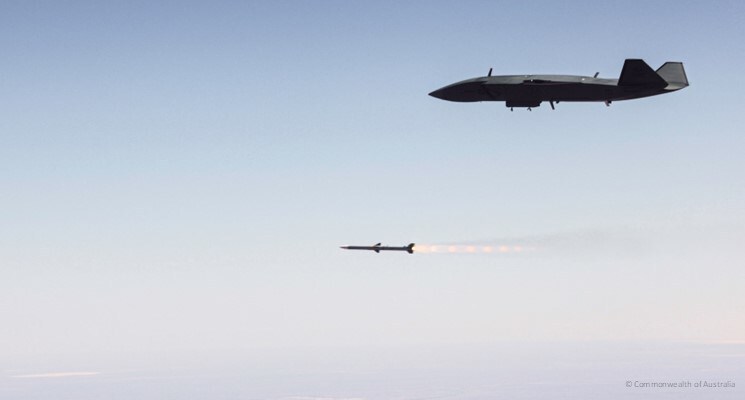
Boeing and the Royal Australian Air Force (RAAF) have successfully executed the first air-to-air weapon engagement by an uncrewed, autonomous aircraft using an AIM-120 missile. The test, conducted at the Woomera Test Range in Australia on December 9, saw an MQ-28 Ghost Bat Collaborative Combat Aircraft (CCA) destroy a fighter-class target drone. Boeing officials described the event as proof that the platform has evolved into a “mature combat capable” asset, marking a significant evolution of autonomous aircraft into the air-to-air combat role.
The mission highlighted complex manned-unmanned teaming (MUM-T) capabilities, integrating the Ghost Bat with an RAAF E-7A Wedgetail and an F/A-18F Super Hornet. While the aircraft launched from different locations, they formed a cohesive network once in the air. The Super Hornet provided sensor coverage to identify and track the target, sharing data across the formation, while an operator aboard the E-7A Wedgetail maintained “custodianship” of the drone to ensure safety and oversight. Once the target was confirmed, the MQ-28 autonomously adjusted its flight path, received authorization from the E-7A, and deployed the Raytheon AIM-120 AMRAAM to neutralize the threat.
Boeing’s Phantom Works division says the specific hardware and software required to employ the weapon were developed and integrated in under eight months utilizing open architecture standards. This rapid prototyping approach allows the MQ-28’s mission autonomy system to interface with existing fourth and fifth-generation fleets, as well as future sixth-generation aircraft. The test was a joint effort involving the RAAF, the U.S. Air Force, and various industry partners, signaling a unified push toward operationalizing loyal wingman concepts.
The test demonstrated that a Collaborative Combat Aircraft (CCA) can successfully navigate the “kill chain”—receiving targeting data from a fighter and firing authorization from a command node. That means defense planners can now realistically move forward with concepts of operation where manned jets command armed drone wingmen. This capability promises to significantly increase the “magazine depth” of air wings and allow human pilots to stand off at safer distances while autonomous assets engage high-threat targets.