Executing the first order of a broader contract, the U.S. Navy has awarded BAE Systems $322 million to produce Advanced Precision Kill Weapon System (APKWS) kits to equip the Army, Navy, and foreign customers with “tens of thousands” of precision munitions. The APKWS II converts unguided Hydra 70 2.75-inch rockets into cost-effective, semi-active, laser-guided munitions for a wide range of platforms, including fixed- and rotary-wing aircraft, UAS, vehicles, and vessels.
This deal represents the first action under a $1.74 billion indefinite-delivery/indefinite-quantity (IDIQ) contract to BAE Systems in August. The umbrella agreement covers full-rate APKWS II production for Lots 13 through 17–up to 55,000 units until 2031. The single-supplier IDIQ framework affords the U.S. government flexibility and stability for cost-effective procurement, allowing separate orders from a sole contractor over a fixed time period.
The U.S. Navy last issued a major APKWS IDIQ contract to BAE Systems in 2019 that covered production for Lots 8 through 12. That $2.68 billion deal listed the U.S. Air Force as a supported customer along with the Army, Navy, and other foreign nations. For FY26, the Air Force requested $13.4 million to convert APKWS II under the Fixed-Wing Air-Launched Counter Unmanned Aerial Systems Ordnance (FALCO) program for A-10, F-15, and F-16 aircraft.
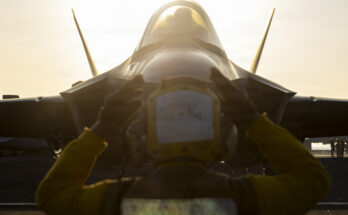
With the continued proliferation of UAS threats, the versatile APKWS has emerged as a cost-effective option for air-to-air counter-UAS (C-UAS) operations. U.S. armed forces turned to APKWS during the past year to defeat Houthi drones in the Red Sea. In March, Air Force fighters were part of successful kinetic drone kills, with F-15 and F-16 aircraft in the area spotted with APKWS loadouts.
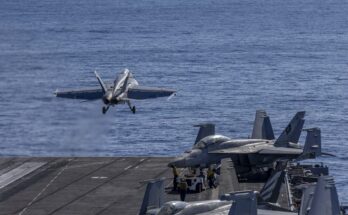
U.S. defense officials have not publicly commented on which specific APKWS-equipped platforms performed the strikes. However, the Harry S. Truman Carrier Strike Group, which engaged in combat operations in the region from 2024 through 2025, employed F/A-18 fighter variants and MH-60R and MH-60S helicopters that can carry APKWS.
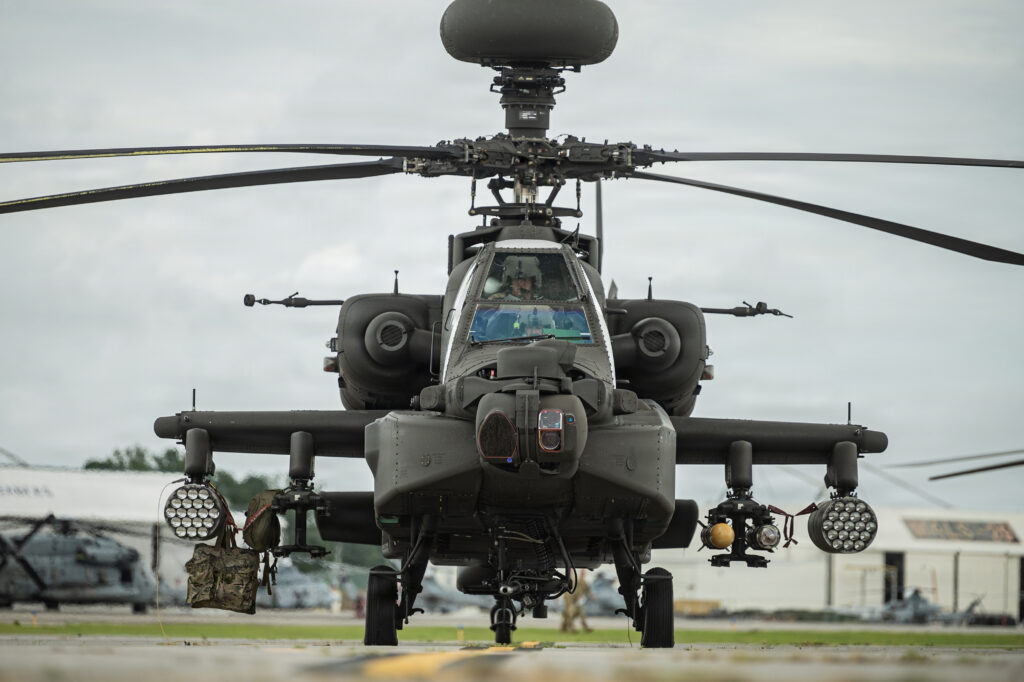
Recent successes with APKWS on U.S. aircraft in the C-UAS role have generated additional related developments. In a November exercise, U.S. Army aviators demonstrated high-rate kills on adversarial UAS using APKWS from AH-64E Apache attack helicopters. The live-fire event proved Hydra 70 rockets were “especially effective” against UAS when buddy-lasing, a technique that uses another friendly platform to paint the target with laser energy for the shooting helicopter.
With these developments and the U.S. five-year commitment in hand, U.K.-based BAE Systems is well-positioned to capitalize on the growing utility of APKWS for low-cost C-UAS applications, including expanding on the American and FMS customer base. The company, along with Eurofighter, is actively engaged in integration studies for the Typhoon fighter, underscoring the urgency across Europe to address C-UAS capabilities.
As part of the Ordnance & Munitions product, Forecast International offers a comprehensive report for U.S. Air-Launched Rockets that includes coverage of the APKWS and a ten-year production forecast for Hydra 70 rockets.

A former naval officer and Seahawk helicopter pilot, Jon currently leads the Military Aerospace and Weapons Systems group at Forecast International. He specializes in current and emerging military fixed and rotary-wing aircraft. With over a decade of experience in military aviation, operations, and education, he forecasts a diverse range of defense and naval systems.
Influenced by his time as a former Presidential Management Fellow and International Trade Specialist at the Department of Commerce, Jon gained insights into government operations and global markets.
Before joining Forecast International, he served as an NROTC instructor and Adjunct Assistant Professor at the University of Texas, teaching undergraduate courses in naval history, navigation, defense organization, and naval operations and warfare.