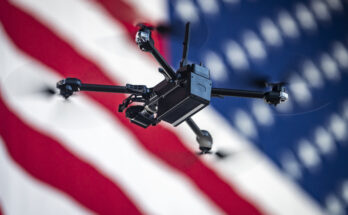
As the use of drone swarms by hostile forces has become an increasingly common threat, and nations of Europe are seeing a persistent rise of UAS incursions into their airspace, the concept of a NATO-led, protective “drone wall” continues to gain momentum. The month of November saw new action toward making the concept a reality. And as usual for the typically active segment of defense technology, the previous weeks have also seen the continued, steady rise in new opportunities for developers of C-UAS.
On November 10, Anduril announced that the U.S. Army had chosen the company to lead its Integrated Battle Command System Maneuver (IBCS-M)-centered C-UAS effort. The IBCS-M command and control system consolidates sensor information, automates engagement processes, and enables simultaneous management of threats as a framework for various C-UAS operations.
November 17 saw the Belgian Ministry of Defense purchasing defensive drones to guard its airspace, amid multiple instances of unknown UAVs flying over sensitive sites. The nation struck a deal with the Latvian company Origin Robotics to purchase its BLAZE drone, which features an explosive payload for destroying hostile drones.
On November 18, the U.S. Office of Naval Research (ONR) released a Request for Information for an upcoming Technology Operational Experimentation Event (TOEE), an initiative that seeks to identify emerging technologies to support specific operational areas. One of these areas, “Wave Breaker,” is focused on defeating swarms of the more broadly designated unmanned systems (UxS) category.
On the “drone wall” front, Anduril announced its participation earlier in the month, in the exercise, Digital Shield 1.0. Joining the U.S. Army’s 10th Army Air and Missile Defense Command (AAMDC) and the Estonian Defense Forces in Tallinn, Estonia, the event helped move the Eastern Flank Deterrence Line (EFDL) concept toward the realm of the practical.
According to Anduril, EFDL comprises a distributed mission command architecture designed to integrate national and Allied sensors, shooters, and unmanned systems into a shared live-data network. Functioning as a digital shield stretching across NATO’s eastern border, sensors could detect incoming aircraft and instantly share that data with air-defense batteries in Latvia or command centers in Poland.
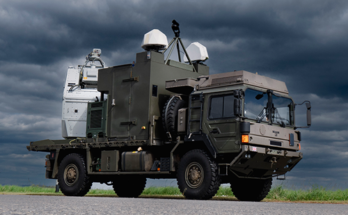
On November 28, MBDA signed its first export contract with a Middle Eastern country to provide its SKY WARDEN C-UAS solution. SKY WARDEN is a multi-layer system that protects an area from micro to tactical drones, up to eight kilometers away.
MBDA states that SKY WARDEN further offers a range of complementary effectors designed to counter and destroy enemy drones, such as CILAS HELMA-P laser weapon, omni and directional jammers, MBDA HTK (Hit-to-Kill) drone interceptors and the MISTRAL 3 missile.

Andrew Dardine is lead analyst for Forecast International's Defense Electronic Systems group. He is the primary author of Forecast International's Electronic Warfare Forecast and co-author of Electro-Optical Systems Forecast and C4I Forecast. Andrew is also a regular contributor to FI's Defense & Security Monitor blog, offering insights into developing technologies such as directed-energy and next-generation jamming systems. His analysis of such vital market areas as EO/IR systems and electronic countermeasures technology has been cited in Defense News, Aerospace Daily, and Bloomberg Businessweek, among other news media. He has also written about the electronic defense market for Aviation Week and the Journal of Electronic Defense.