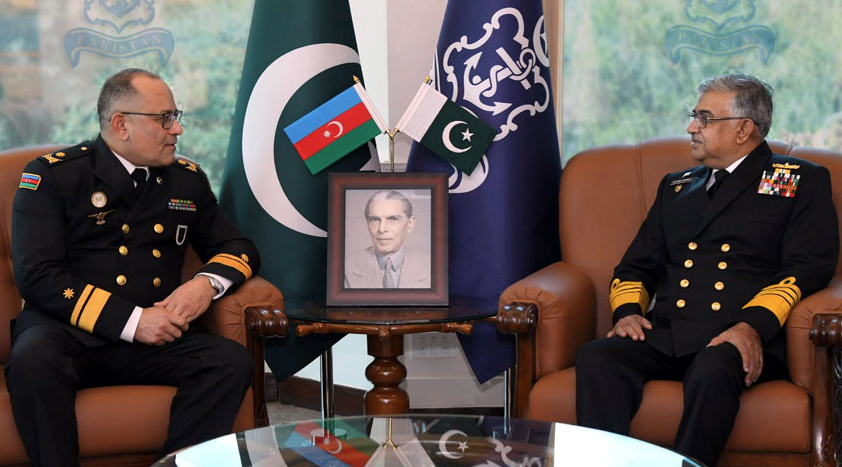
Admiral Naveed Ashraf, Chief of the Naval Staff of Pakistan, and Rear Admiral Shahin Mammadov, Commander of the Azerbaijan Naval Forces, meet at Naval Headquarters in Islamabad to discuss maritime defense cooperation. Source: Radio Pakistan
The development of the Zangezur Corridor and the expansion of the Middle Corridor are positioning Azerbaijan as a central Eurasian trade hub, increasing the strategic importance of its Caspian maritime domain. To safeguard this transition, Azerbaijan is modernizing and expanding its naval capabilities through defense cooperation with Pakistan.
Background
In November 2025, an Azerbaijani naval delegation visited Pakistan to explore avenues for maritime cooperation and defense collaboration. The delegation attended the Pakistan International Maritime Expo & Conference, which showcased Pakistan’s capabilities in naval defense, maritime technology, and infrastructure. Discussions focused on maritime security, environmental protection, trade, and transportation.
In February 2026, senior naval leadership from both countries pledged to strengthen and diversify their defense relationship. At Naval Headquarters in Islamabad, Chief of the Naval Staff Admiral Naveed Ashraf and Commander of the Azerbaijan Naval Forces Rear Admiral Shahin Mammadov discussed opportunities for enhanced cooperation in training, naval projects, and broader security initiatives.
Azerbaijan’s Strategic Repositioning on Corridors and Trade Growth
Azerbaijan is developing the Zangezur Corridor and the Middle Corridor, also called the Trans-Caspian International Transport Route, to expand its role in regional trade. The Middle Corridor offers a land-sea link between China and Europe, avoiding Russia, while the Zangezur Corridor, recently established under the August 2025 trilateral Joint Declaration in Washington, D.C., connects Azerbaijan’s main territory with the Nakhchivan Autonomous Republic via Armenia.
To support this increased trade flow, Azerbaijan has invested heavily in port infrastructure. In December 2024, President Ilham Aliyev authorized a $12 million investment in the Port of Baku to expand its annual cargo capacity from 15 million to 25 million tons. This expansion positions the port to handle rising volumes and ensures Azerbaijan can meet growing regional demand, reinforcing its role as a logistics hub in the Caspian Sea region.
Caspian Maritime Dynamics
Maritime conditions in the Caspian Sea are becoming more competitive as littoral states expand their naval capabilities and increase operational activity. Russia continues to conduct regular missile and air‑defense exercises, while Iran, Kazakhstan, and Turkmenistan have pursued incremental modernization of their own patrol and coastal forces. This environment places greater emphasis on domain awareness, rapid response, and infrastructure protection across the Caspian Sea.
The Port of Baku’s expanding capacity and the increased movement of cargo across the Middle Corridor have created new exposure points for disruption. While Azerbaijan maintains a functional naval force, its current maritime capabilities will need further modernization to support its expanding role as a regional trade hub.
Pakistan as a Defense-Industrial Partner
Pakistan has become a strategically valuable partner as Azerbaijan evaluates options for expanding and modernizing its maritime security forces. The bilateral naval engagement initiated in November 2025 and reinforced during the February 2026 meetings reflects a shared interest in building structured cooperation focused on training, technology, and future naval projects. These discussions signal Azerbaijan’s intent to develop capabilities that match its expanding economic and security responsibilities in the Caspian Sea.
The broader defense relationship between the two countries provides a strong foundation for maritime collaboration. Azerbaijan’s acquisition of additional JF‑17 fighters in June 2025 under a $4.6 billion contract demonstrates a high level of trust in Pakistan’s defense‑industrial base. Complementary investment packages worth an estimated $2 billion across industrial and energy sectors reinforce the strategic depth of the partnership. Although Pakistan cannot operate militarily in the Caspian Sea due to legal constraints under the 2018 Convention on the Legal Status of the Caspian Sea, it can supply platforms and industrial support that directly enhance Azerbaijan’s capacity to secure its maritime interests.
For Azerbaijan, this cooperation offers a means to acquire scalable capabilities while expanding its economic prospects. For Pakistan, it expands its industrial reach and solidifies a long‑term strategic relationship with a future transit hub.
***
Azerbaijan’s recent initiatives reflect an understanding that trade expansion requires parallel investments in maritime security. As the country positions itself as a central transit hub linking Asia and Europe, the stability of its ports and cargo movements becomes essential to its economic credibility.
Aligning naval development with trade growth strengthens the reliability of the Middle Corridor by reducing operational risks and enhancing deterrence against both state and non‑state threats. Improved maritime security supports uninterrupted cargo flows and increases confidence among commercial partners that rely on Azerbaijan’s transit routes. By pairing defense‑industrial cooperation with infrastructure expansion, Azerbaijan is reinforcing the long‑term resilience of its corridors and shaping a maritime posture suited to its evolving regional position.

Lauren Estrada has a background in global and cyber intelligence, with a strong interest in communicating technical threats to non-technical audiences. She currently works as an Editor & Analyst with Forecast International and Military Periscope, where she contributes to research and analysis on defense technologies. Her previous experience includes defense technology research, regional risk assessments, client-facing intelligence reports, trend analysis, threat of actor behavior, and cyber-focused research.
While pursuing her B.S. in Global Security and Intelligence Studies at Embry-Riddle Aeronautical University Prescott, Lauren co-led a cross-disciplinary initiative to introduce cybersecurity fundamentals to students across all majors. Her team designed and proposed a course that bridged cybersecurity and non-technical disciplines, fostering inclusive engagement with cyber skills. This work led to speaking engagements at university industry board meetings and the 2025 National Conference on Undergraduate Research in Pittsburgh, PA.