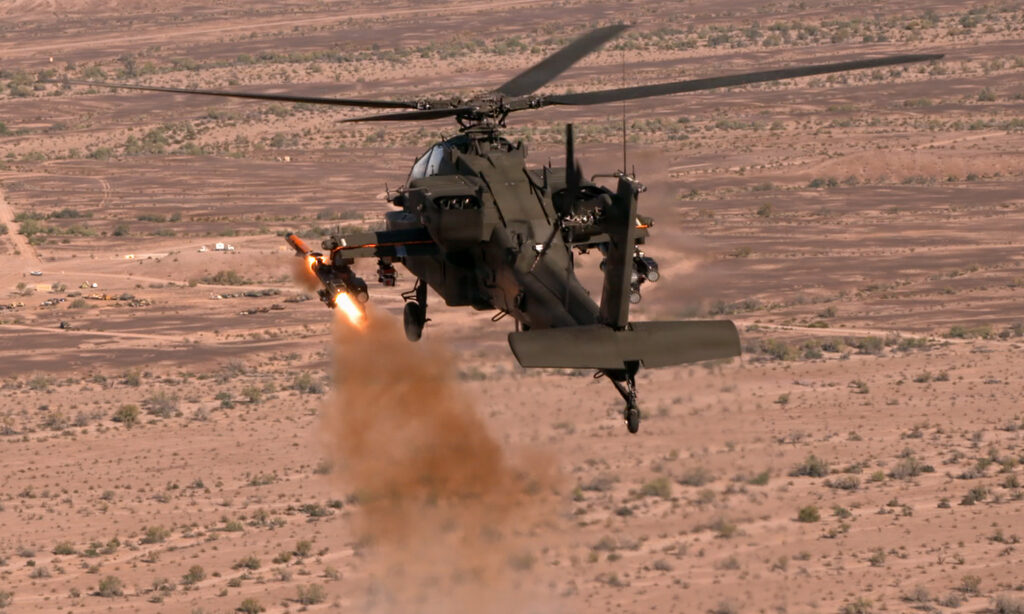
 A U.S. Army AH-64 Apache launches an Anduril Altius 700 Medium-Range Launched Effect (MR-LE) at Yuma Proving Ground during a recent concept exercise. Image–Courtesy Photo via DVIDS.
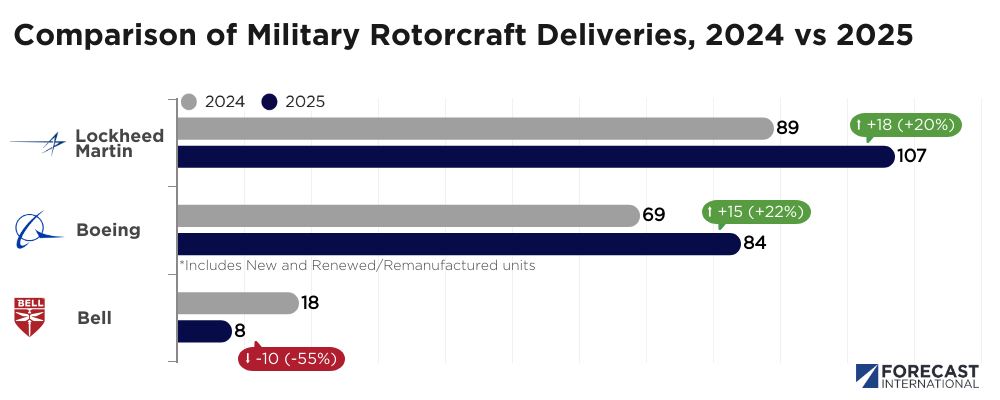
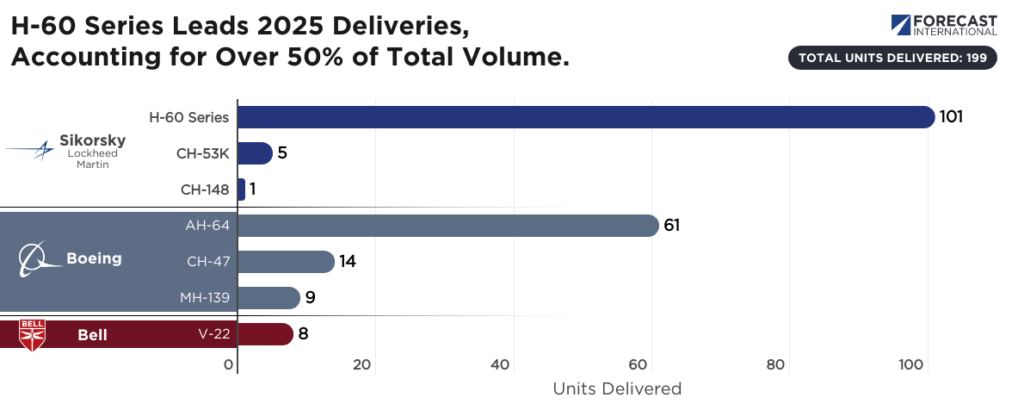
The big three American rotorcraft manufacturers, Bell, Boeing, and Sikorsky (a Lockheed Martin subsidiary), delivered a combined total of 199 military rotorcraft in 2025. That figure represents a 13 percent increase over 2024, helping to cool concerns over the past few years that human-piloted rotorcraft face obsolescence in the modern era.
By the Numbers
Sikorsky delivered the most units in 2025, anchored by the H-60 line, a total of 101 Black Hawk and Seahawk examples. Boeing recorded the most growth, increasing annual deliveries by about 22 percent. Bell experienced the only decline among the three companies, turning over ten fewer units in 2025 as AH-1Z exports taper and MV-22 Osprey production for the U.S. Navy and Marine Corps nears completion.
Fall 2025 showed huge contractual wins for Boeing and Sikorsky’s key military helicopter programs. Building on a long-developing agreement, Boeing formally announced in November that it will build 96 AH-64E Apache attack helicopters for Poland. The deal, valued at $4.7 billion, will make Poland the 19th global operator with the largest Apache fleet outside of the U.S.
Capitalizing on its other legacy helicopter offering, Boeing secured over $1.6 billion in contracts for its heavy-lift Chinook series late last year. Included in those awards are funding to accelerate U.S. Army fielding of the CH-47 Block II, agreements for the MH-47G for U.S. Special Operations Command (SOCOM), and $876.4 million to produce up to 60 CH-47F Block II helicopters for Germany.
During the same timeframe, Sikorsky inked a historic $10.9 billion contract with the U.S. Navy, confirming the Marine Corps’ long-term commitment to the CH-53K. The five-year framework secures five production lots for up to 99 helicopters.
Although Forecast International projects Boeing to build more units from 2026 through 2030, our estimates show that Sikorsky will build a larger share, approximately 40 percent, of the total market production value. This prediction is primarily due to the high unit cost of the powerful triple-engine King Stallion.
Tiltrotor Transition
Despite a declining production trend in the near term, Bell is experiencing a transitional period as it prepares to introduce the MV-75 tiltrotor under the U.S. Army Future Long Range Assault Aircraft (FLRAA) program. Assembly work is now underway on the first test aircraft. Bell and the U.S. Army are prioritizing the rapid fielding of the MV-75, with initial production expected in the next one to two years.
Bell’s market position will rise during the mid-2030s as it approaches full-rate manufacturing of the MV-75. Cumulatively, the program could ultimately approach $70 billion. While Boeing and Sikorsky’s helicopter portfolios remain rooted in modernized legacy designs, the MV-75 represents the first clean-sheet U.S. rotorcraft since the joint Bell-Boeing V-22 Osprey entered service nearly 20 years ago.
As the military rotorcraft market transitions from legacy to successor platforms during the next decade, the overall forecast remains robust. Bell, Boeing, and Sikorsky will produce nearly 600 units during the next three years. Meanwhile, rotorcraft demand remains strong in the broader market. European-based Airbus Helicopters delivered 31 more units in 2025 than the previous year across its civil and military product range. The company also reported 544 gross orders in 2025, up from 455 during 2024.
Hybrid Horizon
Naturally, the proliferation of uncrewed systems and drone warfare has raised questions about the future viability of manned military rotorcraft. Nonetheless, current market signals project stability and reinforce the utility of these aircraft in contemporary environments. If anything, these forces are driving traditional prime contractors to integrate emerging technologies with their existing platforms while developing next-generation initiatives.
Hedging on the momentum of the U.S. Air Force Collaborative Combat Aircraft (CCA) program, Boeing debuted a similar drone wingman concept last October for accompanying U.S. Army rotorcraft. That same month, Sikorsky unveiled a tablet-controlled UH-60L helicopter, the U-Hawk, which features the company’s MATRIX autonomy suite. More recently, Sikorsky announced a joint project with the Robinson Helicopter Company–a world leader in civil rotorcraft–to integrate MATRIX with the R66 TURBINETRUCK, an autonomous helicopter built on the R66 airframe.
For its part, Bell has been working on uncrewed rotorcraft capabilities for years, most notably under a joint Defense Advanced Research Projects Agency (DARPA) and SOCOM program. Earlier this month, Bell announced that its Speed and Runway Independent Technologies (SPRINT) design entry received the designation X-76, clearing the way to build a high-speed demonstrator. That prototype will likely feature Bell’s revolutionary Stop/Fold rotor system to meet SPRINT requirements for a 400-plus knot aircraft that can operate from austere environments.
Proven Legacy
Uncrewed technologies aside, legacy rotorcraft are demonstrating renewed mission versatility. Israeli and Emirati AH-64 Apache attack helicopters have reportedly downed Iranian Shahed drones in recent combat operations. Likewise, the U.S. Army is testing Apaches for Counter-UAS applications utilizing the underslung 30mm cannon and guided munitions via Advanced Precision Kill Weapon System (APKWS) kits from the stub-wing pylons.
The integration of launched effects and standoff weapons, paired with doctrinal adaptation, is significantly enhancing rotorcraft survivability. High-speed tiltrotor design and uncrewed systems may define the future, yet conventional attack and utility helicopters remain vital, evidenced by market data and operational necessity.

A former naval officer and Seahawk helicopter pilot, Jon currently leads the Military Aerospace and Weapons Systems group at Forecast International. He specializes in current and emerging military fixed and rotary-wing aircraft. With over a decade of experience in military aviation, operations, and education, he forecasts a diverse range of defense and naval systems.
Influenced by his time as a former Presidential Management Fellow and International Trade Specialist at the Department of Commerce, Jon gained insights into government operations and global markets.
Before joining Forecast International, he served as an NROTC instructor and Adjunct Assistant Professor at the University of Texas, teaching undergraduate courses in naval history, navigation, defense organization, and naval operations and warfare.