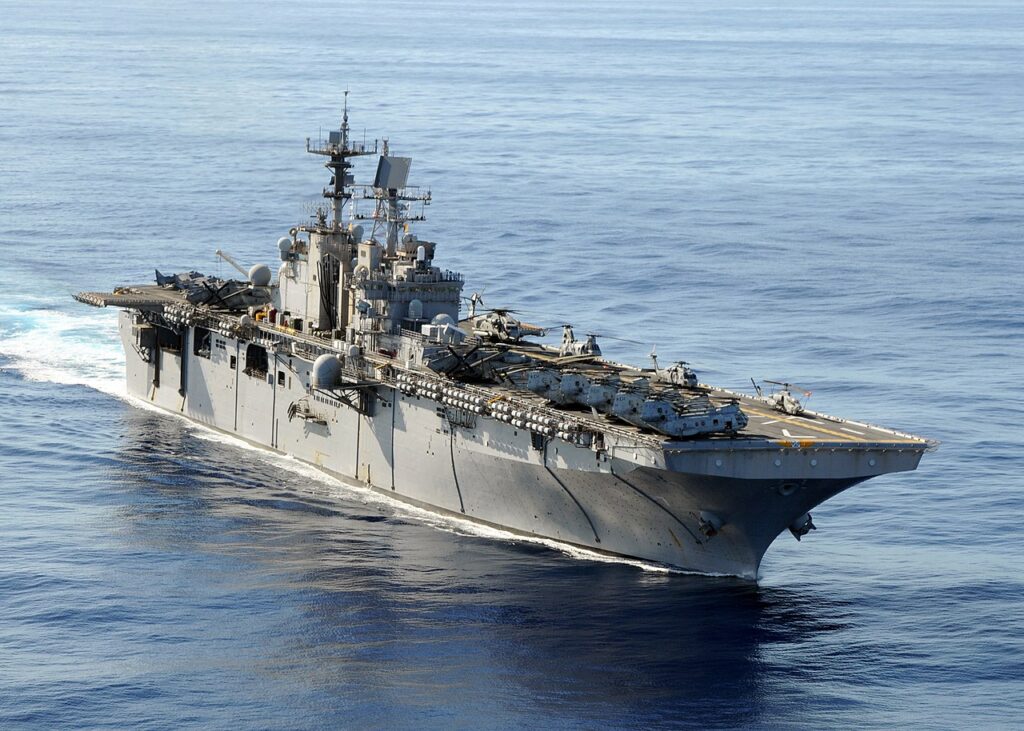
After over a decade of rule characterized by pervasive economic and political tumult that generated an exodus of millions of citizens and the country’s deepening diplomatic isolation, on January 3rd Venezuelan President Nicolas Maduro’s tenure was brought to an abrupt conclusion by his forcible seizure and arrest by the United States in an early morning raid on Caracas led by formations operating under the Joint Special Operations Command (JSOC) and supported U.S Navy and Marine assets and the Central Intelligence Agency (CIA). The United States Military suffered no casualties in the raid. The Cuban government, Venezuela’s leading provider of military and intelligence expertise, reported the loss of 32 military and intelligence personnel in the action. The Venezuelan government has reported the death of at least one civilian and an unspecified number of Venezuelan military personnel.
The raid marks the culmination of not only of a monthslong military buildup and diplomatic pressure campaign initiated by the second U.S Presidential Administration of Donald Trump targeting Venezuela since its inauguration in January 2026, but of over two decades of heightened bilateral acrimony between the two states originating with the political ascent of late President Hugo Chavez and his ‘Bolivarian’ socialist movement in the late 1990s. In its press statements, the Trump administration has cited stemming narcotics and migration flows, diminishing Russian and Chinese influence in Latin America and gaining access to Venezuelan energy resources as guiding its decision behind the raid. Maduro, Chavez’s appointed political successor, and his wife, Cilia Flores, both now reside in the custody of U.S law enforcement in the state of New York on pending charges of drug trafficking.
The sudden fall of Maduro signals the beginning of an uncertain new phase of Venezuela’s political history. At the time of publication, the political structures and authority of the ruling United Socialist Party of Venezuela (PSUV) remain largely intact despite Maduro’s removal. Early on January 5th, executive authority in Venezuela was formally assumed by Maduro’s Vice President and longtime political ally, Delcy Rodríguez. In the days since the action, both the Trump and Rodríguez administrations have probingly cycled between defiance and conciliation, with each party seeking to establish the opening terms of the post-Maduro political landscape. In the immediate aftermath of the raid, President Trump indicated amenability to reaching an agreement for Rodríguez to remain in power, while also emphasizing that the United States would nevertheless be ‘in charge’ of the country and take on a leading role in critical decisions pertinent to determining Venezuela’s future. The President issued a warning that Rodríguez could ‘pay a very big price’ if cooperation were not forthcoming. Although Rodríguez’s initial public statements stressed the PSUV’s continuing fealty to Maduro and contained vows to resist U.S demands, on January 4th the Venezuelan government adopted a more diplomatic posture. In a public statement, Rodríguez invited the Trump administration to build ‘an agenda of cooperation oriented towards shared development within the framework of international law to strengthen lasting community coexistence’.
The outlook for Venezuela’s near future is liable to be determined by whether the interests of a triangle of three independent actors, consisting of the United States Government, the incumbent PSUV establishment and the Venezuelan democratic opposition can be collectively reconciled. Although potential avenues and incentivizes for cooperation and conciliation amongst these parties exist, the realization of one or two of these groups’ interests at the heightened expense of another elevates the risks of irreconcilable fractures emerging during the incipient bargaining process and subsequent aftermath. The broader fault lines that might emerge over contentious issues of justice, transparency and redistribution are represented in microcosm by emerging debates over the future of Venezuela’s long beleaguered, but once lucrative, oil industry.
In his January 3rd press conference, President Trump emphasized that the United States is ‘deadly serious about getting back the oil that was stolen from us’. The statement harkens back to Chavez’ administration’s partial nationalization of the Venezuelan energy sector in the early 2000s, with facilities and assets previously developed by external companies brought under the umbrella of the country’s national oil company, Petróleos de Venezuela, S.A (PDVSA). Litigation stemming from the nationalization processes resulted in a range of arbitrated financial settlements between the relevant parties. Referencing the steady collapse of Venezuelan outputs over the past decade, President Trump articulated the administration’s vision for the sector, stating that “United States oil companies, the biggest anywhere in the world, go in, spend billions of dollars, fix the badly broken infrastructure, the oil infrastructure, and start making money for the country” and that the “wealth is going to the people of Venezuela and people from outside of Venezuela that used to be in Venezuela.”
Although once a dominant player in the energy market in Latin America and a major provider to the United States, over the past decade plus the cumulative impact of the loss of qualified personnel, endemic corruption and neglect, economic sanctions and a succession of market shocks and diversifying competitive landscape have rendered the Venezuelan energy sector a husk of its former self. While Venezuelan outputs reached over 3.0 million barrels per day in the late 1990s, by the early 2020s outputs consistently failed to breach even 1.0 million. Independent analysts have estimated that the restoration of Venezuelan oil facilities to their previous standard could require the dedication of years of effort and up to $100.0 billion in capital expenditures.
In the context of these objectives, the Trump administration may regard the political accommodation of the existing structure of the PSUV government and the powerful reigning trio of Vice President Rodríguez, Interior Minister Diosdado Cabello Rondón and Defense Minister Vladimir Padrino López as offering potential dividends in near-term stability, hypothetically avoiding the disintegration of public order and subsequent diffusion of armed actors that characterized the opening days of de-baathification in Iraq. Maintaining a continuity of executive power through the PSUV might be intended to provide the U.S administration with pliant and predictable local partner with whom terms can be negotiated, material concessions attained and through which a potential transitional process can be guided indirectly. In a January 4th press interview, U.S Secretary of State Marco Rubio reinforced this notion, signaling a belief that discussion holding new elections in Venezuela was still ‘premature’ at this stage of the process.
Although the PSUV is the nominal inheritor of the anti-imperialist messaging and ideology of the Chavez era, factional politics and rent-seeking behavior has long since superseded these loftier considerations. For the remaining leaders of the existing regime, acquiescing to close cooperation with the Trump administration presents a number of straightforward practical benefits, particularly given the Venezuelan state’s apparent incapacity to conventionally contest U.S military power. Indeed, for PSUV apparatchiks fatigued from laboring under years of relentless external sanctions and vociferous internal opposition, the opportunity to reintegrate the country into the global marketplace and potentially reinvent themselves at Maduro’s expense alone may be a welcome one. These actors within the PSUV may seek to mirror the savvy political adaptations undertaken by many long-serving state functionaries in post-Communist states across the former Warsaw Pact.
However, what ails the Venezuelan energy sector is not merely a lack of financial resources or technical maintenance. Although the brain drain of qualified personnel and subsequent neglect of physical facilities were both significant factors in the deterioration of the Venezuelan energy sector, to characterize the nature of the PSUV’s management of PDSVA as ‘mismanagement’ would be something of a misnomer. An emphasis on simple incompetence obscures the extent to which rent-seeking behavior was deliberately incentivized and cultivated across Venezuelan state entities as a means of distributing rewards and benefits to the PSUV’s most loyal retainers and constituents. Although potentially less fraught opportunities to benefit from untapped Venezuelan resources might exist for Western companies to seek out and invest in, increasing outputs at PDVSA would also require introducing higher standards of professional and fiscal responsibility and accountability to the company’s internal processes. Paradoxically, the forcible removal of the country’s head of state by a foreign power might represent far less of an existential threat to the PSUV’s interests than the introduction of reforms to the energy sector, and consequently, could generate deeper alarm and stiffer resistance from within its ranks than Maduro’s ouster. It is in these granular details that schisms between the U.S and Rodriguez administrations could emerge. The Trump administration’s interest in a profitable energy sector that offers terms and access preferential to U.S interests and the PSUV’s interest in sustaining the patronage flows upon which its control of armed groups depends could run in contravention of each other. At the time of publication, both parties are already testing the boundaries of the other, with the U.S sustaining its blockade posture as a bargaining tool and Venezuelan tankers still making efforts to evade it. Although the PSUV could seek to retain the loyalty of its security networks during a potential reform process via the hypothetical promise of the greater rewards that might emerge the industry’s greater access to global markets, any immediate or intermediate term disruptions to patronage flows could still prompt factions within the military, security services or collectivos to defect towards independence.
The third primary actor in the post-Maduro landscape is the democratic opposition and more broadly, Venezuela’s population of over 28 million people. Long beset by false starts and divisions amidst withering government repression, in the last five years the Venezuelan opposition marshalled newfound institutional and public strength to challenge the Maduro government. Under the auspices of the Unitary Platform coalition, opposition leaders Edmundo González and María Corina Machado credibly attained nearly 70 percent of the vote in the 2024 Venezuelan presidential election despite the Maduro government’s subsequent falsification of the results and its arrest and intimidation of opposition figures before, throughout and after the election process. The desire for change and antipathy for the existing authorities is widespread. In the immediate term, the Venezuelan public, which continues to face the same daily struggles as prior to Maduro’s ouster and has witnessed the regime wither states of near-collapse before, may nevertheless be predisposed to wait and see how the situation evolves before embracing action.
However, after years of stolen elections and aspirations, the ouster of Maduro is likely not only to be regarded as a sign of hope for change, but also of the regime’s weakness. Jubilation over Maduro’s ouster could evolve into bitterness if the public perceive that regime insiders may end up being the primary beneficiaries of the post-Maduro order. Democratic governance and accountability will also be essential in rebuilding Venezuela’s emaciated central government and restoring dynamism to the economic base, energy or otherwise. The PSUV cannot fully afford to govern more cleanly as it would require abandoning the patronage ties that give it its power over armed groups, but without better governance the public will continue to chafe against the PSUV’s democratically illegitimate rule and the squandering of the country’s resources, escalating the likelihood of renewed unrest and renewed state repression that could bring the country back to something resembling the pre-raid status quo.
Lastly, the Venezuelan political landscape is populated by diverse range of periphery actors that nevertheless may possess the capacity to complicate any burgeoning political transition. The atrophied condition of the Venezuelan state has facilitated broad swathes of both urban slums and the rural hinterlands being ceded to criminal organizations and non-state groups such as the National Liberation Army (ELN) over the past decade. As the authority of the PSUV government has weakened over this time, it has cycled through phases of cooption, conflict and uneasy détente with the diverse groups that constitute this category. As the fall of Maduro subtly shifts the factional balance within the PSUV, and Venezuelan society at large, political actors may seek to leverage the capability of this fourth category to advance their own political ambitions or act as spoilers to those of competitors. Similarly, these groups may aim to seize the opportunities presented by a shifting balance of power to elevate their own status as players within the political landscape, as has occurred in nearby Haiti.
The United States faces a gordian knot to untie in this regard. How it chooses to mediate, or whether it chooses sides, in these conflicts could tip the domestic balance of power in ways that are difficult to fully anticipate and will require scrupulous and disciplined management.

A lifelong enthusiast of armored vehicles, Thomas serves as an analyst on Forecast International's Military Vehicles Forecast product. In addition, Thomas is responsible for updating the reports and analysis within Forecast International's International Military Markets – Latin America & Caribbean product. He also provides analysis for Forecast International's Airborne Retrofit & Modernization Forecast. Before this assignment, Thomas served as a research assistant for Forecast International's analytical team and has made written contributions to the Civil Aircraft Forecast, Military Aircraft Forecast, and Rotorcraft Forecast services. Thomas derives his knowledge from a multidisciplinary background, with a strong emphasis on the history and politics of Russia and the former satellite republics of the Soviet Union. He has studied in the Russian Federation at Saint Petersburg State University and is proficient in the Russian language at an advanced level.