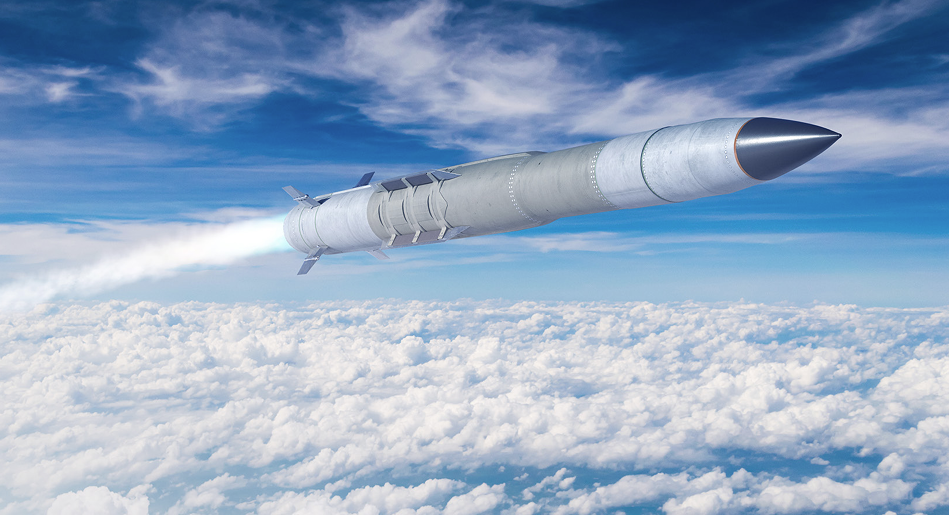
Illustration of the PAC-3 MSE interceptor. Source: Lockheed Martin
The U.S. is significantly expanding production of missile systems, including PAC-3 MSE, Tomahawk, Advanced Medium-Range Air-to-Air Missile (AMRAAM), SM-3, and SM-6, to meet rising operational demands in the Indo-Pacific. By scaling annual output across these high-demand munitions, the U.S. is strengthening the industrial capacity required to sustain layered air and missile defense networks. This expansion reflects a strategic emphasis not only on advanced capabilities, but on ensuring the production depth necessary to support long-term deterrence and allied defense integration in a contested region.
U.S. Missile Production Expansion
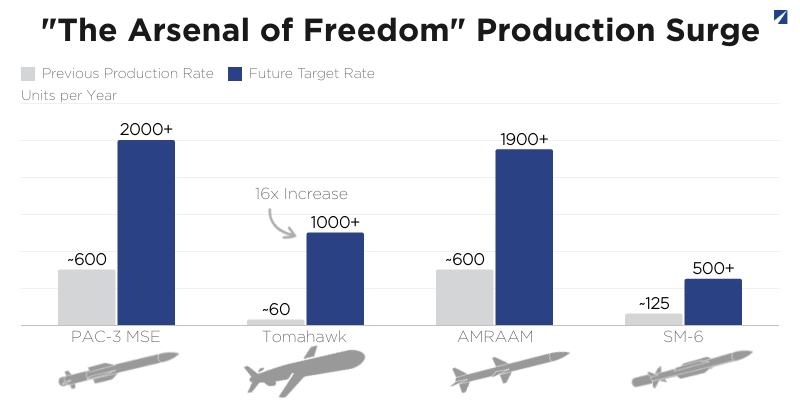
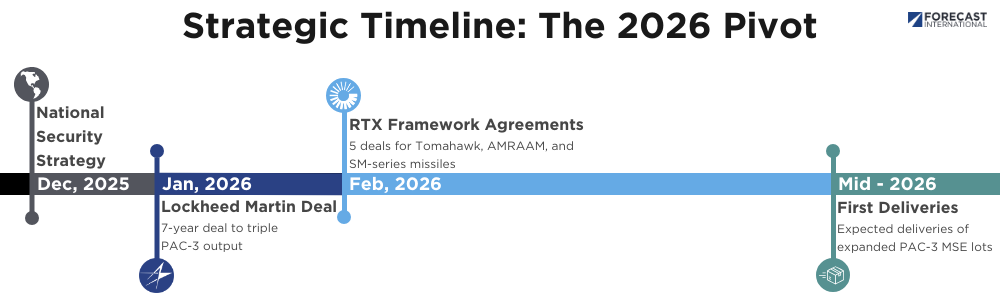
U.S. missile production has accelerated sharply at the start of 2026, with major defense contractors expanding output across several high-demand systems. On January 8, Lockheed Martin announced a seven-year agreement to scale production of the PAC-3 MSE from 600 to 2,000 missiles annually.
In early February, RTX secured five agreements with the U.S. Department of Defense covering a range of key missiles, including Tomahawk cruise missiles, AIM-120 AMRAAMs, SM-3 interceptors, and SM-6 missiles. Under the new agreements, annual production of Tomahawks is expected to top 1,000 missiles, AMRAAM output will reach at least 1,900, and SM-6 production will exceed 500. Meanwhile, SM-3 interceptors are set to be manufactured at up to four times the current rate.
Strategic Drivers in the Indo-Pacific
In response to China’s growing assertiveness, the U.S. has raised security concerns for its Indo-Pacific allies, emphasizing in its December 2025 National Security Strategy the need to prevent large-scale conflict. The strategy calls for building a military capable of denying regional aggression, with further investments in naval capabilities spanning from India to Japan. It also encourages allies, including Japan and South Korea, to strengthen their own defenses and enhance deterrence against potential adversaries.
Key Missile Systems Driving Expansion
The recent surge in missile production centers on several core systems that underpin U.S. and allied deterrence in the Indo-Pacific. The Tomahawk cruise missile allows U.S. Navy ships and submarines to conduct highly accurate long-range strikes, with a reach of more than 1,000 miles. In the air domain, the AIM-120 AMRAAM is integrated across U.S. and allied fighter aircraft and also serves as the interceptor for NASAMS ground-based air defense systems.
At sea, Aegis-equipped vessels operate the SM-3 interceptor, including the SM-3 IB and the more advanced SM-3 IIA, designed to counter short- to intermediate-range ballistic missiles. The SM-6 complements this capability by supporting air defense, anti-surface warfare, and terminal ballistic missile defense, giving naval forces greater operational support.
Allied Missile Defense Capabilities
Both Japan and South Korea play key roles in the region’s integrated missile defense network. Japan operates several Aegis-equipped destroyers and hosts U.S. vessels carrying SM-3 interceptors. U.S. PAC-3 batteries in Okinawa also provide a short-range defensive layer, reinforcing protection of critical infrastructure and population centers.
South Korea has also been expanding its ballistic missile intercept capabilities with SM-3s, enhancing the interoperability of its missile defense network with regional allies. These upgrades strengthen a layered defense architecture that complements U.S. investments in missile production and forward-deployed forces.
***
The surge in missile production strengthens U.S. naval posture and integrated defense coverage across the Indo-Pacific. Ongoing production growth of PAC-3 MSE, Tomahawk, AMRAAM, SM-3, and SM-6 missiles enables the U.S. to sustain a layered, persistent defense spanning the air, land, and maritime domains. Forward-deployed U.S. naval vessels and aircraft equipped with these systems, alongside allied defense assets across the region, reinforce alliance interoperability, ensuring compatibility between U.S. and partner platforms while supporting a more resilient regional deterrent. To sustain this strategic posture, production growth is likely to remain steady in the coming years, creating expanded opportunities for industry participation.
Forward-Looking Analysis
As the U.S. and its allies continue expanding missile capabilities, these advancements will be closely monitored by regional adversaries. With production increasing, it will be important to track how these systems are handled moving forward, whether they are sold to regional allies, integrated into joint operations, or used to reinforce existing posture. At the same time, noting how adversaries adjust their own development and procurement in response will offer early indicators of shifts in the Indo‑Pacific strategic environment. Together, these developments demonstrate the boundaries between strengthening deterrence and inadvertently contributing to escalation in a region.

Lauren Estrada has a background in global and cyber intelligence, with a strong interest in communicating technical threats to non-technical audiences. She currently works as an Editor & Analyst with Forecast International and Military Periscope, where she contributes to research and analysis on defense technologies. Her previous experience includes defense technology research, regional risk assessments, client-facing intelligence reports, trend analysis, threat of actor behavior, and cyber-focused research.
While pursuing her B.S. in Global Security and Intelligence Studies at Embry-Riddle Aeronautical University Prescott, Lauren co-led a cross-disciplinary initiative to introduce cybersecurity fundamentals to students across all majors. Her team designed and proposed a course that bridged cybersecurity and non-technical disciplines, fostering inclusive engagement with cyber skills. This work led to speaking engagements at university industry board meetings and the 2025 National Conference on Undergraduate Research in Pittsburgh, PA.