In end-of-year contract action, the Pentagon announced on December 29 an $8.58 billion award to Boeing to build 25 new F-15IA aircraft for Israel. The ten-year Foreign Military Sale (FMS) framework also includes an option for 25 additional fighters.
Israel began pursuing the modernized F-15 variant during the Biden Administration as Israeli leadership requested financing to support a deal. Following a 2023 formal request and FMS approval in August 2024, an initial $5.2 billion agreement was reached with Boeing in November 2024 for 25 F-15IAs.
The latest contract adjustment increases the cost by over $3 billion, which is likely due to an option for 25 more units. Israel’s forthcoming F-15IA fighters, based on the F-15EX Eagle II, will receive country-specific modifications–likely Israeli-built electronic warfare, avionics, and weapons subsystems.
Eagle II
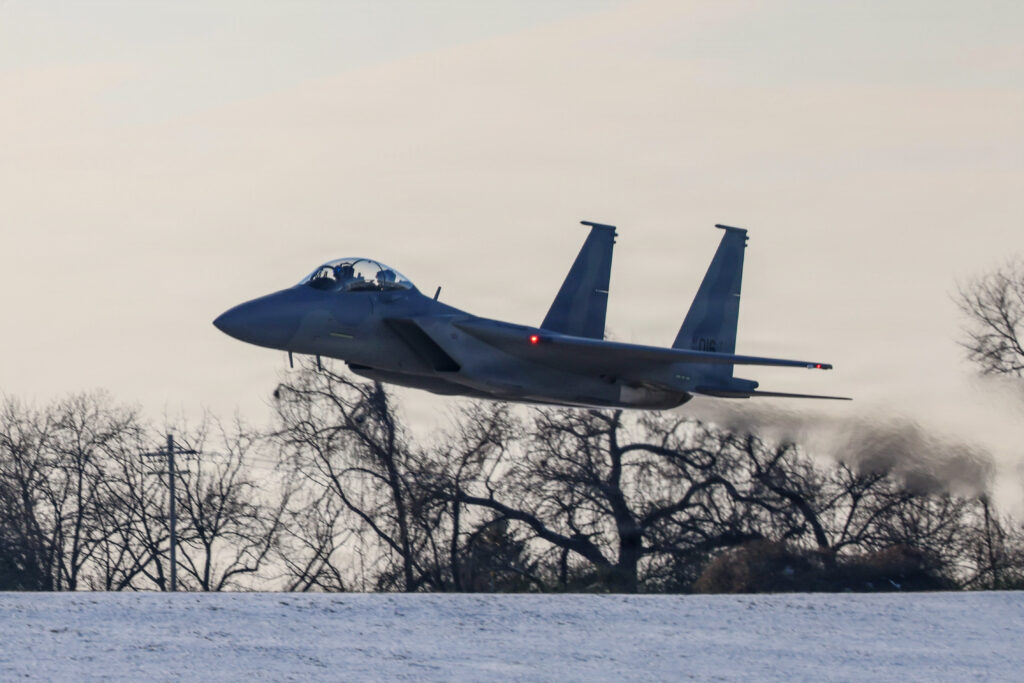
Building on the legacy F-15 platform, Boeing has found growing success with the F-15EX in U.S. Air Force procurement and foreign sales. Improving on previous variants, the Eagle II affords a service life of 20,000 hours and a greater payload capability of 29,500 pounds.
Described as a “missile truck,” external pylon stations are opened up, allowing carriage of 12 air-to-air weapons with rack options to support up to 22 missiles. The airframe is mated with a pair of GE F110-129 engines that individually produce 29,000 pounds of thrust.
Aside from performance metrics, what is increasingly setting the Eagle II apart from comparable 4 and 4.5 generation fighters is the aircraft’s versatility for next-generation mission sets in electronic warfare (EW) and UAS applications.
In U.S. Air Force service, the F-15EX is equipped with BAE Systems’ Eagle Passive/Active Warning Survivability System (EPAWSS), designated the ALQ-250. EPAWSS is an all-digital EW suite that elevates the Eagle II to near-fifth-generation capability.
The suite integrates multispectral sensors, microelectronics, and advanced signal processing to allow the Eagle II to autonomously detect, identify, and pinpoint the location of enemy radar and missile systems in dense radio frequency environments. This 360-degree situational awareness provides pilots with a real-time picture of the battlespace, enhancing survivability.
Beyond simple detection, EPAWSS serves as an electronic shield, utilizing active countermeasures and jamming to deceive and defeat modern air defense systems. This creates a “digital stealth” effect; while the Eagle II lacks a low-observable airframe, its ability to disrupt enemy sensors allows it to penetrate deeper into contested airspace and act as a force multiplier for F-35s. Its modular architecture ensures that the Eagle II remains future-proof, capable of receiving rapid updates to counter evolving electronic threats.
The Israeli Air Force will utilize this force-multiplying relationship by pairing the F-15IA with its growing fleet of fifth-generation F-35I Adir jets. Israel’s program goal stands at 75 F-35I fighters, with approximately 45 delivered. Forecast International projects that F-15IA production will peak in the early 2030s, coinciding with wrap-up deliveries of Israel’s active F-35I order.
CCAs and C-UAS
As the integration of Collaborative Combat Aircraft (CCA), or loyal drone wingmen, with manned fighters matures, Boeing continues to market the F-15EX as a quarterback platform. While the F-15EX can be single-piloted, the legacy backseat design allows a station for CCA management. With the nascency of CCA integration, a twin-seat fighter could serve as a stepping stone for air forces to develop uncrewed systems tactics while distributing in-flight task loads. As part of a campaign for Poland’s open fighter requirement, Boeing has packaged the F-15EX with its MQ-28 Ghost Bat CCA.
The Eagle II is also poised to play a significant role in C-UAS as the Advanced Precision Kill Weapon System (APKWS), also built by BAE Systems, gains momentum as a cost-effective means of addressing drone threats. Recognizing this utility, the U.S. Air Force moved quickly late last year to outfit F-15E fighters with APKWS II pods, allowing the jet to carry up to 42 rockets in addition to a standard missile loadout. Although yet to be publicly acknowledged, outfitting the Eagle II with APKWS is a logical progression due to its enhanced payload capacity.
These next-generation capabilities, coupled with a trusted design, have helped renew the F-15’s place in the U.S. Air Force’s fighter force structure. The Pentagon’s FY26 request notably included $3.1 billion and 21 aircraft for the F-15EX program. The total acquisition objective is now set at 129 fighters, a boost from the previously planned 98.
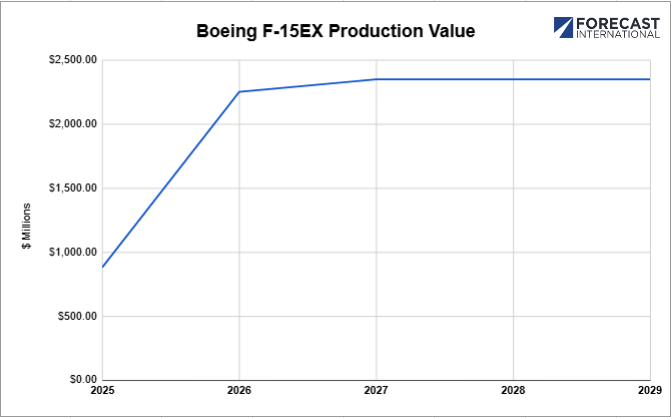
Despite various headwinds with early production issues, supply chain vulnerabilities, and a related labor strike in the latter half of 2025, F-15EX manufacturing is expected to accelerate in the next few years. Forecast International projects that Eagle II production value will more than double from 2025 to 2026 and remain steady throughout the next four years.
Although the bulk of work on Israel’s order is unlikely until around 2030, production growth in the interim will continue to support U.S. Air Force procurement. Meanwhile, Boeing will look to capitalize on potential global opportunities from Egypt, Indonesia, Poland, Saudi Arabia, and Turkey.

A former naval officer and Seahawk helicopter pilot, Jon currently leads the Military Aerospace and Weapons Systems group at Forecast International. He specializes in current and emerging military fixed and rotary-wing aircraft. With over a decade of experience in military aviation, operations, and education, he forecasts a diverse range of defense and naval systems.
Influenced by his time as a former Presidential Management Fellow and International Trade Specialist at the Department of Commerce, Jon gained insights into government operations and global markets.
Before joining Forecast International, he served as an NROTC instructor and Adjunct Assistant Professor at the University of Texas, teaching undergraduate courses in naval history, navigation, defense organization, and naval operations and warfare.

Anna Miskelley has cultivated a deep interest in global security, emerging technologies, and military systems throughout her academic and professional career. She is currently a Defense Industry Analyst with Forecast International.
Before joining Forecast International, Anna was a research fellow at the Center for Security, Innovation, and New Technology, where she researched the impact of artificial intelligence on U.S. nuclear command and control systems. Proficient in Mandarin Chinese, Anna has published research on topics including strategic stability, internal Chinese politics, and artificial intelligence.