 Source: Planet Satellite Imagery
Context
Operation Epic Fury began at 01:15 Eastern time on February 28th, 2026. In the first 24 hours of strikes on Iran, American B-2 bombers, stealth fighter jets, reconnaissance aircraft, and other weapons were used to strike more than 1,000 targets.
According to a fact sheet distributed by U.S. Central Command (CENTCOM), initial targets included aerospace forces and joint headquarters facilities of the Islamic Revolutionary Guard Corps (IRGC), Iranian ships and submarines, anti-ship and ballistic missile sites, command and control centers, military communications capabilities, and air defense systems. While Operation Epic Fury targeted Iran’s military infrastructure across multiple domains, the destruction of Iranian naval assets was listed as a top priority within the first 48 hours.
Importance
The prioritization of Iranian naval assets was intended not simply to reduce Iran’s capabilities at sea. This prioritization also sought to preserve freedom of navigation through the Strait of Hormuz—a vital maritime chokepoint connecting the Persian Gulf with the Gulf of Oman and the Arabian Sea. The strategic sea passage, located on Iran’s southern border, ordinarily enables the flow of about 20% of global oil and liquefied natural gas shipments.
Following the launch of Operation Epic Fury, the IRGC threatened to attack ships passing through the Strait, which led to a significant reduction in maritime traffic through the strategic waterway. Consequently, oil prices have jumped 10% to roughly $80 per barrel.
Iran’s Navy
Iran has two naval forces: the Islamic Republic of Iran Navy (IRIN) and the Islamic Revolutionary Guard Corps Navy (IRGCN). The IRIN is the traditional naval force that existed before the 1979 revolution. The IRIN operates Tehran’s large surface combatants and submarines as part of a blue water force. Many of the IRIN’s surface ships are old, dating back to the 1960s and 1970s. The sectarian IRGC is responsible for coastal defense and security in the Persian Gulf, primarily with a fleet of small, fast attack craft.
Naval Targets
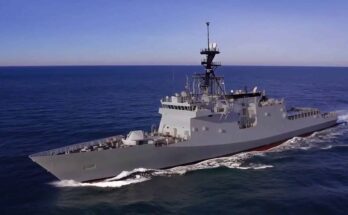
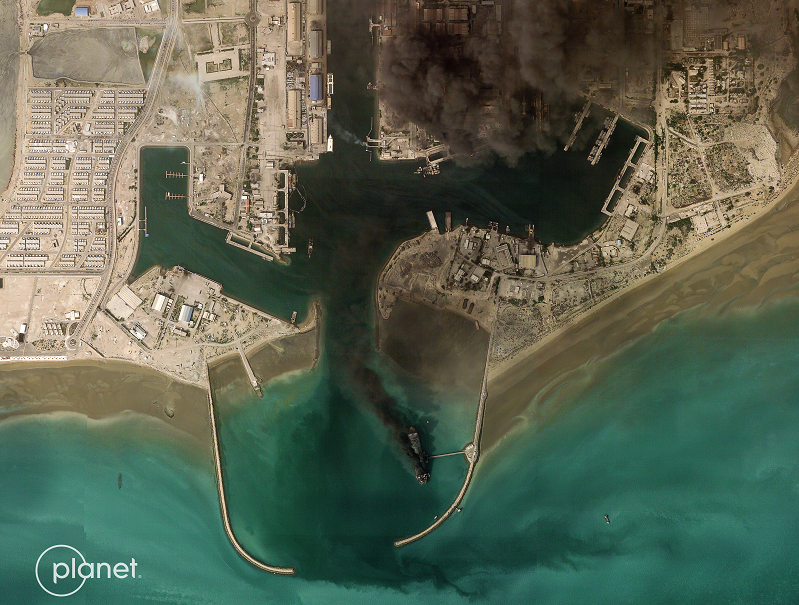
Widespread strikes across Iran have included several attacks on naval bases along Iran’s coastline of the Persian Gulf and the Gulf of Oman. Satellite imagery from Planet and Vantor highlighted the severity of the strikes across the naval bases, including Konarak and Bandar Abbas, showing multiple fires, sunken vessels, and destroyed buildings. In a post on X, CENTCOM claimed to have destroyed all 11 of Iran’s ships in the Gulf of Oman. While the destruction of every vessel has not yet been verified, struck and sunken vessels reportedly include several frigates from the Bayandor, Alvand, and Jamaran classes.
On Sunday, March 1st, CENTCOM posted that an Iranian Jamaran-class (also known as Moudge-class) corvette had been hit by U.S. forces and the domestically-built vessel was “sinking to the bottom of the Gulf of Oman at a Chah Bahar pier.” Satellite imagery from commercial providers showed smoke rising from the naval wharf at the Konarak Naval Basin near Chah Bahar, where a frigate had been docked.
“An Iranian Jamaran-class corvette was struck by U.S. forces during the start of Operation Epic Fury. The ship is currently sinking to the bottom of the Gulf of Oman at a Chah Bahar pier.” – U.S. Central Command
CENTCOM also confirmed the destruction of the IRIS Shahid Bagheri (C110-4) at its berthing in Bandar Abbas. The vessel, a container ship that was converted over two years into an aircraft carrier for drones and rotorcraft, was reportedly struck within hours of launching Operation Epic Fury. Shahid Bagheri was Iran’s first domestically produced drone carrier and had only recently entered service with the IRGCN on February 6, 2025.
Satellite imagery also indicated the IRIS Makran (441), the IRIN’s first forward base ship, had been struck while moored at Bandar Abbas. The Makran, originally a Japanese-built Aframax crude oil tanker completed in 2010, had been converted into a military vessel capable of supporting helicopter operations and serving as a mothership for special operations forces.
While damage to Iranian submarines has been more difficult to verify, U.S. forces have reportedly targeted Iran’s small submarine fleet, which is composed of numerous midget submarines and a handful of formerly-Russian Kilo-class attack boats.
Conclusion
Although it is likely that Iran still has several naval assets at its disposal, the swift and focused strikes by the United States and Israel have undoubtedly diminished Tehran’s ability to project power at sea, and perhaps more importantly, to threaten freedom of navigation in critical waterways like the Strait of Hormuz.

image sources
- Bandar-Abbas Military Harbor, Iran: Planet Satellite Imagery