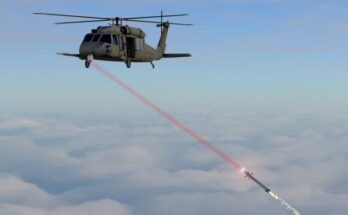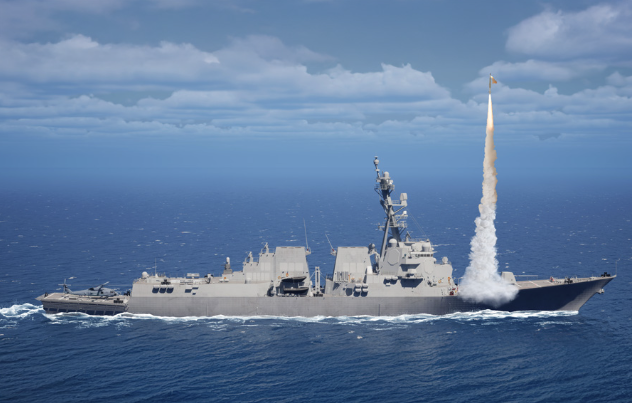
Demonstration of the PAC‑3 Missile Segment Enhancement integrated into the Aegis Combat System. Source: Lockheed Martin
The U.S. Navy is set to become the second U.S. service branch to operate the PAC‑3 Missile Segment Enhancement (MSE), joining more than a dozen allied partners currently fielding the interceptor. This expansion follows an April 21, 2026 Lockheed Martin announcement confirming the award of a long‑anticipated contract to integrate the PAC‑3 MSE with Aegis‑equipped surface combatants. The integration reflects a shift in how the Navy is strengthening its missile defense architecture by aligning modernized radar and launch systems to enhance defensive capability while increasing the effective combat power of individual ships.
Parallel Technology Developments in Aegis
The integration of PAC‑3 MSE into the Aegis Combat System is occurring amid a broader modernization effort, including the fielding of the AN/SPY‑6 radar family. Representing a substantial improvement in sensitivity, discrimination, and range, AN/SPY‑6 is being installed into Aegis as a foundational upgrade to fleet air and missile defense. In August 2025, RTX conducted the first live maritime test of the AN/SPY‑6(V)4 variant, an effort toward expanded operational deployment and demonstrating the system’s role in supporting next‑generation interceptors.
Launcher advancements are evolving in parallel. In May 2024, Lockheed Martin successfully launched a PAC‑3 MSE interceptor from the MK 70 Mod 1 Payload Delivery System (PDS) using the Virtualized Aegis Weapon System. Designed as a four‑cell launcher derived from MK 41 Vertical Launching System technology, the MK 70 PDS enables the rapid addition of precision fires to non‑traditional platforms, including littoral combat ships, and potentially destroyers.
Strategic Implications
The integration of the PAC‑3 MSE into the Aegis Combat System functions as a unifying element that provides a clearer operational purpose to parallel modernization efforts, particularly the AN/SPY‑6 radar and the MK 70 PDS. Together, these technologies point toward an evolved configuration of U.S. naval missile defense, reflecting a shift toward a more integrated, flexible, and layered fleet architecture.
While not yet formally announced, broader adoption of the MK 70 PDS on destroyers could further reinforce the integration of PAC‑3 MSE by increasing per‑vessel interceptor capacity and accelerating its operational utility across the surface fleet. Such an approach would align with the broader emphasis on maximizing defensive depth and adaptability without relying solely on legacy vertical launch configurations.
Outlook
Over the next five years, the significance of PAC‑3 MSE integration into Aegis will be defined less by individual integration milestones and more by the cumulative effect of aligned modernization efforts across radars, launch systems, and interceptors.
As the PAC‑3 MSE’s naval role expands, industrial investment is likely to deepen across manufacturing, integration, and sustainment infrastructure, accelerating the shift toward scaled production and fleetwide implementation.
From a strategic signaling perspective, this integration reinforces that the PAC‑3 MSE is not a temporary solution, but a missile with a defined growth path embedded within a premier naval combat system.

Lauren Estrada has a background in global and cyber intelligence, with a strong interest in communicating technical threats to non-technical audiences. She currently works as an Editor & Analyst with Forecast International and Military Periscope, where she contributes to research and analysis on defense technologies. Her previous experience includes defense technology research, regional risk assessments, client-facing intelligence reports, trend analysis, threat of actor behavior, and cyber-focused research.
While pursuing her B.S. in Global Security and Intelligence Studies at Embry-Riddle Aeronautical University Prescott, Lauren co-led a cross-disciplinary initiative to introduce cybersecurity fundamentals to students across all majors. Her team designed and proposed a course that bridged cybersecurity and non-technical disciplines, fostering inclusive engagement with cyber skills. This work led to speaking engagements at university industry board meetings and the 2025 National Conference on Undergraduate Research in Pittsburgh, PA.