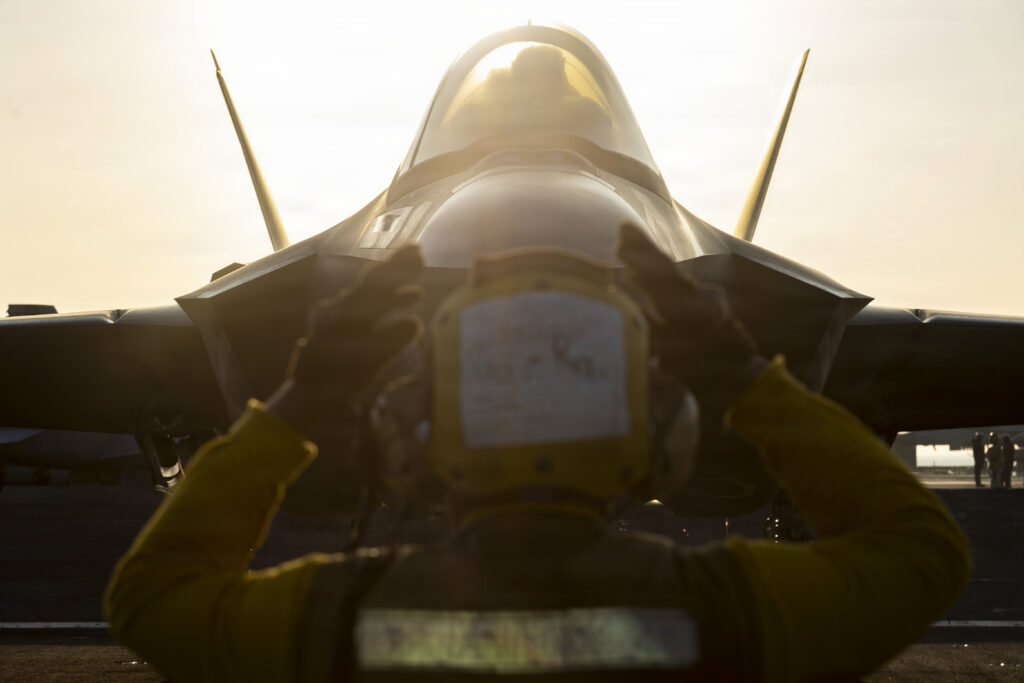
On Tuesday, a U.S. Marine Corps F-35C Lightning II fighter operating from the USS Abraham Lincoln (CVN-72) aircraft carrier shot down an Iranian drone in the Arabian Sea. Reports indicate that a Shahed-139 drone flew toward the ship with “unclear intent” as Abraham Lincoln pursued “de-escalatory measures” before engaging the drone to protect the carrier and crew. No casualties or damage to U.S. equipment occurred as a result of the event.
U.S. Central Command (CENTCOM) said the Abraham Lincoln was sailing in international waters, roughly 500 miles south of Iran at the time. U.S. naval forces have been ordered to the CENTCOM area of responsibility in recent days amid heightened tensions between the U.S. and Iran.
According to USNI News, embarked Carrier Air Wing 9 includes the “Black Knights” of Marine Fighter Attack Squadron (VMFA) 314, the only F-35C unit onboard CVN-72.
While no specific configuration information has been released, the F-35C can carry the AIM-9X Sidewinder short-range missile, the AIM-120 Advanced Medium-Range Air-to-Air Missile (AMRAAM), and an under-mounted GPU-8/A 25mm cannon. Although specifications remain classified, estimates place the AIM-120 range at over 11 miles, and depending on the variant, AMRAAM ranges are as high as 100 miles.
According to Tasnim news, an outlet with connections to the Islamic Revolutionary Guard Corps (IRGC), the downed drone in question was a Shahed-129 aircraft conducting surveillance actions. Forecast International’s intelligence shows the Shahed-129 is a medium-altitude, long-endurance (MALE) system that closely resembles the MQ-1 Predator. Estimates suggest a range of 2,000 km and an operating endurance of 24 hours. The Shahed-139 represents an upgraded version of the 129 and may have entered service in 2024.
The shootdown is part of a broader series of naval incidents in the region. On the same day, IRGC boats, along with a drone, attempted to overtake a U.S.-flagged tanker, the Stena Imperative, in the Strait of Hormuz. CENTCOM said the USS McFaul (DDG-74) arrived on scene and successfully escorted the Stena Imperative through the Persian Gulf.
The events took place only days after CENTCOM released a statement urging the IRGC to “avoid escalatory behavior at sea” following Iran’s planned live-fire exercises in the Strait of Hormuz. Ahead of planned U.S.-Iranian talks on Friday in Oman, the incidents add a challenging backdrop for diplomacy as officials attempt to ease pressure between the two nations.

A former naval officer and Seahawk helicopter pilot, Jon currently leads the Military Aerospace and Weapons Systems group at Forecast International. He specializes in current and emerging military fixed and rotary-wing aircraft. With over a decade of experience in military aviation, operations, and education, he forecasts a diverse range of defense and naval systems.
Influenced by his time as a former Presidential Management Fellow and International Trade Specialist at the Department of Commerce, Jon gained insights into government operations and global markets.
Before joining Forecast International, he served as an NROTC instructor and Adjunct Assistant Professor at the University of Texas, teaching undergraduate courses in naval history, navigation, defense organization, and naval operations and warfare.