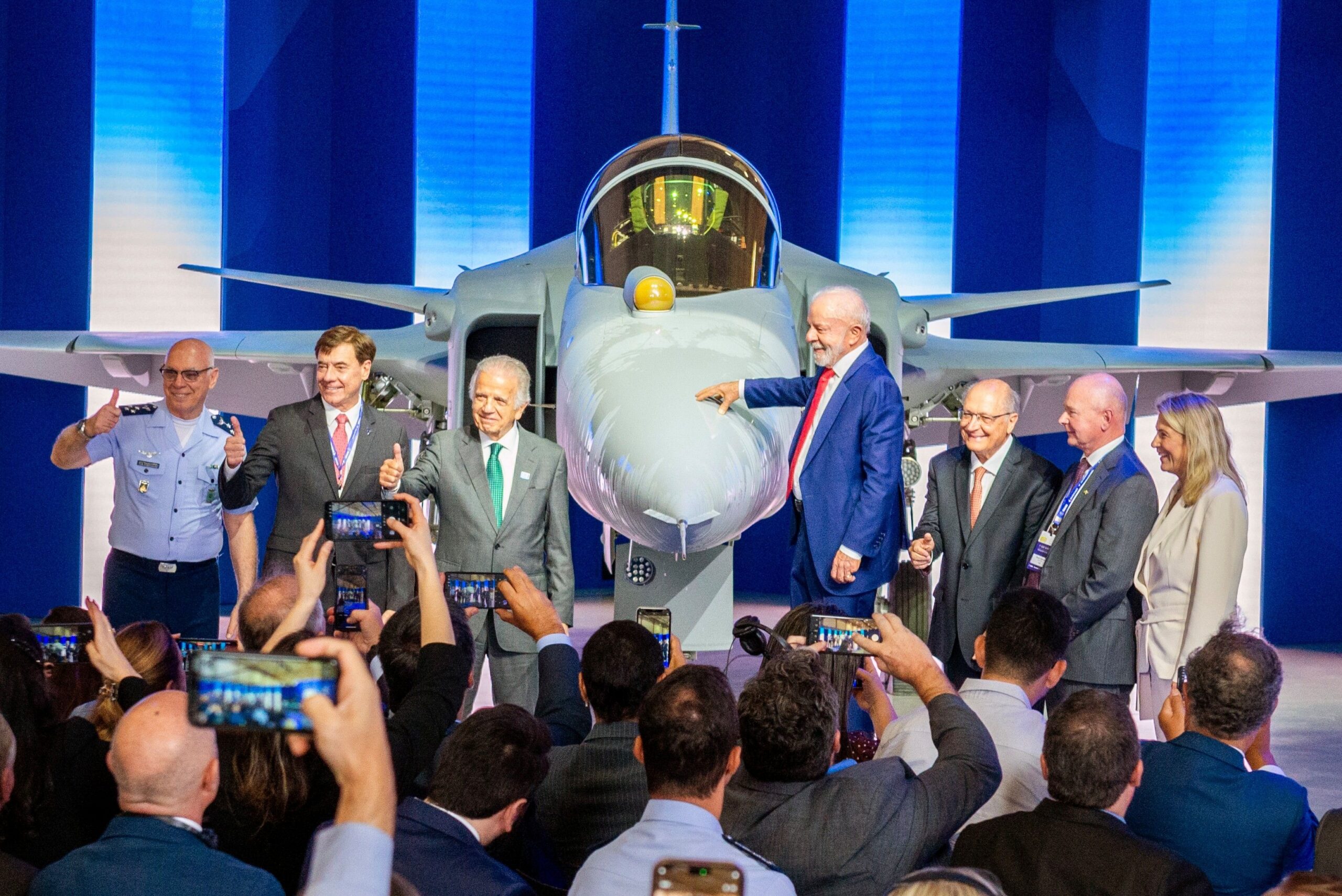
Sweden’s Saab unveiled the first Gripen E fighter produced in Brazil during a ceremony held March 25 at Embraer’s industrial complex in Gavião Peixoto. The rollout marks a significant achievement, placing the country among a select group of nations capable of assembling advanced supersonic aircraft.
Under a 2014 contract, the Brazilian government ordered 36 Gripen fighters: 28 single-seat Gripen E and eight two-seat Gripen F models. While deliveries began in 2020, the fleet has already seen active service; since February, the fighters have been flying Quick Reaction Alert (QRA) missions from Anápolis Air Force Base to safeguard the federal district’s airspace.
The Gavião Peixoto facility produces the jets through a global supply chain that includes aerostructures from Saab’s plant in São Bernardo do Campo. An additional 14 aircraft are slated for this same domestic production model. Before official induction into the Brazilian Air Force (FAB), this first locally made unit will undergo a series of functional and production flight tests.
Through 2025, approximately 250 JAS 39A/B/C/Ds and an estimated 18 JAS 39E/Fs have been produced, including three test aircraft and three Instrumented Production Aircraft (IPA). The Gripen E/F variants represent more than a simple upgrade to the earlier Gripen C/D models. While much of the design and systems remain the same, the Gripen E/F is a larger, heavier aircraft with a more powerful engine in place of the C/D’s Volvo RM12, a derivative of the GE F404 turbofan. The E/F models are powered by the F414-GE-39E engine, a new version of the GE F414. GE and GKN jointly developed the F414-GE-39E, which is rated at 22,000 lbst (the F414-GE-39E is also known as the Volvo RM16).
Other new features include increased fuel capacity, greater payload, the Leonardo Raven ES-05 AESA radar, and two additional weapons pylons. The sensor suite is further enhanced by the passive Skyward-G infrared search and track (IRST) system. The design also shifts the main landing gear from the fuselage to the wing to allow for more fuel and adopts a “split” avionics architecture that separates flight-critical code from mission systems to speed up software updates. Inside the cockpit, traditional dials have been replaced by a single panoramic wide-area display and AI-assisted human-machine collaboration tools.
A Joint Swedish-Brazilian Evolution
The Gripen E/F program has transitioned from a Swedish sovereign project into a joint effort. While Saab maintains its core production in Linköping, the establishment of the Gavião Peixoto final assembly line in May 2023 serves as a strategic link to the South American market. This facility is currently tasked with the assembly of 15 aircraft from the initial Brazilian order, utilizing a supply chain that integrates aerostructures from both Sweden and Saab’s specialized plant in São Bernardo do Campo. The arrangement is meant to transfer technology to Brazil while keeping production consistent across both facilities.
The Brazilian Air Force (FAB) has progressively adjusted its procurement strategy to match evolving budgetary and operational needs. Following a 2022 amendment that increased the original 36-unit order to 40, a Letter of Intent was signed in November 2024 to expand the fleet by approximately 25%. Current projections suggest a long-term requirement of 55 to 65 aircraft. However, due to the lead times associated with the Embraer assembly line, Brazil is currently negotiating the lease or purchase of up to 15 legacy Gripen C/D models from Swedish stocks. This stopgap measure is intended to maintain interceptor capacity until the E-model deliveries reach full scale through 2032.
Program Outlook
Meanwhile, the platform is gaining traction beyond Brazil’s borders. The contract signed with Colombia in November 2025 highlights the Gripen’s growing footprint in the region. The EUR 3.1 billion agreement for 17 aircraft (15 E-models and 2 F-models) includes an industrial offset package that aligns with the established Brazilian infrastructure. Saab and Embraer hope to position the Gavião Peixoto facility for long-term support and potential future production, allowing the two companies to market the aircraft as a regional solution for Latin American nations requiring a modern, cost-effective multirole platform. This was essentially the choice made by Colombia, which presumably could have selected Lockheed Martin F-16C/D Block 70/72 fighters instead.
Beyond the South American theater, the Gripen E/F backlog is anchored by the Swedish Air Force’s 60-unit order and a recent August 2025 commitment from Thailand for four additional aircraft. Saab has also secured a non-binding Letter of Intent signed by Ukraine in October 2025, which outlines a potential requirement for 100 to 150 aircraft. The viability of any future order from Ukraine depends on securing funding for such a large program.

A lifelong aviation enthusiast, Douglas Royce currently co-edits Forecast International's Military Aircraft Forecast and Aviation Gas Turbine Forecast. As such, he plays a key role in many important projects that involve market sizing and forecasting for various segments of the world aerospace industry, as well as demand for related systems.