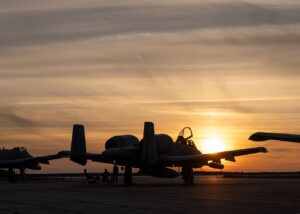
At the beginning of the 2026, it appeared that after years of institutional debate and congressional interventions on its behalf that the service life of the A-10 Thunderbolt II in the inventory of the United States Air Force (USAF) was quickly approaching its definitive conclusion. For years prior, the USAF argued that the escalating lethality of the modern contested airspace environment and the mounting maintenance costs and complications associated with maintaining the readiness of decades old airframes had rendered the A-10 platform an increasingly obsolescent drain on the service’s limited resources.
Although affinity for the model amongst aircrews and persistent congressional concern over the potential emergence of a capability gap in the close air support mission profile had repeatedly seen its service life extended beyond expectations, come the 2023 fiscal year both the healthy momentum of the F-35 program and broader fiscal considerations leant increasing weight to the USAF’s preference to expedite the A-10’s retirement. Congress began to accede to elevated rates of annual airframe divestments. From a then-fleet of over 200 airframes, from FY23 to FY25 the USAF advanced requests for the cumulative divestment of 122 A-10s. The target date for full fleet retirement was likewise placed on an expedited schedule.
Correspondingly, residual fleet modernization plans were progressively downscaled in anticipation of the fleet’s imminent retirement. Active appropriations for the A-10 Modifications and A-10 Squadrons Research Development Test & Evaluation (RDT&E) budgetary line items were discontinued in FY24. The final phases of A-10 retrofit efforts encompassed multiple segments extending from a major re-winging initiative to more modest human interface and communications improvements. As recently as February 2026, the finality of the A-10’s exit from service seemed increasingly assured, with the USAF recording the conclusion of depot level maintenance activities.
Yet, against the long odds that pigs will fly, the venerable ‘Warthog’ will continue to do just that. On April 20th 2026, Secretary of the U.S Air Force Dr. Troy E. Meink announced in a post on the social media platform X that the service will extend the operational service life of the A-10 to 2030. The reversal reflects both the tactical urgency of sustaining close air support capabilities amidst the escalation of hostilities between the United States and Iran and the broader strategic need to preserve a diverse base of assets during a time in which defense technologies and requirements are evolving at a rapid pace and in unpredictable directions.
Although the A-10’s survivability deficits remain salient, during ongoing operations in the Middle East its capabilities have continued to prove relevant both within its traditional operational niche and emergent new roles. Under the auspices of the United States’ Operation Epic Fury, A-10s have been sortied extensively. Through early 2026, A-10s have been deployed to launch attacks on Iranian naval assets, provide protection to SAR teams in the aftermath of the downing of an American F-15 aircraft and provided ground attack capability against Iran-aligned militia entities in Iraq amidst attacks on U.S allies, personnel and embassy facilities.
Alongside these more conventional operations, over the past several years the USAF has sought to experiment with, and hone, the A-10’s potential as a drone killer. Across the globe, the proliferation and deepening sophistication of relatively inexpensive unmanned aerial systems (UAS) threats has paradoxically resulted in the rejuvenation of both systems and tactics previously thought obsolete. Faced with the pressure of responding to the rapid evolution of threat dynamics and need to preserve stores of critical air defense assets, many older platforms are gaining new leases on life. On the aerial battlefields of Ukraine for example, the flight characteristics of primary trainers have made them highly adept at the interdiction of Russian drones. A range of similarly eclectic solutions have yielded considerable successes. Beginning in at least 2025, USAF A-10s have been utilized to intercept and down Iranian Shahed drones using the Advanced Precision Kill Weapon System II (APKWS II) package.
The 2029-2030 target still presents a relatively limited window for hypothetical modernization efforts, and despite the extension of the platform’s position within the USAF’s force structure the gradual winnowing of active inventories can be expected to continue over the years ahead. As such, most new activity will pertain to generalized maintenance and readiness requirements. Still, the A-10’s recent mission profile provides some insight into how the service may opt to invest in the platform over the remaining years of its service life. The integration of armament capabilities related to emerging mission profiles such as UAS interdiction and the mitigation of lingering survivability deficits may be areas of emphasis. The execution of modifications activities that were previously truncated as a result of advancing divestment expectations, namely interface improvements, may also gain a new lease on life as a result of this policy shift.

A lifelong enthusiast of armored vehicles, Thomas serves as an analyst on Forecast International's Military Vehicles Forecast product. In addition, Thomas is responsible for updating the reports and analysis within Forecast International's International Military Markets – Latin America & Caribbean product. He also provides analysis for Forecast International's Airborne Retrofit & Modernization Forecast. Before this assignment, Thomas served as a research assistant for Forecast International's analytical team and has made written contributions to the Civil Aircraft Forecast, Military Aircraft Forecast, and Rotorcraft Forecast services. Thomas derives his knowledge from a multidisciplinary background, with a strong emphasis on the history and politics of Russia and the former satellite republics of the Soviet Union. He has studied in the Russian Federation at Saint Petersburg State University and is proficient in the Russian language at an advanced level.