Boeing and Lockheed Martin’s combined fourth-quarter reports indicate a banner year for fighter aircraft deliveries, but a deeper look reveals important context and program-specific headwinds from 2025. Overall, the only two active U.S. fighter producers delivered 230 aircraft during the year, an increase of over 50 percent from 2024.
Despite the collective appearance of a highly successful year, some programmatic challenges, apparent at the mid-year point, lingered on, affecting optimistic projections previously outlined by company officials.

F-35 Lightning II
With 191 F-35 Joint Strike Fighters (JSF) delivered, Lockheed Martin achieved a program record during 2025. Yet, that number obscures a key point–that nearly half of those aircraft were overdue to customers. According to Bloomberg, 93 of 191 deliveries were contractually obligated for handover during previous years. This qualification places 2025 F-35 delivery performance closer to figures from 2023 and 2024, when the Pentagon’s pause on JSF deliveries was in effect.
The pause, due to problems with necessary software and hardware upgrades, led to new-build F-35s entering storage and delivery backlogs that rolled over into 2025. While the backlog is now clear, the issue with Technology Refresh 3 (TR-3) remains only partially resolved, with full combat capability pushed into 2026.
Nonetheless, clearing the backlog bodes well for Lockheed Martin. With stored units now delivered, Lockheed Martin is likely to stabilize delivery patterns over the next few years, streamlining the gap between F-35 production and handover.

Block 70/72 Fighting Falcon
Despite continued foreign interest in the export-driven Block 70/72 F-16, Lockheed Martin recorded only 16 deliveries in 2025, the same figure as in 2024. Company officials previously targeted building over twice that number in 2025, with another increase planned for 2026.
While a significant number of F-16s are in various stages of assembly, it’s unclear how much stagnant deliveries might be impacting production. However, this has not led to a slowdown in the F-16’s popularity abroad as progress continues for multiple customers. During the final month of 2025, Lockheed Martin completed initial Block 70 fighters for Bulgaria and Slovakia.
Market intelligence from Forecast International shows planned agreements or active orders from six other nations, including a high-profile 66-unit deal from Taiwan. This interest caused a significant order backlog of 114 Block 70/72 fighters as of April 2025, with probable new foreign orders this year.
F/A-18 Super Hornet
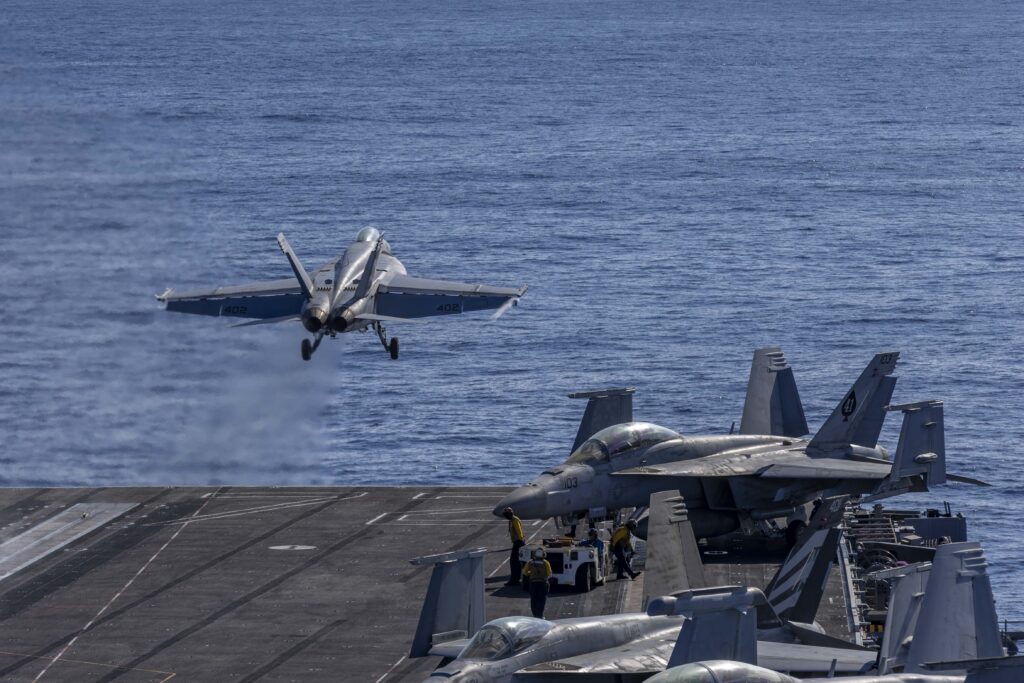
Boeing’s fighter deliveries reveal a similar mixed trend with a slight increase in F/A-18 deliveries, but a decrease for the F-15EX program. The F/A-18 program, perhaps, represents the only true bright spot for the American fighter delivery outlook from 2025. Boeing ended the year up three units from its 2024 delivery total.
Boeing is in the process of sunsetting its new-build F/A-18 line. Service life extension and upgrade work will continue, but the U.S. Navy plans to receive its final new Super Hornet airframes in 2027. Northrop Grumman, a key program subcontractor, recently announced that it built the final new fuselage section and vertical tail components last year, closing down a crucial section of the new production pipeline.
F-15EX Eagle II
Challenges related to scaling up deliveries on the F-15EX program for the U.S. Air Force continued from the mid-year point of 2025. A Boeing St. Louis labor strike that lasted from August to November last year appears to have impacted the delivery rate, with five fewer fighters handed over compared to 2024. Before the 2025 strike, F-15EX deliveries at mid-year already fell behind the respective 2024 timeframe by nearly 50 percent.
Boeing and Lockheed Martin faced a complex 2025 landscape, including inflationary and political pressures, tariff effects, raw material shortages, supply disruptions, and delays related to critical technologically complex subsystems. Rather than a single identifiable factor, it’s the cumulative interplay between these variables that influences performance.
While many of these issues remain in play during 2026, anticipate some dust to settle throughout the year. The F-35 delivery picture is likely to improve upon TR-3 disruptions, and the conclusion of the F/A-18 new-build line should free up resources for new work. Targeted 2025 ramp-up efforts for F-16 Block 70/72 and F-15EX are expected to translate to a successful 2026.
The next horizon of U.S. fighter development and manufacturing is approaching quickly as the industry enters a transformational phase. Of the four actively produced fighter models, the F-35 represents the newest airframe design, with the initial production-representative F-35 delivery in 2011.
For the next generation of fighter jets, American airframers will build clean-sheet aircraft for the first time in well over a decade with the F-47 and the anticipated F/A-XX. Public questions continue regarding the industrial bases’ capacity to supply both sixth-generation fighters simultaneously, only intensifying the pressure for the primes to deliver.

A former naval officer and Seahawk helicopter pilot, Jon currently leads the Military Aerospace and Weapons Systems group at Forecast International. He specializes in current and emerging military fixed and rotary-wing aircraft. With over a decade of experience in military aviation, operations, and education, he forecasts a diverse range of defense and naval systems.
Influenced by his time as a former Presidential Management Fellow and International Trade Specialist at the Department of Commerce, Jon gained insights into government operations and global markets.
Before joining Forecast International, he served as an NROTC instructor and Adjunct Assistant Professor at the University of Texas, teaching undergraduate courses in naval history, navigation, defense organization, and naval operations and warfare.