AI as Organizational Technology
In his 2025 book, AI, Automation, and War, Anthony King implores the reader to understand artificial intelligence (AI) as a phenomenon most closely related to organizational structure. He bluntly states:
It is vital that we recognise and try to understand this military-tech complex, especially since…so much of the literature has fetishized AI as a technology, ignoring its organisational aspects.
One neglects the structure in which a technology is embedded at their peril.
Commentary on the use of AI for targeting in Iran by the U.S. Department of Defense (DoD) has coalesced around exactly this fixation on the raw capabilities of underlying technologies. This is done at the expense of understanding the pairing of technology with organizational structure.
At the same time, much commentary has assumed that Anthropic’s “Claude” Large Language Model (LLM) is the principal driver of U.S. target acquisition in Iran. This appears mistaken, though not without some basis in reality. The more important system, within which Claude is integrated, is Palantir’s Maven Smart System. This system is not best conceived as an “AI targeting system.”
A review of the facts follows, followed by the upshot for defense analysts and DoD contractors: the name of the game for the adoption of critical technologies by the DoD is speed, strategic aims notwithstanding. This is not to suggest that strategy and reliability are no longer of concern – U.S. target acquisition and selection remain sophisticated processes – but that the speed of deployment threatens to overwhelm the ability to validate relevant data.
This should be understood as coupled with a desire by DoD leadership to retain maximum operational access to such technologies, as discussed previously.
“AI Targeting” in Iran
After a slew of reports that Anthropic’s Claude was used before and during the U.S.’s mission to capture Venezuelan President Nicolás Maduro, and immediately after the Anthropic-DoD dispute culminated in the former’s supply chain risk designation, the U.S. and Israel would begin strikes in Iran on February 28th. (A lawsuit is ongoing over the supply chain risk designation, with a federal judge temporarily barring the Pentagon from invoking the designation on March 26th – though, the decision is almost certain to be appealed. For fuller details, see here and here.)
Reports have emerged that Claude is being used to significant effect. The news took two forms.
First, outlets like the Wall Street Journal reported that “AI tools are helping gather intelligence, pick targets, plan bombing missions and assess battle damage at speeds not previously possible.”
Second, talk of “AI targeting” was associated with a targeting error in Iran. A Tomahawk missile – an American-made missile – struck an Iranian girl’s school, Shajareh Tayyebeh, in the Southern Iranian city of Minab in the initial U.S.-Israeli strikes. At least 175 people were killed.
Week in Worcester reported that “deployment of AI” resulted in the strike, focusing on the ramping up of a “Claude-based system” for “many core operational decisions” in the DoD. The use of “older, archived intelligence” about the school’s position was cited as a possible point of failure. The DoD was said to have launched an internal investigation.
(This depiction of the system appears to be inaccurate with respect to the role of Claude; see below.)
A New York Times report provides additional details. The DoD investigation preliminarily determined that the U.S. was responsible for the strike. The school was, in years prior, a part of an Iranian military base that is currently adjacent to the school. The use of older intelligence provided by the Defense Intelligence Agency (DIA) – in which the school’s building was still part of the military base – led to the school being designated a target. The Times’ own analysis of geospatial data indicated that the school was “fenced off” from the base sometime between 2013 and 2016 – the implication being that some of the DoD’s targeting data was roughly one decade out-of-date.
Palantir’s Maven Smart System in Iran
In September 2024, Palantir published an innocuous press release stating that it had received a contract from the DEVCOM Army Research Laboratory worth up to $99.8 million over five years related to the expansion of access to its Maven Smart System, then-part of the National Geospatial-Intelligence Agency’s Maven AI infrastructure. (Maven was also acquired by the NATO Communications and Information Agency (NCIA) in March 2025.)
Maven Smart System (“Maven”) is a descendant of the 2010s-era Project Maven, an attempt to enhance human-machine collaboration in the domain of imagery analysis (e.g., object detection) and targeting assistance. Project Maven caused a stir within Silicon Valley, leading to Google’s withdrawal from a related DoD contract in 2018, clearing the way for Palantir.
Much work has evidently been done by Palantir to expand the offerings of Maven. Its headline use in Iran is for target generation and associated matters, like strike damage assessments (estimated blast radius, etc.). All targets are selected by humans, concurrent with existing DoD policy.
Consider the DoD target generation and selection process beyond Maven, for a moment (usefully broken down by The Economist’s Shashank Joshi here):
- Options Production: A commander – say, at Central Command (CENTCOM) which oversees U.S. Middle East operations – produces options for targeting in specific scenarios.
- Database Construction: These options depend on an intelligence directorate (“J2”) that uses satellite imagery, signals intelligence, and other sources to build a database of thousands of possible targets. This database, critically, includes “no strike” lists comprised of buildings like schools.
- Munition-Target Matching: A “weaponeer” then matches targets with appropriate munitions (which weapon is most effective for which target).
- Legal Counsel: A lawyer informs the commander of the consequences of potential strikes – but the decision belongs to the commander.
- Conversion Into War Plan: The database is then converted by the Strategy and Plans Directorate (“J5”) into a war plan.
- Air Tasking Orders: The war plan is passed off to Operations (“J3”) which breaks the plan down into air tasking orders for (up to) two days out from the possible strikes.
As Joshi notes, software is used historically in this process to estimate the probability of destruction of targets, likely civilian harm, blast effects, simulations, etc. Thus, historically, human personnel engage in extensive work to generate and validate targets, using various forms of software to these ends.
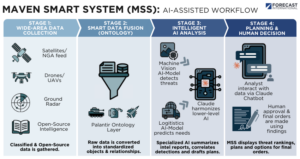
Maven might be seen as a compression of at least some of these stages of target acquisition.
Maven cross-references a mix of open- and closed-source data to produce targets both in advance of conflict and in real-time. The latter source is likely data that would traditionally constitute the constructed target database (classified data). The former includes data that is likely more pertinent during real-time operations (rather than planning stages, though not exclusively). This could include social media feeds where information relevant to, say, the movement of a particular enemy munition (i.e., someone posting information to this effect) may be used to locate the location of enemy forces (one piece of data among others to be cross-referenced).
Maven therefore performs three core functions:
- Generation of targets
- Matching of munitions with targets
- Assessment of the possible strike’s damage
Bearing in mind that the structure and constitution of Maven is somewhat speculative, to carry out these functions, Maven should be understood as a complex system that embeds various sub-components (modules for various functions).
Some sub-components are modules for command-and-control, target intelligence, battle damage assessment, and so forth. Others are bespoke AI models, such as a model that is designed to perform object detection over, say, geospatial intelligence (which Claude does not perform in Maven).
Importantly, only some of these sub-components rightly fall under the category of “artificial intelligence.” It is a mistake to deem Maven an “AI targeting system,” as some reports have indicated.
Claude Is a Late Arrival to Maven
Anthropic’s “Claude” LLM appears to be a significant add-on to Maven, but not a necessary component, for two reasons.
First, according to Joshi, Claude plays a high-level synchronization role, where the model harmonizes (in some unspecified manner) other modules/AI models in the broader system. We may think of Claude, on this basis, as something of a sophisticated interface or organizing module. In this sense, Maven presumably could function without Claude, though likely increasing the number of steps the human operator must manually perform to carry out the same functions. (Note, also, that Claude does not directly provide targeting recommendations; its functions subserve target generation within the broader Maven system.)
The reported “ramping up” of a “Claude-based system” mentioned above likely refers to this integration, rather than the development of a system that is built around Claude from the get-go.
Second, as historian Kevin Baker observes in a detailed essay, the underlying software related to battle damage assessments and data fusion and so forth all predate the origin of LLMs, Claude included, indicating that Claude was a post-hoc addition to Maven. (Note also that Palantir’s Artificial Intelligence Platform, or AIP, while making certain AI models accessible, likewise pre-dates Claude’s integration with DoD classified networks.)
The Upshot: Speed, Speed, and Speed
The actual use of a complex, interacting technologies embodied in Palantir’s Maven indicates that – while precision of targeting by the DoD remains historically high, with the strike on the Iranian girl’s school a major error – the distinction between a system that provides performance guarantees during mission-critical operations, and a system that is used to such effect that human personnel cannot realistically validate the steps from leading from target generation to selection, is a distinction without much of a difference. (This use suggests Anthropic CEO Dario Amodei’s emphasis on reliability in decisions to use lethal force is not a sufficient framing to understand the DoD’s current disposition.)
The apparent (though, somewhat speculative) failure for CENTCOM to validate the data provided to it by DIA means that the speed of target acquisition – following a trend more prominent in the Israel Defense Forces – overwhelmed the ability to verify targets with the National Geospatial-Intelligence Agency’s data. Indeed, CENTCOM’s Adm. Charles Cooper noted of AI’s use in Iran that AI is used to compress days or hours of work into seconds, at a speed faster than the enemy can react.
This sentiment is not particularly new, as Baker also details extensively, as the aim of generating more targets more quickly at a pace faster than which the U.S.’s adversary can materially or psychologically respond is decades-old, stretching back to (at least) American tactics in the Vietnam War and the Cold War’s nuclear deterrence doctrines. The use of defense technologies like Maven today should be understood as a prioritization of tactics over strategy – “operational excellence,” as Joshi notes, but without a “causal mechanism” that links targets with overarching war aims. (For a more tailored use-specific deployment of AI for target acquisition, see my colleague Douglas Royce’s recent piece on the integration of an AI module in Embraer’s A-29 Super Tucano for drone targeting.)
The upshot for DoD contractors working in related areas of defense technology is that the speed of deployment of technologies that can subserve systems like Maven are being prioritized by the DoD. Some portions of the AI Acceleration Strategy are therefore being executed upon in earnest.
To the point, Maven is reportedly set to become a Program of Record by the Pentagon, according to an internal letter sent by Deputy Secretary of Defense Steve Feinberg dated March 9. Maven will be transferred from the National Geospatial-Intelligence Agency to the Chief Digital Artificial Intelligence Office (CDAO) within 30 days (by April 8th). The designation will allow the DoD to fund and further entrench the system over longer stretches of time.
Assuming these developments pan out over the coming months, the key to understanding the trajectory of “AI” in U.S. targeting will be to situate relevant technologies within the organizational structure(s) responsible for target generation and selection in the DoD. Capabilities of headline-grabbing AI models are and will continue to be relevant, but any assessment of these capabilities in isolation will be incomplete. The organizing principle behind the DoD’s use of Maven is not a stance on the capabilities of AI models like Claude per se, but instead the dramatic compression of the steps between targeting options and strikes with the use of interlocking, intermediary technologies – of which AI models are but one, albeit important, grouping.

Vincent Carchidi has a background in defense and policy analysis, specializing in critical and emerging technologies. He is currently a Defense Industry Analyst with Forecast International. He also maintains a background in cognitive science, with an interest in artificial intelligence.