The past few weeks have yielded a burst of updates on the Collaborative Combat Aircraft (CCA) program, one of the U.S. Air Force’s fastest-moving and high-profile defense initiatives. Since Anduril and General Atomics were downselected in April 2024 to build “production representative CCA vehicles,” or loyal wingman drone prototypes, the pace of updates and milestones has only quickened.
Following the downselect announcement, the Air Force assigned designations for each entry in March 2025. Within 18 months of the prototype award, the General Atomics YFQ-42A and Anduril YFQ-44A made their first flights in August 2025 and October 2025, respectively. The latest updates introduce nomenclature, advance flight testing, and identify software package partnerships as propulsion options progress.
Alias Unveil
CCA models have now received monikers in addition to their formal alphanumeric designators. General Atomics Aeronautical Systems, Inc. (GA-ASI) announced that the YFQ-42A will be called “Dark Merlin” as a nod to the falcon, and Northrop Grumman named the YFQ-48A, “Talon Blue.” For now, Anduril’s YFQ-44A remains Fury, carried over from Blue Force Technologies, a company that Anduril acquired in 2023.
Although Northrop Grumman was among the five initial companies under consideration for Increment 1, only Anduril and GA-ASI received follow-on government funding for prototype builds and flight testing. In December 2025, the U.S. Air Force officially assigned Northrop Grumman’s Project Talon the YF-48A designation, a somewhat surprising move considering the 2024 downselect.
Yet, the designation announcement underscores a crucial detail of the competition. Northrop Grumman continued CCA efforts on its own dime through independent research and development. Meaning, despite Anduril and GA-ASI’s selection, Northrop Grumman remains in the mix for an Increment 1 FY26 production contract along with “more than 20 companies” pursuing future CCA awards.
Munition On Board
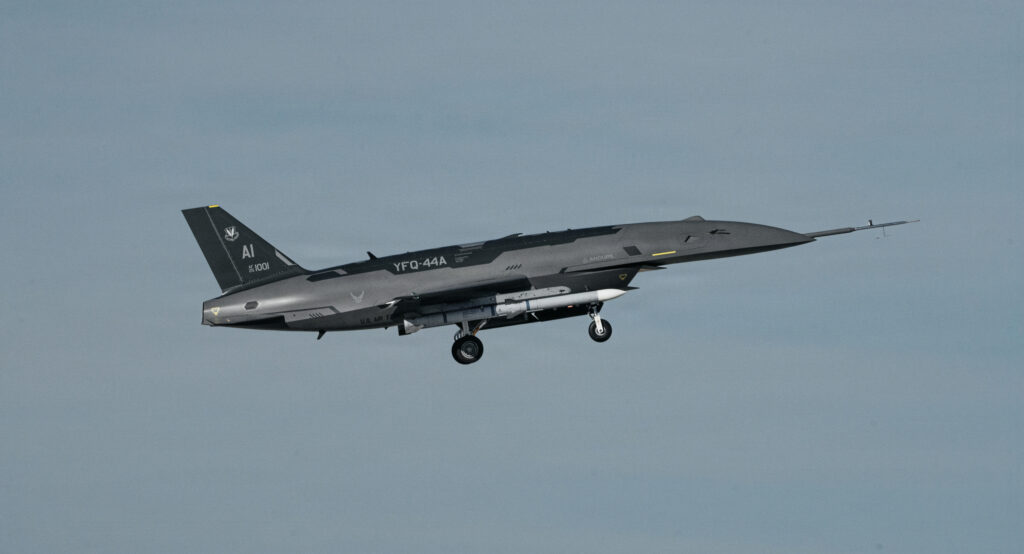
In addition to nomenclature, Air Force and company officials disclosed last week that flight testing of Anduril’s YFQ-44A CCA, equipped with inert AIM-120 Captive Air Training Missiles (CATM), has commenced. According to Defense One, GA-ASI will integrate captive carry flights on YFQ-42A in the “very near future.”
Anduril notching a CATM-equipped first flight over GA-ASI might illustrate an important design distinction. Fury features external hardpoints for air-to-air weapons carriage compared to Dark Merlin’s internal bay. As Forecast International previously noted, the difference suggests an intentional design choice by each company. External pylons generally translate to simplicity, cost-effectiveness, and faster loading, while internal carriage preserves stealth and flight performance.
The Air Force will presumably use CATM test sorties to evaluate and compare performance characteristics in payload capability and G-loading, while also determining airframe structural limitations.
Northrop Grumman will likely follow with their own weapons testing campaign. It bears noting that Boeing, in coordination with the Royal Australian Air Force, completed an autonomous AIM-120 live-fire from an MQ-28 Ghost Bat CCA in December.
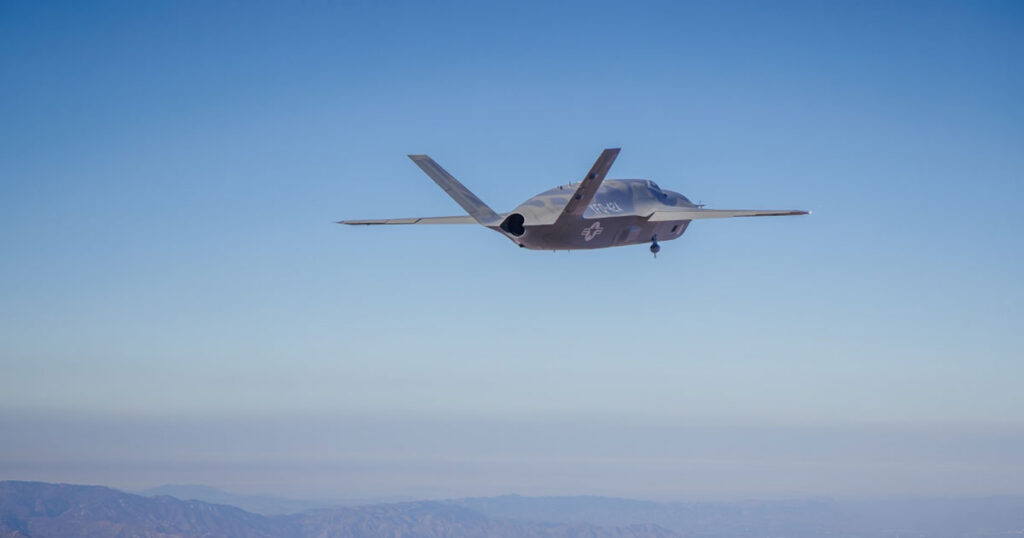 General Atomics Aeronautical Systems, Inc.’s YFQ-42A CCA. Image–GA-ASI.
Software Shapes Up
Perhaps the pinnacle element of the CCA program, Autonomy Government Reference Architecture (A-GRA), has enabled recent key milestones. Under the government’s broader Modular Open Systems Approach (MOSA), the A-GRA framework effectively allows the Air Force to decouple the platform from the software. This method prevents vendor lock and promotes competitive fielding for crucial subsystems.
In an actual demonstration, Collins Aerospace’s Sidekick AI mission autonomy software has flown with GA-ASI’s YFQ-42A. Likewise, Shield AI’s Hivemind software pilot notched a successful flight of Anduril’s YFQ-44A. And in an even more dramatic example of A-GRA flexibility, during testing, YFQ-44A received handoff control between two different software pilots, switching in flight between Hivemind and Anduril’s Lattice autonomy package.
As Increment 1 awards near, the open acquisition structure allows the Air Force to select different airframe and mission autonomy providers with a mix-and-match capability. The approach promotes faster upgrades, interoperability, and competition among a diverse range of vendors at each phase.
Engines Get a Boost
The CCA program’s MOSA spirit has also increased activity in the small-thrust-class engine market. In conjunction with updates on flight tests and nickname drops, news broke that the Air Force awarded conceptual design contracts to four companies.
Under a joint initiative, Kratos and GE Aerospace announced a $12.4 million award on February 23 to advance work on the GEK1500, a 1,500-lb thrust system built on the architecture of the GEK800 cruise missile engine. The same day, Honeywell announced a contract for prototyping the company’s SkyShot 1600, a propulsion system that is configurable as a turbojet or turbofan affording 800 to 2,800 pounds of thrust.
Beehive Industries and Pratt & Whitney also received related contracts under an Air Force Life Cycle Management Center (AFLCMC) effort. Nearly a year ago, Beehive Industries announced an award under the same authority for a study on CCA propulsion applications in the 1,000-lb thrust class. The Denver-based company builds propulsion systems from metal powder through additive manufacturing, reducing supply chain dependency and build time. Honeywell and Pratt & Whitney also reportedly employ additive manufacturing as part of their processes.
While the engine awards support CCA Increment 2, the AFLCMC Propulsion Directorate also advances a larger agenda, one that extends future propulsion options to other uncrewed platforms, targets, and missiles. The potential for a common small-thrust engine across several systems could translate to future unit demand in the thousands; the Air Force alone plans to field at least 1,000 CCAs. Small turbofans and turbojets will also power future Navy and Marine Corps CCAs and new long-range cruise missiles.
Industry Landscape
As the Pentagon moves to transform the defense acquisition process, some of the largest American defense contractors have found themselves in the Administration’s crosshairs for “years of misplaced priorities,” underperformance, and stock buybacks. Amid this context, the CCA program could serve as a microcosm for a broader industry shakeup. With Anduril, Collins Aerospace, GA-ASI, and Shield AI, among others, in the CCA pool, the company ecosystem highlights shifting dynamics in the U.S. defense industrial base.
Anduril and Shield AI, both software-centric VC successes, were formed in 2017 and 2015, respectively. They face the subsidiaries of RTX and General Dynamics, giants that are a part of the top four “old guard” of defense contractors. Moreover, in the propulsion category, a similar scene is unfolding with Beehive Industries, a six-year-old company contracted alongside another RTX subsidiary, Pratt & Whitney, an engine maker with a 100-year legacy.
With MOSA catalyzing, the CCA program could serve as a harbinger for a renewed marketplace standard. Like the leading-edge technologies that are driving CCAs forward, young entrants are injecting vitality and rivalry into the defense arena, likely a welcome effect for the Pentagon customer.

A former naval officer and Seahawk helicopter pilot, Jon currently leads the Military Aerospace and Weapons Systems group at Forecast International. He specializes in current and emerging military fixed and rotary-wing aircraft. With over a decade of experience in military aviation, operations, and education, he forecasts a diverse range of defense and naval systems.
Influenced by his time as a former Presidential Management Fellow and International Trade Specialist at the Department of Commerce, Jon gained insights into government operations and global markets.
Before joining Forecast International, he served as an NROTC instructor and Adjunct Assistant Professor at the University of Texas, teaching undergraduate courses in naval history, navigation, defense organization, and naval operations and warfare.