U.S. Central Command (CENTCOM) has officially activated Task Force Scorpion Strike (TFSS), the military’s first dedicated one-way kamikaze drone squadron in the Middle East. This milestone was punctuated on December 16th, when the U.S. Navy successfully launched a Low-Cost Uncrewed Combat Attack System (LUCAS) from the flight deck of the USS Santa Barbara in the Arabian Gulf. Built to address a glaring strategic gap, LUCAS is a loitering munition reverse-engineered from Iran’s Shahed-136. Its deployment marks a pivot away from U.S. military reliance on multi-million dollar platforms like the MQ-9 Reaper, which are increasingly difficult to justify in high-attrition, swarm-based conflicts.
Timeline
The development of LUCAS has moved at a breakneck pace throughout 2025. Following successful reverse-engineering and flight tests earlier in the year, the system was integrated into the Rapid Employment Joint Task Force in September. By November, the formation of TFSS solidified the Pentagon’s commitment to fielding mass-produced, expendable drone technology. This rapid timeline reflects an urgent need to counter adversaries who use low-cost production to impose asymmetric pressure on U.S. forces.
LUCAS vs. Shahed: Specifications and Integration
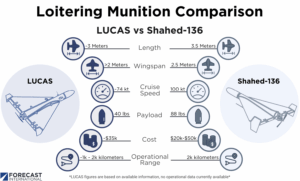
While the two platforms share a number of physical similarities, the Pentagon intends for the true distinction of the American-made system lies beneath the surface. While the Shahed-136 maintains a slight edge in raw payload capacity and base unit price, the Pentagon has designed LUCAS to prioritize modularity and sophisticated networking. Unlike its Iranian predecessor, LUCAS is being built to support satellite datalinks for autonomous target hunting and mesh-network swarming. This could allow the U.S. to maintain an operational edge through advanced autonomy and potential future AI integration, seeking to find a sweet spot where sophisticated software enhances the still affordable platform.
Scaling Production for Drone Dominance
The success of LUCAS ultimately depends on the Pentagon’s ability to scale production to unprecedented levels. To ensure the U.S. can compete, the LUCAS program involves up to 20 vendors and a design that allows multiple manufacturers to produce both airframes and warheads simultaneously. This is a foundational piece of the Pentagon’s broader Drone Dominance program, which aims to acquire 300,000 low-cost drones beginning in early 2026. By injecting $1 billion into the industry across four phases, the military hopes to eventually drive the per-unit cost down to as little as $5,000, creating a resilient supply chain that can continue to provide mass quantities of drones through regular budgeting.
Challenges Moving Forward
Despite this technological and industrial momentum, significant questions remain regarding the long-term integration of these systems into U.S. warfighting. Fielding 300,000 drones is an equipment solution, but it necessitates a shift in doctrine. Units must be trained to manage mass drone deployments, and new sustainment infrastructure must be built to handle high volumes of expendable tech. Whether LUCAS allows the U.S. to “win” the drone war depends on more than just the assembly line; it depends on how effectively the military can evolve its tactics to accommodate the reality of cheap, ubiquitous, and autonomous flight on the battlefield.
Additional Sources:
https://www.axios.com/2025/12/03/us-iran-military-drones-lucas-shahed
https://www.cnn.com/2025/12/03/politics/drones-us-iran-middle-east
https://www.twz.com/news-features/what-does-a-shahed-136-really-cost

Anna Miskelley has cultivated a deep interest in global security, emerging technologies, and military systems throughout her academic and professional career. She is currently a Defense Industry Analyst with Forecast International.
Before joining Forecast International, Anna was a research fellow at the Center for Security, Innovation, and New Technology, where she researched the impact of artificial intelligence on U.S. nuclear command and control systems. Proficient in Mandarin Chinese, Anna has published research on topics including strategic stability, internal Chinese politics, and artificial intelligence.