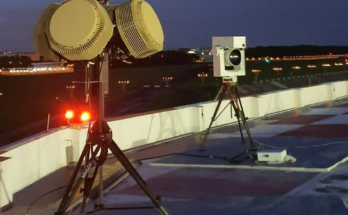
At least this time we are getting a somewhat clearer picture of what has transpired. An unannounced use of counter-drone technology near El Paso, similar to an incident earlier this month, has caused no small amount of concern, if not acrimony, between U.S. government agencies.
As it’s being widely reported this morning, and as involved agencies are officially admitting, the U.S. military accidently shot down a Customs and Border Protection drone somewhere in the region of Fort Hancock, Texas. Once again, were it not for the F.A.A. temporarily closing airspace in the vicinity, we probably would not be hearing about the event at all. And once again, we are seeing that the use of military counter-drone systems near airports is going through a serious learning period.
Also being revealed, is that the action involved a directed energy weapon. And apparently it worked. While the exact weapon used has not been announced, we do know that the U.S. military has numerous Counter-Unmanned Aerial Systems (C-UAS) options at its disposal, including several DE types, both U.S. and internationally developed. Indeed, testing of all variety of kinetic and non-kinetic C-UAS has been an ongoing activity of multiple, U.S. security agencies for years now, and in the process, the country has grown a substantial arsenal of systems.
Some of the possible systems that could have been used in Texas this morning have been the subject of numerous news articles in recent years, regarding development, testing, production contracts, and various deployments.
A Raytheon-developed, DE weapon system has been incorporated into the U.S. Army’s Directed Energy Maneuver-Short Range Air Defense, or DE M-SHORAD. Used to acquire, track, target and defeat air-launched threats, including drones, the 50kW system has been mounted on Stryker vehicles. These have reportedly been in use by the U.S. Army since at least early 2024.
A 20kW-class LOCUST Laser Weapon System (LWS), developed by BlueHalo features a gimbaled electro-optical tracking system, powerful telescope, laser rangefinder, acquisition tracking system (ATS), and targeting laser. The system is available in fixed and mobile platform configurations.
In September 2025, AeroVironment announced delivery of the two mobile C-UAS prototype LWS to the U.S. Army as part of the first increment of the Army Multi-Purpose High Energy Laser (AMP-HEL) prototyping effort. The prototype featured LOCUST LWS integrated on the General Motors Defense Infantry Squad Vehicle (ISV) platform.
This latest border C-UAS event is still a developing story, and more information, perhaps even what weapon was actually used, may emerge in the coming days and weeks.

Andrew Dardine is lead analyst for Forecast International's Defense Electronic Systems group. He is the primary author of Forecast International's Electronic Warfare Forecast and co-author of Electro-Optical Systems Forecast and C4I Forecast. Andrew is also a regular contributor to FI's Defense & Security Monitor blog, offering insights into developing technologies such as directed-energy and next-generation jamming systems. His analysis of such vital market areas as EO/IR systems and electronic countermeasures technology has been cited in Defense News, Aerospace Daily, and Bloomberg Businessweek, among other news media. He has also written about the electronic defense market for Aviation Week and the Journal of Electronic Defense.