 Source: U.S. Air Force/Courtesy photo
The FY26 defense appropriations bill signed into law earlier this month included a significant injection of new resources from Congress to support a mix of core capabilities and advanced technology development efforts. While lawmakers were largely supportive of the Pentagon’s spending plans, they pushed back on several proposals and sought additional clarification on how billions of dollars in previously appropriated reconciliation funding will be spent.
Topline Spending Exceeds Pentagon’s Request
Congress provided $858.9 billion in base discretionary spending for the Pentagon in FY26, which is around $10.6 billion more than requested. Those figures include the regular defense appropriations bill, as well as military construction funded through a separate piece of legislation. Lawmakers frequently add funding to develop and procure military hardware that wasn’t requested by the Pentagon, and the FY26 budget is no different. Congress added a total of $18.3 billion for acquisition programs above the request, split between $14.4 billion for procurement and $3.9 billion for research, development, test, and evaluation (RDT&E).
The spending bills only address the Pentagon’s base budget, but the military also has access to around $151 billion in reconciliation funds in FY26 as well. Topline details of the final appropriations bill are available through Forecast International’s U.S. Defense Budget Spotlight, a free tool that tracks acquisition spending through the entire defense budget process.
Shipbuilding, Aircraft, and Missiles Drive Procurement Gains
The defense appropriations bill provided each service with a windfall in their procurement accounts, but the additional funding wasn’t distributed evenly. The Navy and Air Force were the big winners, gaining an additional $7 billion and $3.7 billion for procurement, respectively. The Army also gained $1.7 billion, while Defense-Wide programs were increased by $2 billion, largely reflecting additional resources for the Missile Defense Agency.
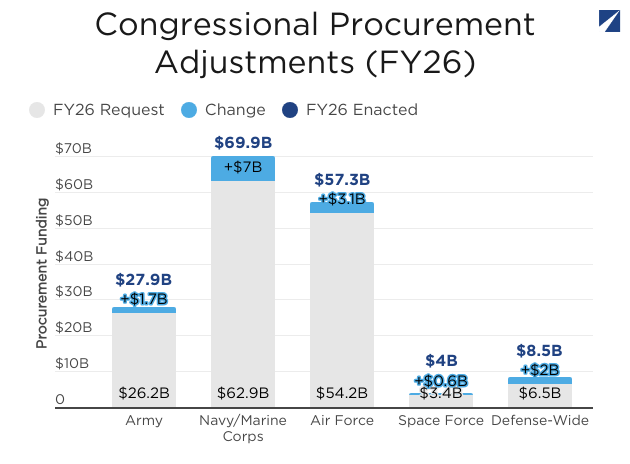
Three key areas stand out when looking where Congress added procurement dollars in the FY26 spending bill: shipbuilding, aircraft, and missiles. The Navy’s shipbuilding account received, by far, the largest increase in the entire budget. That comes as no surprise, as the massive costs associated with construction means that even adding a single ship can result in billions of dollars flowing into that account. There is also an ongoing trend of lawmakers boosting the shipbuilding account in recent years to increase construction rates and help support the industrial base. A total of $6 billion was added for ships in the final spending bill, including a $1.8 billion investment in DDG 51 destroyer production, a funding shift for the new FF(X) frigate – which replaces the canceled Constellation class frigate – as well as additional Medium Landing Ships and Ship-to-Shore Connectors. Some of the new funding reflects a realignment driven by the Navy’s reliance on reconciliation funding in its original request. In several cases, the service reduced resources in the base budget with the expectation that reconciliation dollars would fill the gap. Lawmakers ultimately made several adjustments targeting what they saw as shortfalls in the base budget because of that approach. For example, the bill added $1.9 billion for the Virginia-class submarine to address a “reconciliation funding incongruence.”
The Air Force led the charge in the aircraft domain, receiving an additional $2.2 billion from lawmakers for seven C-130Js (including one LC-130), two EA-37B Compass Call aircraft, one F-15EX, one C-40A transport, $100 million for additional HH-60W helicopters, and $63 million for the MH-139 program. Congress also added 12 Apaches for the Army, as well as $240 million for an estimated eight MQ-1C Gray Eagle drones, despite the service’s plans to move away from the platform as part of its transformation initiative. The Navy received funding for an extra four KC-130J tankers and two CH-53K helicopters, but the budget cut an E-2D early warning aircraft from the request.
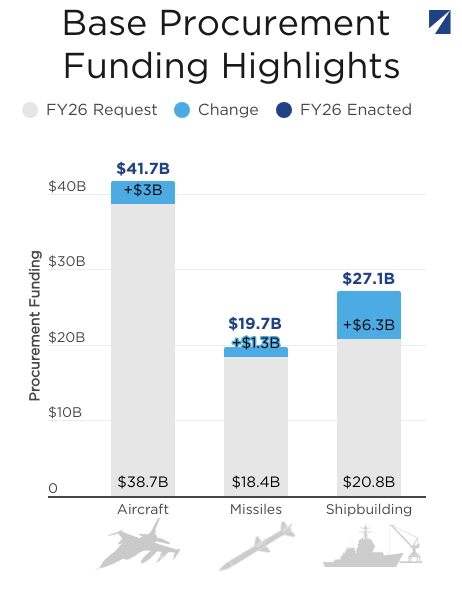
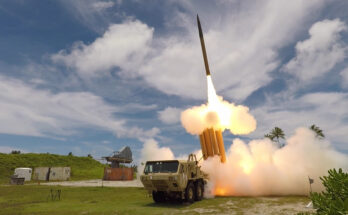

Lastly, the legislation added around $1.3 billion for missile procurement. Notably, that figure falls well short of a $5 billion increase originally proposed by the Senate, but the military still plans to use reconciliation funding in FY26 to scale up missile production rates across the board. Although the final bill didn’t match the Senate’s recommended levels, the spending bill grants multiyear authority for eight out of 13 munitions requested, but not every program received additional funding. Those eight programs approved for multiyear procurement and their congressional funding adjustments are as follows:
- Lockheed Martin PAC-3 (+$500 million)
- Lockheed Martin Long Range Anti-Ship Missile (LRASM) (+$413.5 million)
- Lockheed Martin Joint Air-to-Surface Standoff Missile Extended-Range (JASSM-ER)
- Lockheed Martin Terminal High Altitude Area Defense (THAAD) (+$300 million)
- Raytheon SM-6 (+$191.5 million)
- Raytheon AMRAAM (+$17 million)
- Raytheon Tomahawk
- Raytheon SM-3 Block IB (+$475 million)
Next-Generation Tech Dominates RDT&E
Research and development programs accounted for 21 percent of the additional acquisition funding added to the bill. While congressional adjustments spanned all areas of the research budget, much of the growth was driven by flagship aircraft programs like the Navy’s F/A-XX fighter and the Air Force’s E-7 aircraft. Further, the spending bill added $3.7 billion for early-stage research efforts across the services to support a wide range of technologies, including materials research, artificial intelligence, hypersonic propulsion, counter-unmanned aerial system (C-UAS) capabilities, and sensors, among others. The legislation also added $381 million for Defense Innovation Unit initiatives that support rapidly fielding new capabilities.
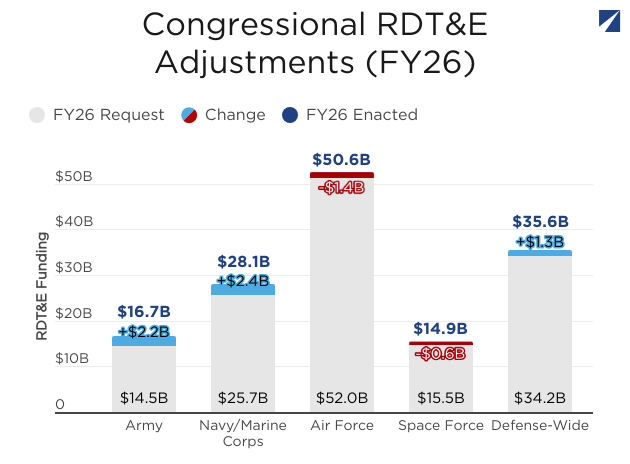
Note: Enacted Air Force funding includes a $4.2 billion classified reduction from an account that also supports agencies outside of the Air Force
Lawmakers imposed funding reductions for both the Air Force and Space Force of $1.4 billion and $642.4 million, respectively. However, the Air Force cut is largely due to a $4.2 billion reduction to a classified funding line that includes pass-through funding for agencies outside of the Air Force. Excluding this classified line, the Air Force gained $2.8 billion for research and development, reflecting the largest increase among the services. However, the lack of transparency surrounding the classified adjustment makes it hard to determine the full impact on the Air Force’s topline research budget.
The bill added $900.3 million for continued work on E-7 Wedgetail prototypes, which the service tried to cancel in its FY26 request. Another $409.2 million was added for B-21 development, partially offsetting a cut for the program in the procurement account. Legislative tables also show a $500 million increase for the F-47 fighter, but this appears to be another reconciliation adjustment, rather than a net increase. Despite an overall cut for Space Force RDT&E, Congress added resources for low-Earth-orbit defense, the Space Development Agency’s Transport Layer, and radar technologies, all of which could feed into the administration’s Golden Dome missile defense system. However, Golden Dome was primarily funded through the reconciliation bill, meaning the FY26 spending bill only had a limited impact on the program as a whole. With that in mind, lawmakers included a provision in the bill calling for increased transparency for Golden Dome, which will hopefully result in more informative FY27 justification documents.
The Navy gained $2.4 billion, and the Army was close behind with a $2.2 billion increase. The addition of $897.3 million for the F/A-XX next generation fighter was the single largest change in the Navy’s RDT&E budget and reversed the Pentagon’s decision to cut resources for the program in favor of the Air Force’s F-47. Other areas of gain in the Navy’s research budget include network technologies, missiles, and classified programs. However, command and control and undersea warfare efforts experienced modest reductions.
The Army’s original RDT&E request of $15.4 billion was around half that of the Navy ($29.2 billion) and less than one-third of the combined Air Force and Space Force request ($51.6 billion, excluding the classified pass-through funding). Congress’ $2.2 billion increase for the Army therefore had an outsized impact compared to the other services. Lawmakers took issue with the Army’s plan to scale back the Improved Turbine Engine Program (ITEP) and added $175 million to continue development. Other notable adjustments include an additional $110 million for the Soldier Borne Mission Command program, $100 million for UH-60 modernization, and $67.1 million for weapons and munitions product improvement programs. Congress also increased investment in a wide range of development efforts for AI and cyber, electronic warfare, autonomous systems and drones, C-UAS, kinetic and non-kinetic air and missile defense, and battery technologies.
More Information
Forecast International’s U.S. Defense Budget Spotlight will continue monitoring future budget cycles in real-time, offering a high-level overview of annual budget requests and congressional markups. For individual program information and deep-dive research capabilities, our U.S. Defense Budget Forecast database tracks every line item in the Pentagon’s acquisition portfolio and includes downloadable spreadsheets, data visualizations, and one-click access to program-level justification documents.

Shaun's deep-rooted interest in military equipment continues in his role as a senior defense analyst with a focus on the United States. He played an integral role in the development of Forecast International's U.S. Defense Budget Forecast, an interactive online product that tracks Pentagon acquisition programs throughout the congressional budget process. As editor of International Military Markets – North America, Shaun has cultivated a deep understanding of the vast defense markets in the United States and Canada. He is a regular contributor to Forecast International's Defense & Security Monitor blog and has co-authored white papers on global defense spending and various military programs.
image sources
- USAF E-7A: U.S. Air Force/Courtesy photo