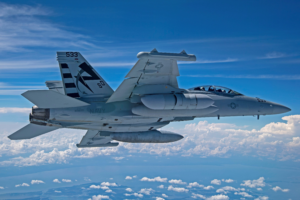
Since the start of military operations against Iran, U.S. Navy EA-18G Growler electronic attack aircraft have been participating in multiple missions, launching from the USS Abraham Lincoln and USS Gerald R. Ford carriers. The aircraft’s electronic and kinetic systems have been vital in their roles of confusing, suppressing, and destroying communication and radar systems and surface-to-air missile batteries. The platform has even been given ghost-based nicknames for its perceived, phantom-like capabilities.
The aircraft were used in the January operation to invade Venezuela’s airspace, destroy Russian and Chinese-derived air defenses and other infrastructure, and abduct President Nicolas Maduro. Growlers were seen as crucial in laying the groundwork, allowing air operations deep within the country to be conducted with virtually no resistance. As usual in these types of operations, Venezuelan air defense operators did not know of the impending attack until after their radar screens went dark.
But the Growler’s more extensive use in the Middle East is a major milestone for the multi-billion dollar program, displaying a sharp rise in the use of air-launched electronic attack on the battlefield. Just as importantly, these missions are also a good harbinger for future development and systems upgrades, which has been the nature of the beast since its inception.
In development since 1995, the electronic warfare variant of the F/A-18F was designed to replace the late-Vietnam War era EA-6B Prowler. After Boeing received the EA-18G System Development and Demonstration contract in December 2003, the program progressed on schedule, and the first Growler was delivered to the Navy in September 2006.
The Navy’s original production target for the Growler was 90 aircraft. After some temporary cuts and budget fenagling, the Navy’s FY11 budget raised the requirement to 114 aircraft. The total was later raised to 135 aircraft in FY14 and to 160 aircraft in FY17, with the final U.S. Navy Growler delivered in 2018.
The Jamming Power Under the Wings
Key to the aircraft’s effectiveness is the Growler’s pod-based, ALQ-249 Next-Generation Jammer (NGJ), and its three major increments, which have been in development since 2010. This is the crucial system at the heart of the EA-18G’s electronic attack capabilities.
The U.S. Navy has structured NGJ as an evolutionary acquisition program providing capability in three frequency increments: Increment 1 (Mid-Band), Increment 2 (Low-Band), and Increment 3 (High-Band). The last of these, High-Band, is still awaiting funding and development timelines.
In March 2023, Mid-Band prime contractor Raytheon received a $650.4 million contract for the production of Lot III NGJ-MB to include 15 NGJ-MB LRIP shipsets (two pods per shipset). This broke out further into 11 for the Navy and four for the Royal Australian Air Force (RAAF), which also operates the aircraft.
Work on development of the Low-Band version is moving ahead. In December 2020, L3Harris won a $495.5 million contract award for the production and delivery of 10 NGJ-LB pod simulators, eight operational prototype pods, four jettison mass model pods, two captive mass models, and other support systems. The company received a further $587.3 million for Low-Band development in August 2024.
In May 2025, Raytheon won a three-year, $580 million Navy contract to continue production of NGJ-MB, covering additional pod shipsets, spare parts, and support equipment for both the U.S. Navy and the RAAF.
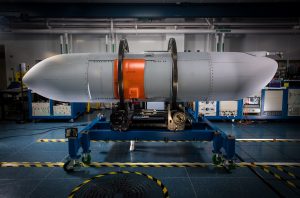
Shoring up its work on the Low-Band effort, in June 2025, L3Harris selected Honeywell to support development of the jamming pods. News of the selection did not include specific details on the nature of the work Honeywell would provide.
There’s Always More on the Horizon
The Growler’s capabilities will probably always be a work in progress. In March, the Navy awarded Boeing a four-year, $489.3 million order for the ALQ-264(V) Beowulf system, which upgrades the jamming hardware. The contract includes four ALQ-264(V) Beowulf A-Kits, four Gunbay Pallet A-Kits, 12 Beowulf B-Kits, 15 sensor control unit B-Kits, and nine power control unit B-Kits, as well as various support equipment.
Not surprisingly, the addition of AI and machine learning algorithms are said to be an increasingly significant element of the aircraft’s EA systems, to more rapidly analyze hostile signals and instantly transmit tailored noise to degrade enemy air defenses. Also using Active Electronically Scanned Arrays (AESA), and powered by Gallium Nitride transmitters, AI-enabled hardware can simultaneously shoot precise, high-powered beams of electronic noise at multiple enemy targets.
The Navy has already invested over $5 billion on development of the NGJ since the start of the program. In the Pentagon’s, just-released $1.5 trillion defense budget request, the program will likely see continued support, with $428.6 million allocated for FY26 alone.
In addition to the 160 Growlers operated by the U.S. Navy, Australia maintains a fleet of 12 aircraft which it purchased in July 2014, through the U.S. Foreign Military Sales program.
Along similar lines to efforts in the U.S., the RAAF Growler is the subject of a significant upgrade program for its electronics, with an added local investment element. In February 2023, through Project AIR 5349 Phase 6 – Advanced Growler, Australian radar company CEA Technologies was awarded a $277 million contract to perform improvements to a number of the aircraft sensor’s fixed and portable emitters.

Andrew Dardine is lead analyst for Forecast International's Defense Electronic Systems group. He is the primary author of Forecast International's Electronic Warfare Forecast and co-author of Electro-Optical Systems Forecast and C4I Forecast. Andrew is also a regular contributor to FI's Defense & Security Monitor blog, offering insights into developing technologies such as directed-energy and next-generation jamming systems. His analysis of such vital market areas as EO/IR systems and electronic countermeasures technology has been cited in Defense News, Aerospace Daily, and Bloomberg Businessweek, among other news media. He has also written about the electronic defense market for Aviation Week and the Journal of Electronic Defense.