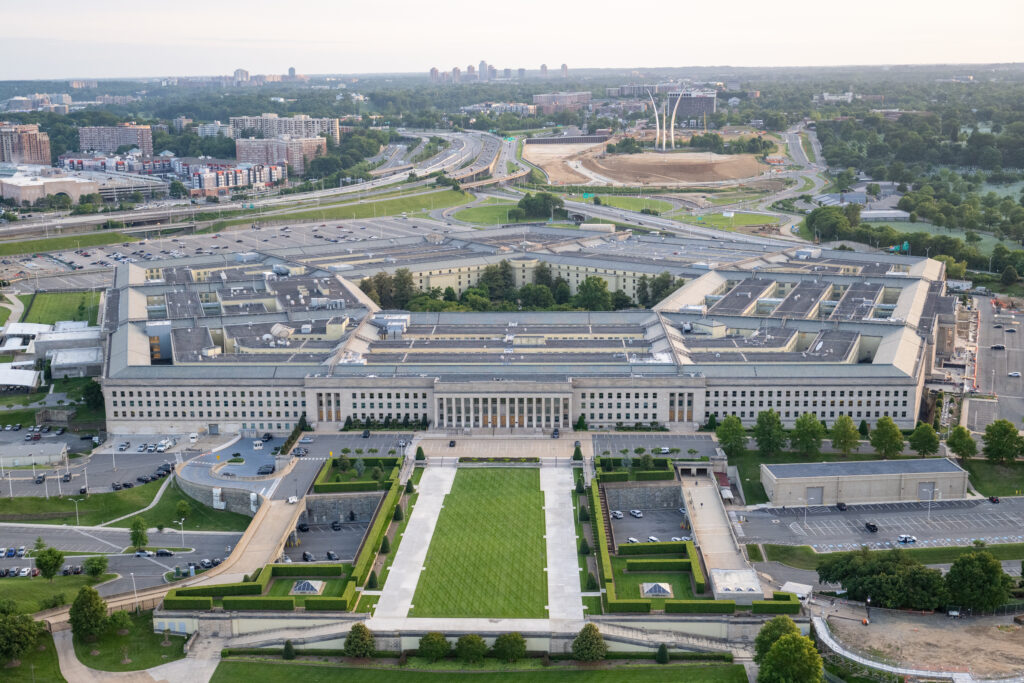
 Source: U.S. Air Force
The White House recently released a historic $1.5 trillion national security budget that sets out expansive investment plans for munitions, shipbuilding, drones, and emerging technologies, while also pouring billions into the defense industrial base. When plans for a $1.5 trillion budget were first announced, it was initially unclear if it was a serious proposal. However, the official FY27 request proves those statements were no exaggeration, representing a truly ambitious shift in size and scope.
In our latest white paper, “The FY27 Defense Budget Request Represents a Foundational Shift for the Pentagon,” we break down exactly where this money is going, the strategic priorities driving the surge, and the legislative hurdles that lie ahead.
The massive national security request comprises $1.15 trillion in discretionary spending alongside $350 billion that the administration wants included in a new reconciliation bill. This combined figure reflects a massive 42 percent increase over FY26 levels. Furthermore, the Pentagon’s base budget alone has officially broken the $1 trillion barrier, totaling $1.1 trillion.
Key Teasers from the White Paper
Here is a sneak peek at some of the paradigm-shifting data and topics we explore in the full report:
A Historic Acquisition Surge: The FY27 spending surge is driven primarily by new resources for the DoD’s procurement and research, development, test, and evaluation (RDT&E) accounts. Taken together, the FY27 procurement and RDT&E request totals $756.8 billion, which is roughly the size of the entire defense budget from just a few years ago.
Munitions in Overdrive: The request includes a total of $76.3 billion for munitions procurement, up significantly from $26.8 billion in FY26. To highlight this scale, the Army’s missile procurement account alone is slated to rise from $8 billion in FY26 to $36.6 billion in FY27.
Unprecedented Autonomous & Industrial Investment: The Defense-Wide portion of the procurement budget is increasing by 571 percent to $101.4 billion in FY27. In addition, the RDT&E budget includes an abnormal $54.6 billion in a single program element for the Defense Autonomous Working Group (DAWG) to focus on larger unmanned systems.
Shipbuilding Expansion: The Navy is a major winner in the request, seeking $65.8 billion for shipbuilding to procure 18 battle force ships and 16 non-battle force ships.
The Road Ahead
While the administration’s spending plans represent a clear strategic shift for the military, a request is far different from a finalized spending plan. The White House faces an uphill battle in getting the entire budget proposal through the House and Senate.
Serving as an offset to the Pentagon’s larger spending plan, the new federal budget request proposed a 10 percent cut for domestic spending, which is considered a non-starter for Democrats. The sheer size of the defense budget, combined with the reliance on another reconciliation bill to bypass regular appropriations, serves as a major potential red flag for Democrats and fiscal hawks alike.
Want to dig deeper into the numbers, the specific program allocations, and the political challenges shaping the future of U.S. defense?
Download the Full White Paper Now

Shaun's deep-rooted interest in military equipment continues in his role as a senior defense analyst with a focus on the United States. He played an integral role in the development of Forecast International's U.S. Defense Budget Forecast, an interactive online product that tracks Pentagon acquisition programs throughout the congressional budget process. As editor of International Military Markets – North America, Shaun has cultivated a deep understanding of the vast defense markets in the United States and Canada. He is a regular contributor to Forecast International's Defense & Security Monitor blog and has co-authored white papers on global defense spending and various military programs.
image sources
- Pentagon Aerial Photos: U.S. Air Force