When Russia launched its multi-front invasion of Ukraine on February 24, 2022, the Kremlin anticipated a swift decapitation operation to dismantle the country’s government and military within weeks. Years later, that “rapid” conflict has morphed into a bloody, stagnant war of attrition, with Russian forces holding just 20% of southeastern Ukraine and failing to meet their core objectives. The Armed Forces of Ukraine (AFU) defied expectations against a seemingly overwhelming opponent by rapidly mobilizing and pioneering a new vision of warfare. This tactical evolution has caught the attention of the global community; notably, the U.S. Department of Defense (DoD) is now sending military personnel to study Ukraine’s cutting-edge integration of drones in both offensive and defensive operations.
A New Technology in a Stagnant Battlefield
Not only has the AFU mastered Unmanned Aerial Vehicle (UAV) use for combat roles, but they have also begun to deploy Unmanned Ground Vehicles (UGVs) throughout the extensive front lines in Eastern Ukraine. UGVs are heavily used in logistical operations where crewed vehicles are either too large to maneuver or, more importantly, in situations where the danger to military personnel is too great. UGVs have been confirmed to have reduced Ukrainian casualties by 30% according to a study by the Central Research Institute of the Armed Forces of Ukraine. UGVs have already begun to be used in resupply missions where they are outfitted with ammunition, food, medical supplies, and various other necessary materials to allow Ukrainian forces to maintain their strategic positions.
Furthermore, the AFU has founded the world’s first dedicated military branch for aerial, maritime, and ground-based drone operations, the Unmanned Systems Forces, allowing them to further specialize their knowledge in unmanned systems and apply it effectively. Currently, the AFU has integrated more than 20 units with unmanned systems divisions that operate in various roles such as combat support, reconnaissance, logistics, and medical evacuations. Earlier this year, a UGV operated by the AFU’s 1st Separate Medical Battalion worked with the 425th Separate Assault Regiment, “Skelia” unit, to successfully evacuate a wounded soldier from a front line position during an assault operation. The medical evacuation lasted approximately two hours and thirteen minutes with the UGV covering a total of 36.5 km, during which it came under effective enemy fire, including two anti-personnel mines, with no additional injuries to the soldier being evacuated.
UGVs Evolve Into Direct Weapon Systems
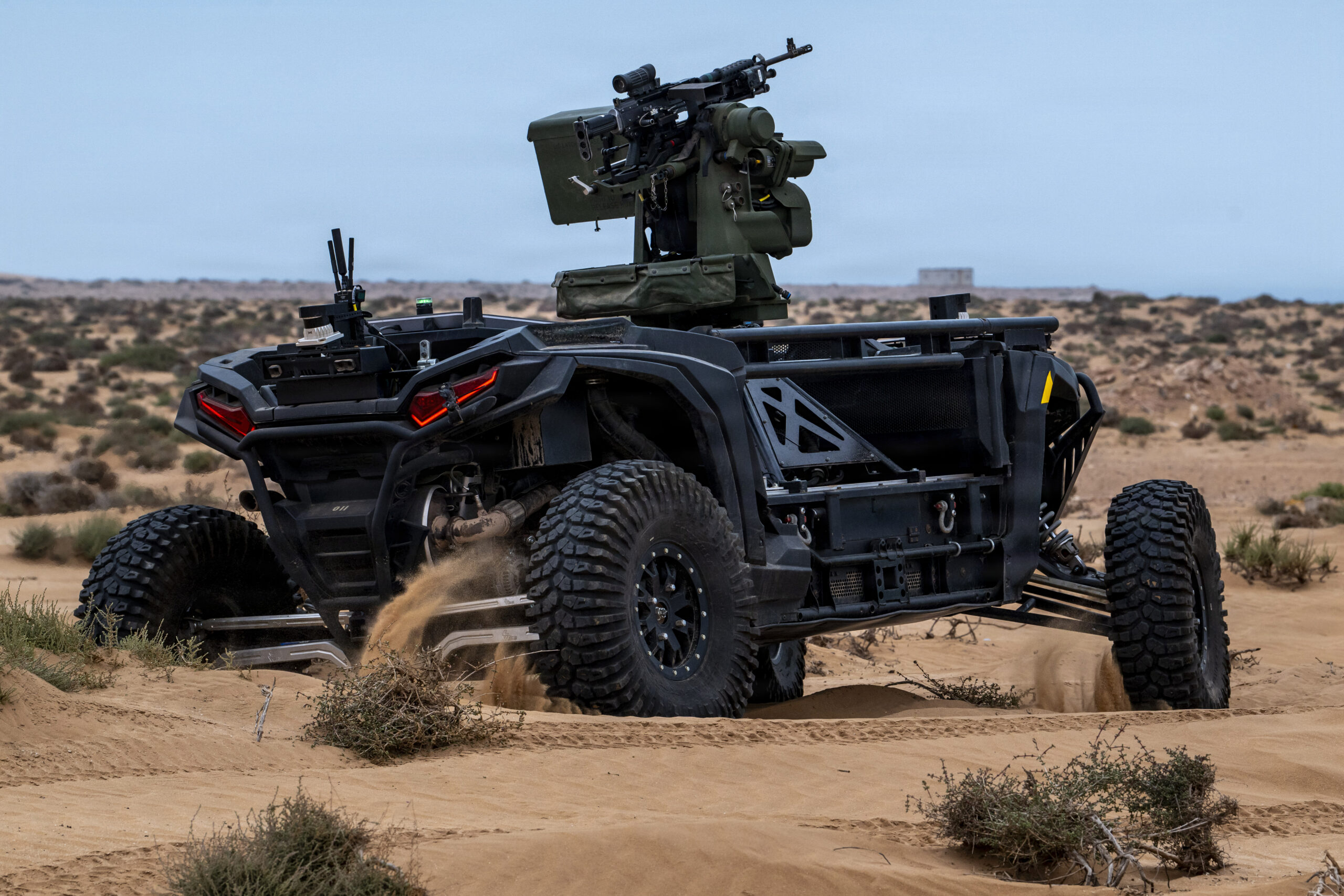
Last summer, a single UGV successfully defended a key AFU position from constant Russian military ground assaults for 45 days with no Ukrainian human losses. The UGV was operated by soldiers with a specialized unit known as the “NC13” Strike UGV Company within the AFU’s 3rd Army Corps. This unit was founded in 2025 to specifically use UGVs in combat roles. The drone used, a Droid TW 12.7, usually armed with an M2 Browning .50 cal heavy machine gun, managed to fend off several assaults. The kill chain during this operation incorporated new technology to make accurate and quick decisions possible. UAVs flown by supporting units provided reconnaissance and surveillance of the front line; these pilots relayed intelligence once enemy movements were identified, and the UGV operator deployed the drone to appropriate locations to direct effective fire from the weapon system mounted to the vehicle.
On April 13th, 2026, Ukrainian President Volodymyr Zelenskyy stated that UGVs and UAVs had captured an enemy position on their own, without any infantry support and no Ukrainian casualties–the first recorded case in the Russo-Ukrainian War. Additionally, there are several reports from AFU units of Russian forces surrendering to UGVs as Ukraine has placed an emphasis on the use of uncrewed vehicles for assault operations.
These instances have highlighted the rapidly evolving nature of autonomous warfare in modern times. Military leaders are learning the invaluable nature of uncrewed platforms in battlefield scenarios, which has led to further development of direct combat modular systems that can be outfitted on UGVs, such as mortars, larger-caliber weapons, remotely operated turrets, and other combat augmenting features. These capabilities, for instance, can allow a forward operating assault force to send in UGVs outfitted with offensive weapon systems into dangerous scenarios and suppress or neutralize enemy positions before conventional infantry units advance. This can provide a more secure environment for troops to operate and potentially minimize unnecessary casualties.
Defense Companies Adapt to the UGV Market
The continued lessons learned in Ukraine have allowed defense companies to adapt their products to the perceived demand and reality of modern warfare. Seattle-based Overland AI deployed two of its ULTRA Autonomous Ground Vehicles (AGVs) to African Lion 2026, U.S. Africa Command’s largest annual joint exercise. The AGVs, which used Overland AI’s OverDrive autonomy software, operated in tandem with soldiers from the U.S. Army’s 173rd Airborne Brigade and 7th Engineer Brigade as well as the U.S. Marine Corps’ 2nd Combat Engineer Battalion. Soldiers and Marines were trained to use these AGVs during combat support missions where they provided cover fire and in a combat engineering capacity to clear concertina wire for soldiers to advance on a position. These vehicles were deployed and made mission-ready in a day’s time, demonstrating their rapid deployment capability.
Defense industry giant Rheinmetall has also developed a suite of AGVs and has been delivering models of its flagship Mission Master SP vehicle to the U.S. Marine Corps since early 2023. These systems have been involved in major training exercises, including live-fire missions, since the Marine Corps first accepted deliveries of these vehicles. The most recent instance was a week-long training course in mid-May 2026 that was hosted by the Marine Corps Warfighting Laboratory (MCWL) in Quantico, VA, where Marines from Fleet Marine Force combat units worked in tandem with Mission Master SP vehicles during day and night, live-fire missions to showcase the AGVs’ capabilities for logistics resupply, medevac, and direct combat support.
Conclusion
Although various UGV models have been integrated into training within the past few years, the DoD has largely adopted a “crawl-walk-run” methodology in its implementation of such systems at a significant scale that would hinder any meaningful results in a real-world conflict. Testing of unmanned systems has not gone unfunded over the past several years, yet the bulk of DoD funding has been funneled to UAV and Unmanned Underwater Vehicles (UUVs) at a disproportionate rate. A National Defense University study highlighted that in FY21, the DoD allocated $2.8B for UAVs compared to $241M for UGVs. Although the Ukrainian war has sparked funding shifts in unmanned vehicle priorities, the historical disparity highlights an institutional lag in the adoption of new battlefield doctrine. Apart from a limited number of UGV deployments to standing military units, the DoD’s procurement and implementation of these platforms is drastically behind what, theoretically, would be needed on a modern battlefield. Indeed, the Armed Forces of Ukraine, currently seen as one of the premier and most experienced military forces in Europe, have adapted, pioneered, and mastered the forward use of UGVs as a force multiplier. One thing is certain: if the U.S. military is to maintain its strict posture of combat readiness, it has a lot of catching up to do when it comes to this aspect of war.