 Source: DVIDS
In some ways, the early days of Lockheed Martin’s SPY-7 radar – derived from the same architecture as the Long Range Discrimination Radar (LRDR) funded and tested by the U.S. Missile Defense Agency (MDA) – are a tragic story.
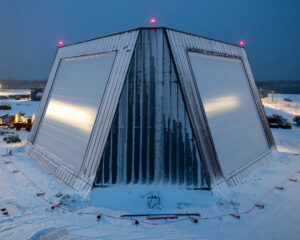
The LRDR passed its Critical Design Review in 2017. The wind in its sails, an LRDR facility was stood up by the MDA at the Clear Air Force Station in Alaska in 2018 (currently, the Clear Space Force Station). That same year, in December, the MDA awarded Lockheed with a $585.2 million delivery order for a dedicated Homeland Defense Radar – Hawaii (HDR-H) derived from the LRDR for the MDA’s ballistic missile defense system. The MDA also awarded Lockheed, Northrop Grumman, and Raytheon design study contracts for the establishment of a Pacific Discriminating Radar (PDR) facility comparable to HDR-H. Lockheed anticipated that full-rate production for the LRDR program would begin in 2019.
By November 2023, HDR-H was officially cancelled by the U.S. Congress. To make matters worse, the Japanese Ministry of Defense’s (JMOD) selection of an LRDR-derived system for the country’s AEGIS Ashore installations in 2019 – beating out Raytheon’s SPY-6 AMDR proposal – was cut short with the JMOD’s official cancellation of its AEGIS Ashore program in June 2020.
Continuing but Scaled-down U.S. MDA Interest
At present, the U.S. MDA’s procurement budget request for Fiscal Year 2027 declines to allocate dedicated funding for the Defense of Guam Procurement line beyond FY26 (though, the possibility of future funding remains live). In its RDT&E FY27 budget request, both the Defense of Guam Development program and the Long Range Discrimination Radar (LRDR) fundings lines are set to receive relatively significant funding, with LRDR requested to receive a boost in FY27 to $125.0 million. The increase in funding will, among other things, support LRDR software delivery acceleration.
Although these RDT&E efforts are ongoing – and their knock-on effects for the LRDR should not be discounted over the next decade – the radar’s most significant impact is currently being made abroad across at least three states and three variants of the SPY-7.
The Road Back
Japanese Procurement
In late 2023, JMOD announced that funding had been secured for the construction of two new AEGIS destroyers, termed AEGIS System Equipped Vessels (ASEVs). The SPY-7(V)1 radar was specified for these ASEVs. Later, the U.S. MDA awarded Lockheed Martin a contract in November 2024 worth $578.999 million under the Foreign Military Sales (FMS) program in support of the ASEV program. A steady pace of demonstrations, testing, and deliveries of SPY-7(V)1 components to JMOD began in April 2024, with the first shipset delivered to JMOD in June 2025 and the second shipset delivered in March 2026.
Notably, Lockheed Martin has made at least two, still-evolving SPY-7 component production localization agreements with Japan-based companies. Some of Lockheed’s deliveries of components to JMOD occur through a Direct Commercial Sale (DCS) between itself and Mitsubishi Corporation, signed by January 2025, if not earlier. Similarly, but separately, Lockheed and Fujitsu signed a Memorandum of Understanding (MoU) in May 2025 specifying supplier selection and industrial partnership arrangements in support of the SPY-7 program. The two later signed another contract, in February 2026, specifying the initial procurement of components necessary for the supply of power to the modular Subarray Suite (SAS) that in part comprises the SPY-7 radar. Fujitsu would later be selected as the formal supplier of the SPY-7 SAS Power Supply Line Replaceable Unit (PS LRU).
The two Japanese ASEVs are expected to enter service in FY2028 and FY2029.
Japanese Future Destroyers and SPY-6 Competition
Given the SPY-7(V)1’s specification for the ASEVs, coupled with Lockheed Martin’s inroads in local production via Mitsubishi and Fujitsu (perhaps fertile ground for further cooperation), one wonders if the SPY-7(V)1 will likewise find a home in Japan’s possible replacements for its Kongō-class destroyers. In doing so, Lockheed would compete with Raytheon’s SPY-6 radars, as the latter company makes comparable inroads via local SPY-6 component production with Mitsubishi Electric and Sampa Kogyo.
As previously noted in these pages, with respect to Raytheon’s possible SPY-6(V)1 production for the German Navy’s F127 frigates, broader geopolitical interests should not be ignored. Japan indeed is sensitive to interoperability with U.S. naval forces given the potential for Chinese uses of force against Taiwan in the future and U.S.-Japanese coordination therein. As a consequence of the U.S. Navy adopting the SPY-6 radar across its DDG-51 Flight III destroyers and DDG-51 Flight IIA destroyers (among others), it may be in Japan’s interest to specify the SPY-6 for its future destroyers.
This is a significant interest, and not to be downplayed. However, the uncertainties that geopolitics generates lead to more speculation than the benefits of smoother interoperability alone may provide.
It is more interesting to focus on production capacity for SPY-7 or SPY-6 radars. To meet demand for its current batch of (at least) 40 SPY-6 radars under contract for procurement, Raytheon is currently taking pains to expand its production capacity at its Andover, Massachusetts radar facility. The potential for excess capacity as a result of this scaling up could make the SPY-6 a more attractive option for future Japanese destroyers given the sensitivity of the timeframe for procurement. The timeframe in question is relatively constrained, and whether production capacity scales sufficiently in time is an open question.
The selection of SPY-7 for ASEVs, however, may generate a certain path-dependency for future Japanese vessels.
Favorable winds blow in either direction, for now, though justifications for selection one way or another (if either of these) are not difficult to identify today.
Spanish Procurement
During Lockheed Martin’s original tumult with JMOD, in December 2019, the American company signed a contract with Spain-based and state-backed shipbuilding firm Navantia to equip five new Spanish F-110 multi-mission frigates (Bonifaz-class frigates), as well as the land-based test site Centro Integración de Sistemas en Tierra (CIST), with the SPY-7(V)2. The frigates themselves are being constructed by Navantia with Lockheed supporting the AEGIS and SPY-7 systems specified for them. This agreement was extended by the two firms in March 2024.
This sale was formalized with a U.S. Navy contract awarded to Lockheed Martin through the U.S. FMS program in April 2020 worth $519.1 million. The contract covered the procurement of both Lockheed’s AEGIS Fire Control Loop development and Solid State S-Band Radar Processing Group, tools, and test equipment (i.e., LRDR-associated tools and equipment). Work was initially expected to be completed by April 2030, although the F-114 and F-115 frigates are likely to be commissioned in 2031 and 2032.
Comparable to Lockheed’s agreements with Japan-based firms, the American company has placed orders with Spain-based firms beyond Navantia. These include an order placed to Indra, Escribano Mechanical and Engineering, and Integral de Conexión y Montajes (ICM) in July 2024 for SPY-7(V)2 components. Lockheed’s engagement with Indra stretches back to at least 2019, when the two signed a €150 million (approx. USD172.9 million) subcontract specifying the supply of “main components” for the SPY-7.
The Spanish Navy initially anticipated that the first three of the Bonifaz-class frigates – F-111, F-112, and F-113 – would enter service in 2025, 2026, and 2027, respectively. To be sure, Navantia has floated the possibility of constructing a sixth “digital twin” frigate in the Bonifaz-class, but details are limited, suggesting plans for this sixth frigate are unconfirmed. If this sixth frigate were to be constructed, it would likely be in the early 2030s as the F-114 and F-115 near their commissioning.
Among the SPY-7 procurement cases abroad reviewed here, the Spanish Navy’s procurement appears to be the smoothest process throughout.
Canadian Procurement
Canada emerged as a significant SPY-7 customer in 2025, when the U.S. Navy awarded Lockheed Martin a contract worth $104.6 million for the production of SPY-7 radars for Canada under the FMS program. The variant to be acquired is the SPY-7(V)3. It was later specified by the Canadian government that the radar will equip its pending River-class destroyers (previously, Canadian Surface Combatants). The Canadian Navy aims to construct up to 15 River-class destroyers.
As with many shipbuilding programs, this number is subject to change, and “up to” 15 River-class destroyers provides wiggle room for the Canadian government to build fewer. Although the program is proceeding, it is somewhat speculative to suggest that 15 SPY-7(V)3 radars will be produced by Lockheed Martin for this program. That said, the earliest commissioning date of the under-construction River-class destroyers is currently expected for 2031, meaning the timeframe for SPY-7 deliveries will run through at least the early-to-mid 2030s. (The U.S. Navy FMS contract, for its part, expected work completion by January 2032, though this contract is likely to be modified.)
Echoing the geopolitical focus above, U.S.-Canada relations are not currently at a high-point, and there is tentative indication that the Canadian government is willing to shift its defense procurement needs elsewhere, as with its selection of Saab-made GlobalEye platforms over the Boeing-made E-7 Wedgetail.
To be sure, such tensions often do not interfere with these considerably less public arrangements. Moreover, one should not exaggerate the ability of states like Canada to dissociate themselves from American defense offerings. In any event, this relationship and its accommodation of the exchange of sensitive military technology should be monitored over time.
Possible United Arab Emirates Procurement
Finally, in March 2026, the U.S. State Department approved a possible FMS to the United Arab Emirates (UAE) for the Long Range Discrimination Radar with Terminal High Altitude Area Defense Integration and Related equipment. The total estimated cost of the sale was $4.5 billion.
A single LRDR was requested for purchase. The variant in question was unspecified. At the time of writing, this FMS is not publicly confirmed to proceed, although it is plausible that it will. The timeframe for delivery of the LRDR is more speculative, though most likely within the remainder of this decade.

Vincent Carchidi has a background in defense and policy analysis, specializing in critical and emerging technologies. He is currently a Defense Industry Analyst with Forecast International. He also maintains a background in cognitive science, with an interest in artificial intelligence.
image sources
- Long Range Discrimination Radar (LRDR): DVIDS