 Source: Rheinmetall
The U.S. Army has been attempting to replace the M2 Bradley Infantry Fighting Vehicle (IFV) for decades with no viable results. The BAE Systems-designed IFV has been in service since 1981 and has been designated as the Army’s primary armored infantry combat vehicle to this day. The Bradley has seen several upgrades throughout the years, including improved engines, sensors, armament, and countermeasures. It showed its worth as a workhorse for Armored Brigade Combat Teams (ABCT) during the conflicts in Afghanistan and Iraq, in the first and second Gulf Wars, and more recently used by Ukrainian Armed Forces during the ongoing Russo-Ukrainian War. Designed and built at the height of the Cold War, the Bradley was intended to go toe-to-toe with Soviet tanks and armored vehicles and it has indeed proven its worth on the Ukrainian frontlines with cases of it taking out Russian BMPs and even destroying a T-90M main battle tank, the crown jewel in Russia’s armored corps. The Bradley’s effectiveness in combat has not come into question yet obvious concerns over its age and lack of technological development has led U.S. Army leadership to consider other more robust options. Enter the XM30 Mechanized Infantry Combat Vehicle (MICV).
Replacing the Bradley for Future Battlefields
The Army launched the Next Generation Combat Vehicle initiative in 2018, later named the Optionally Manned Fighting Vehicle (OMFV) program, to find a modern replacement for a large portion of their fleet of Bradley IFVs. The program was meant to produce a technologically advanced IFV with semi-autonomous and autonomous capabilities, two-person crew, better armament, and the ability to easily be adaptable to new emerging technology in a cost-effective manner via the Department of Defense’s (DoD) Modular Open Systems Approach. After a failed first attempt, the Army released a Request for Proposals (RFP) for digital designs of vehicle concepts in December 2020, with five companies chosen in July 2021 to provide digital mockups. Preliminary contracts were awarded to American Rheinmetall, General Dynamics Land Systems, BAE Systems Land and Armaments, Oshkosh Defense, and Point Blank Enterprises for a combined worth of $299.4 million.
After an RFP for more detailed designs and prototyping specifications, the Army selected American Rheinmetall and General Dynamics Land Systems in June 2023 to move forward into the next phase. American Rheinmetall Vehicles (ARV) was awarded $812.6 million while General Dynamics Land Systems (GDLS) received $767.8 million, a combined $1.6 billion to utilize their digital designs to produce as many as eleven prototypes for testing and evaluation.
The XM30 is Born
The OMFV program was once again redesignated, this time into the XM30 Mechanized Infantry Combat Vehicle (MICV) as ARV and GDLS began development on a prototype for testing and evaluation. Both primes began work with their own designs, working around the common aspects that both prototypes will carry. Both vehicles will be propelled by a hybrid-electric powertrain that will provide better fuel efficiency and stealthier acoustic and thermal signatures. They will also house the Northrop Grumman XM913 50 mm Bushmaster chain gun as their primary armament. The robust weapon system boasts a dual-feed ammunition system, fired-round selection capability, and a selective fire rate between 100 and 200 rounds per minute. It will be capable of firing the advanced XM1204 High Explosive Airburst with Tracer (HEAB-T) cartridge, which has the ability to be fired in three distinct modes: airburst, point detonate, and point detonate delay, depending on the needs of the mission.
The XM30 will also count on the Multi-Mission Launcher to provide access to TOW and Javelin missiles and Raytheon’s Coyote Block 3 loitering munition. A coaxial machine gun is also expected to be fitted on the unmanned turret, likely similar to the Bradley’s M240C 7.62 mm weapon system. Both prototypes will be outfitted with Active Protection Systems (APS), like Elbit Systems’ Iron Fist, that will utilize sophisticated sensors and AI software to counteract threats such as Anti-Tank Guided Missiles. Finally, the XM30 is expected to use modular composite armor to address enemy fire by combining metal, ceramic, and advanced composites to absorb kinetic energy from enemy projectiles that end up finding their mark.
Two Prototypes Fighting for a Major Contract
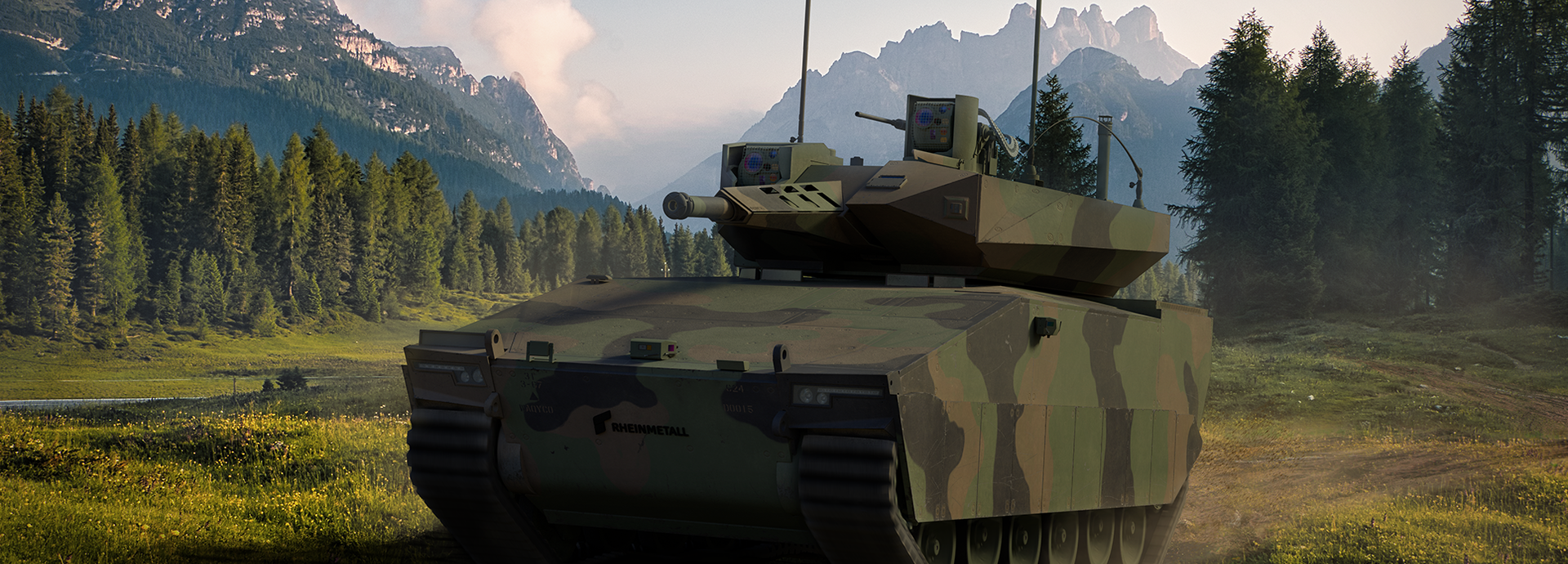
ARV and GDLS have both fielded their own proven technology as a basis for their respective XM30 prototypes. ARV has used their KF41 Lynx IFV as a base for their version of the XM30, a platform that already has a solid industrial base of production and a growing list of clients including Hungary, Italy, and Ukraine. Rheinmetall, ARV’s parent company, has provided Ukraine with a limited number of Lynx IFVs with an understanding of future purchases and domestic production in Ukraine. This combat deployment will provide incredibly valuable information that ARV can use to modify their XM30 prototype to better meet the U.S. Army’s needs.
GDLS has also taken the approach of building on one of its proven products by using a highly modified Griffin chassis as the basis for its XM30 Wolf prototype. Not much is known about the GDLS entry but it is expected to mirror many characteristics of ARV’s Lynx IFV, based on a concept launched in 2018.
A Complicated Future
The XM30 program had seemingly gained momentum in the latter part of 2025 as the Army approved a transition into the Engineering and Manufacturing Development phase, but a surprise pause in early 2026 had left the program’s future in limbo. Additionally, the Army published a Request for Information (RFI) in February 2026, calling for ground combat vehicle concepts and ideas for further Bradley modernization efforts. Nothing new has resulted from this RFI at this time, yet this may prove to apply pressure to ARV and GDLS’s timeframes to build and field their own prototypes of the XM30.
Additionally, it has been confirmed that soldiers with the 1st Cavalry Division will take delivery of a number of XM30 prototypes, alongside the new M1E3 Abrams tank, this fall for initial training with these vehicles. They will then put the MICVs through varied tests at the National Training Center at Fort Irwin, California, in early FY27. Soldiers will be tasked with familiarization of the MICVs and will give valuable feedback to ARV and GDLS engineers so as to address any shortcomings or highlight strengths after extensive testing.
This is a serious undertaking for the Army as it requested $547 million for FY27 in procurement funding to acquire 19 prototype vehicles for testing and evaluation with a final decision expected in the same year. Additionally, the Army is planning to field XM30 MICVs by FY28 with plans to acquire 108 total vehicles by FY31, although it is expected that final production numbers will eventually reach into the thousands. Needless to say, whoever wins the final contract will have a significant footprint in the Army’s warfighting capability for decades. The Army has already confirmed that the new MICV will share deployment to ABCTs with upgraded versions of the Bradley IFV, namely the M2A4E1 variant, pushing the Bradley’s service well into its fifth decade of service. If the XM30 turns out to be anything like its predecessor, it will surely be around for decades to come.

Juan Lopez pursued an undergraduate degree in Political Science with an emphasis in International Relations and a minor in Russian studies from the University of California, Riverside. Juan’s diverse background includes his work as a staffer in the U.S. House of Representatives and in federal law enforcement which gave him extensive experience and knowledge in federal government operations, international affairs, counter terrorism, and national security. His interests include land-based weapon systems, small arms, military fixed wing aircraft, and Latin American relations. He is proficient in the Spanish language at a native level.
image sources
- Rheinmetall’s XM30 concept: Rheinmetall