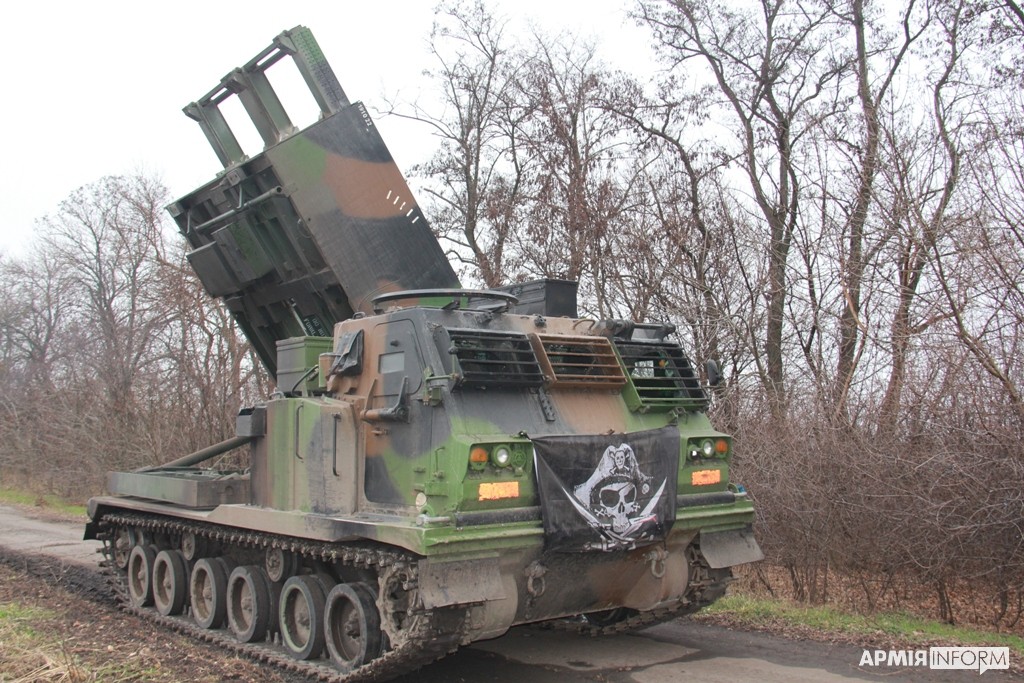
 Source: https://commons.wikimedia.org/wiki/File:UA_LRU_01.jpg
As part of its ongoing military rearmament, the French Ministry of the Armed Forces is pursuing a replacement for the Army’s Lance-Roquettes Unitaire (LRU) multiple rocket launchers, which are approaching obsolescence. France aims to acquire up to 26 multiple launch rocket systems (MLRS) by 2035 under the replacement program, with a requirement that they utilize various types of munitions, including those capable of deep strikes extending at least 500 kilometers. To meet that demand, three domestic options are under consideration, and these competitors have recently begun test demonstrations of their systems.
In mid-April, MBDA and Safran kicked off the first demonstrations, putting their Thundart MLRS through a test-firing at the Île du Levant range in southern France. Thundart features a pair of missile pods, each with four guided rockets capable of reaching targets up to 150 kilometers away. The rocket’s guidance system, derived from the guidance kit installed on Safran’s AASM Hammer, is designed to be resilient in GNSS-denied environments.
ArianeGroup and Thales followed suit with trials of their system in May. On May 5, the partners performed a test-firing of the FLP-t 150 munition, which carries a range of at least 150 kilometers. Like Thundart’s munition, FLP-t 150 should remain effective even amid GNSS denial, a crucial feature given the widespread usage of electronic warfare on the modern battlefield. Several weeks later, on May 20, Thales test-fired a 68mm rocket from the modular X-Fire wheeled MLRS, which ArianeGroup and Thales are pitching for the French MLRS program.
A third domestic option exists in the form of Turgis Gaillard’s Foudre MLRS. The system does not appear to have entered testing yet – and would require a munitions partner for the project to move forward – but Turgis Gaillard promotes Foudre as compatible with guided rockets reaching a range of 75 kilometers, as well as ballistic missiles of ranges up to 300 kilometers.
Any one of these bids would provide France with a sovereign MLRS, supporting the French defense industry in tandem with the military’s overall modernization goals. European capitals are increasingly worried about the direction of the trans-Atlantic relationship with Washington, a concern that has spurred a renewed focus on domestic industrialization, especially in defense. France already relies primarily on its own companies to supply the military and the Ministry of the Armed Forces would like to reinforce self-reliance at any opportunity. According to ministry data, about 80.4 percent of its procurement expenditure in 2023 went to companies based in France.
The French Army, however, faces a time crunch in replacing its current fleet of LRUs, which may become technically obsolete before these domestic programs enter serial production. The MBDA-Safran team expects that operational Thundart systems could be delivered by 2029, for example, whereas the LRUs may exit service in 2027. France could thus find itself forced to procure a capability from abroad – such as the U.S.-made M142 HIMARS or South Korea’s K239 Chunmoo – or accept a lapse in its operational posture as the LRUs are retired without a ready replacement.
The HIMARS presents one option from abroad. Even as French rocket trials were getting underway in mid-May, French media reported that Paris had received an offer from Lockheed Martin to fill its MLRS requirement with the HIMARS. The HIMARS is a wheeled derivative of the M270, the same tracked platform that France’s LRU is based on. Compared to the French programs, which are still in development, HIMARS is already in production and has been ordered by over a dozen customers. It has seen combat experience in the Middle East and with the Ukrainian Armed Forces.
Purchasing HIMARS would also enable France to make use of its existing stockpile of M31 rockets used by the LRUs. The French-made alternatives, by contrast, have been denied integration with the U.S.-made rockets, according to a report published in Euractiv in early April, and the U.S. is not likely to budge on that issue. Washington recently took a similar stance on the integration of American munitions with the German-Israeli EuroPULS. The Trump administration wants its European allies to modernize their militaries, but prefers them to buy American in doing so.
French lawmakers, however, are wary of becoming overly dependent on Washington, BFM reported, particularly in light of delays affecting existing export customers. Estonia, for example, has taken delivery of six HIMARS launchers and recently ordered another three, but is facing timeline setbacks to ammunition deliveries following the U.S.-Israel conflict with Iran. In a parliamentary hearing in April, French senator Cédric Perrin quizzed Minister of Armed Forces Catherine Vautrin on the MLRS topic, seeking to rule out the purchase of HIMARS, which Vautrin refused to do. She instead expressed her ‘hope’ that the future MLRS would ultimately be a sovereign system.
France could alternatively consider a purchase of the K239 Chunmoo rather than the HIMARS. The Chunmoo is already in production and several other European countries have purchased it in recent years in part due to manufacturer Hanwha’s ability to meet demand swiftly. Poland purchased 218 K239s in November 2022 and began receiving the first units by August the following year.
The Chunmoo could also present a semi-European option for France. Hanwha has shown willingness to engage in industrial cooperation as part of its deals, for example partnering with WB Group to localize some of the supply chain for Poland’s Chunmoo fleet. In December, Hanwha inked a $4 billion agreement that will lead to the production of the Chunmoo’s CGR-080 239mm munitions in Poland. That production line is slated to go online in 2030.
Pursuing a ready replacement from abroad would plug capability gaps. Already, the French military is concerned that it is lagging its peers in Europe in the pace of rearmament. Delaying the acquisition of new equipment to await a French-made alternative could compound that problem. French industrialists might counter that, as things stand, the French Army’s active rocket artillery fleet is currently limited anyway. Of the 57 M270s acquired in total, only 13 underwent the LRU modernization in the early 2010s while the rest were sent to storage. Paris later donated several LRUs to Ukraine following Russia’s full-scale invasion in 2022, leaving just nine active LRUs today.
The Ministry of the Armed Forces plans to select its next MLRS this year. The decision will serve as an early indicator of how Paris intends to balance its longstanding preference for defense-industrial sovereignty against the need to rapidly field new capabilities. With the LRU fleet nearing retirement, the outcome will shape French long-range fires capacity for years to come.

Military markets analyst, covering Eurasia, Middle East, and Africa.
image sources
- Ukrainian LRU MLRS: https://commons.wikimedia.org/wiki/File:UA_LRU_01.jpg