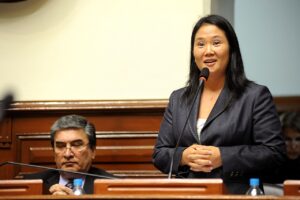
After weeks of anticipation amidst razor-thin margins and a prolonged and contentious counting process, on July 4th Peru’s electoral authority formally announced that Keiko Fujimori had emerged victorious in the country’s latest June 2026 general election cycle. Keiko, at the head of the conservative Popular Force, attained 50.1 percent of the vote against her left-leaning opponent, Roberto Sanchez. For Peru, the election marks the tentative end to years of interim governance and political instability in the long-wake of former President Pedro Castillo’s attempted 2022 auto-golpe, and for Keiko, vindication after electoral defeats in three preceding presidential runs and over a year spent in prison in 2018-2019 on eventually dismissed charges that she and her party’s supporters alleged were politically motivated. Yet, as with her predecessors, Keiko will enter the presidency in a fraught and combative political environment characterized by endemic legislative dysfunction and deep public polarization, with her prominent status as the scion of the Fujimori political dynasty and its contested legacies equally inviting both opposition and nostalgia.
In the years since the resignation of President Pedro Pablo Kuczkynski in 2018, Peru has cycled through a gauntlet of seven presidents. Of these, six were impeached or otherwise removed or compelled to resign in response to legislative or public opposition, often for the frequently instrumentalized cause of “Moral Incapacity”. The last year alone has seen the Peru pass through three interim executives. Though President Dina Boularte managed to fend off several years of impeachment attempts in the politically chaotic aftermath of Pedro Castillo’s autogolpe, ultimately she nevertheless succumbed to removal on grounds of moral incapacity in October 2025. Her direct successor, Jose Jeri, fell to a no confidence vote less than a year into his tenure, with Jose Maria Balcazar finally seeing through country through its latest general election. Peru’s endemic executive instability over the past decade plus is both a product of the structural peculiarities of its system but also the fragmented, and frequently zero-sum, strategic dynamics that pervade its broader political landscape. Profound historical and ideological cleavages across regional, class and ethnic lines and an equally deep sense of generalized alienation with extant party structures and political corruption continue to generate combative dynamics and instability at both the legislative and extrapolitical layers of society. In this environment, Keiko’s position as the inheritor of the Fujimori dynasty lends her both unique vulnerabilities, and advantages, that will come to define whether she is able to realize her political program, or indeed, retain her presidency at all in the coming years.
For the low-income rural, indigenous and left-leaning blocs of the Peruvian electorate, Keiko is a natural foil as the living personification of as a Fujimorismo as a movement and an idea. Though lauded for the stabilization of the Peruvian economy via the introduction of liberal market reforms and his oversight of the effective military defeat of the brutal Shining Path Maoist insurgency, particularly in the country’s rural hinterlands Alberto Fujimori’s is instead defined by the long shadow of grave human rights abuses, electoral interference and extrajudicial killings. Meanwhile, the name of Popular Force remains synonymous amongst this slice of the electorate with entrenched establishment corruption and legislative obstruction. Pervasive fears that Fujimori and the Popular Force will move to marginalize their interests and pursue authoritarian power consolidation are liable to see the political opposition preemptively adopt a posture of defiance and skepticism as Keiko’s tenure begins, with supporters of the disgraced Pedro Castillo amply primed for public mobilization against the new administration.
However, Keiko’s name and political experience also comes packaged with unique benefits that may allow her to persevere in power despite inhabiting an environment that has felled so many other recent Peruvian executives. Chief amongst these is the possession of a cohesive vertical network of supporters and party agents that that will provide her with a consistent basis of loyal support across multiple key nodes of Peruvian society. Deficits in just one or more areas of society often spelled the undoing of preceding Peruvian executives. While President Martin Vizcarra was unprecedently popular with much of the Peruvian public during his tenure, his aggressive anti-corruption campaign and direct challenge to the Popular Force made him a litany of enemies within the legislature and paved the road to his subsequent impeachment in 2020. The politically inexperienced Pedro Castillo proved largely unable to hold together his fractious left-leaning coalition and, already facing skepticism from the country’s security establishment and its conservative and urban constituencies from the outset, was left entirely isolated when he launched his abortive self-coup in 2022. The desperate need for executive continuity in the wake of the Castillo crisis and the support of the armed forces allowed Dina Boularte to hold on for over two years, but public approval ratings that attained memetic infamy for dipping into the low-single digits rendered her politically moribund as an independent political actor. While no party attained a legislative majority in the 2026 election, the Popular Force attained a plurality of 22 seats in the Senate and 41 in the Chamber of Deputies and it is here where the institutional cohesion and loyalty of the Popular Force could prove most critical to Keiko’s political fortunes. Without defections, Keiko will be significantly more insulated from the pervasive threat of impeachment than any of her recent predecessors. From the chambers of the legislature to the individual party entities on the street level, the Popular Force provides Keiko with mobilization capacity at multiple levels of Peruvian society.
Of course, much will also depend upon the decisions and political posture adopted by Keiko herself, and the political opposition likewise. In the initial days following the announcement of Keiko’s victory both sides have taken tentative steps to ameliorate the divisive atmosphere that defined the campaign period. Although during the vote-counting process competing Presidential contender Roberto Sanchez suggested that he may not recognize the results of the race and cast public doubt upon the veracity of the emerging vote totals, on July 6th he formally conceded defeat. For her part, Keiko adopted a conciliatory tone in the wake her victory, publicly pledging to be responsive to public sentiment and to ‘engage in dialogue’ as the transition process begins. The fractious character of Peruvian politics makes it difficult to project whether these statements might simply represent a détente before the resumption of battle by both sides, but perhaps after years of turmoil, Peru is ready to begin leaving a decade of dysfunction behind.

A lifelong enthusiast of armored vehicles, Thomas serves as an analyst on Forecast International's Military Vehicles Forecast product. In addition, Thomas is responsible for updating the reports and analysis within Forecast International's International Military Markets – Latin America & Caribbean product. He also provides analysis for Forecast International's Airborne Retrofit & Modernization Forecast. Before this assignment, Thomas served as a research assistant for Forecast International's analytical team and has made written contributions to the Civil Aircraft Forecast, Military Aircraft Forecast, and Rotorcraft Forecast services. Thomas derives his knowledge from a multidisciplinary background, with a strong emphasis on the history and politics of Russia and the former satellite republics of the Soviet Union. He has studied in the Russian Federation at Saint Petersburg State University and is proficient in the Russian language at an advanced level.