In the months since the initial launch of Operation Epic Fury by the United States against the Islamic Republic of Iran, the majority of the world’s attention has been gripped by the unfolding diplomatic and economic drama surrounding the closure of the Strait of Hormuz. As the leading two combatants now begin to take tentative steps towards deescalation and a formal resolution to the months-long conflict in the Middle-East however, the global community may soon need to turn its gaze to another brewing crisis thousands of miles away that appears on the verge of reaching its own inflection point.
For nearly 70 years, the single-party revolutionary government of the Republic of Cuba has routinely thwarted predictions of its imminent overthrow or collapse, even as the passage of time saw its system begin to wither in the face of the loss of its Soviet-patron, the onset of a succession of economic and social crises and the rigorous and unyielding application of external pressure. Across its history post-revolutionary history, the Cuban state has proven a paradox, a seemingly anachronistic bastion of unreformed 20th century state socialism that has nevertheless exhibited significant systemic resilience, even as comparable states around the globe either passed into the pages of history or undertook radical transformations. However, amidst a cascade of crises the near future of Cuba now appears more uncertain, and potentially more open to dramatic change, than at any point since the years of the tumultuous ‘Special Period’ in the 1990s. As the country’s material and strategic condition continues to rapidly deteriorate heading into the latter half of 2026, the question naturally arises, does the regime that has defied the odds time and time again still possess the capacity to adapt and survive?
The proximate beginning of Cuba’s present path to crisis lay with the outbreak of the first election of U.S Presidential Donald J. Trump in 2016 and subsequent outbreak of the global COVID-19 pandemic in 2020. After scarcely surviving the collapse of the Soviet Union and Warsaw Pact in the 1990s through austerity and repression, Cuba achieved a modicum of stability in its strategic and economic position over the 2000s and 2010s thanks to the combination of a broadly favorable diplomatic environment with its regional neighbors, namely the ideologically aligned Venezuela and other “pink tide’ governments, as well as the dividends paid by state investment into the tourism sector, which generated a consistent and much needed flow of foreign currency for the otherwise perennially cash strapped state. The ultimately abortive normalization of U.S-Cuban diplomatic relations that began in 2015 likewise appeared to signal that the Cuban state’s most precarious days were potentially entering the rearview mirror.
However, a subsequent string of internal and external developments would soon bring this era of relative abundance and security to an end with striking rapidity. In 2016, the nascent détente of the preceding years was complicated by American and Canadian diplomats reporting anomalous health incidents in what came to be known as ‘Havana syndrome. By the close of the year, the election of the first Trump administration saw the United States’ diplomatic and strategic posture towards Cuba shift decisively towards one of renewed strategic pressure and containment. While this broad reversion to the historical norm of bilateral relations might not have otherwise been notably consequential for Cuba’s position, the simultaneous onset of the COVID-19 pandemic and the evolution of Latin America’s political environment laid the foundations for the state of peril in which the regime now finds itself. The dramatic public health challenge and economic disruption instigated by the pandemic saw Cuba’s previously lucrative tourism industry grind to a standstill from which it has still not recovered years later. Meanwhile, the ratcheting up of U.S sanctions and Trump administration’s designation of Cuba as a State Sponsor of Terrorism (SSOT) further constrained the government’s already marginal capacity to court external investment and trade opportunities. Cuba’s traditional friends and allies, meanwhile, were increasingly in little position to aid the long-beleaguered island. The dramatic disintegration of the Venezuelan economy and energy sector under the leadership of Nicolas Maduro gradually saw the vital lifeline of oil shipments dry up, while the recession of pink tide governments era across much of the Latin American region saw long-standing regional sympathies begin to slip away into states of indifference or even hostility.
As Cubans’ access to essential goods and services began to buckle under the weight of these coinciding crises and the government’s attempt to tackle the country’s unwieldy currency system generated spiraling inflation, spontaneous expressions of public frustration exploded into rare street demonstrations that would come to be known as the 11J protests in July 2021. Alarmed by the political potential of the protest wave, the Cuban government pledged to undertake modest economic reforms in a bid to alleviate mounting public pressure but reasserted its authority with even greater vigor through acts of repression, detaining protest participants and delivering stringent sentences to those identified as prospective leaders. While the much feared mobilization of public dissatisfaction was quashed in the immediate term through these actions, the draconian aftermath of 11J only further contributed to the waning optical appeal of the battered Cuban tourism market and politically foreclosed any potential for the substantive renewal of bilateral engagement for the first several years of the then recently elected Biden administration. Through 2024, the status of U.S-Cuban relations and the condition of Cuba itself outwardly entered an interregnum, but momentum was already steadily building towards the deepest crisis in Cuba’s post-revolutionary history since 1962.
Under the second presidential term of Donald J. Trump, the United States has adopted an increasingly forceful and interventionist foreign policy in Latin America guided by the principles of what has informally become known as the ‘Donroe Doctrine’. As the administration has moved to restructure the country’s diplomatic and military posture across the region towards the realization of its ‘America first’ policy objectives, the symbolic and historical status of Cuba as a long-standing ideological and strategic opponent just off America’s shores has seen the administration seek to bring resolution to this half-century long drama on its terms.
Along with the redesignation of Cuba as an SSOT in early 2025, the Trump administration has progressively ratcheted up embargo activity on in a bid to compel the Cuban government to relinquish power or come to the negotiating table. The administration’s January 2026 Executive Order ‘Addressing Threats to the United States by the Government of Cuba’ represents the clearest articulation of its strategic goals regarding the island nation, and its release signaled the beginning of a new phase in its maximum pressure campaign. With each new wave of sanctions over 2026, the Cuban state’s pre-existing structural liabilities have been exploited with maximal precision. Over June 2026, some of Cuba’s last external lifelines began to wither as foreign financial institutions, critical to the functioning of the tourism segment and processing of remittances, began to suspend their remaining activities in the country in the wake of a new executive order. The vulnerabilities of the Cuban energy grid, already beset by decaying infrastructure and lack of investment, have likewise been amplified by the deepening shortages of fuel to power them. Amidst all of this mounting pressure hangs the recent context of Operation Absolute Resolve, the United States’ successful January 2026 lightning operation to capture and overthrow Venezuelan President Nicolas Maduro. In moves mirroring those preceding the Venezuela operation, in May 2026 the U.S unveiled an indictment of Cuban party patriarch Raul Castro, potentially signaling to the Cuban government that this strategic knot could be resolved through similar means.
Even for a Cuban government long adept at operating under embargo and in a condition of diplomatic isolation, the severity of the present scenario outwardly offers little opportunity for latitude of action or leverage. With Venezuela now operating under the watchful eye of the United States and Russia bogged down in its costly quagmire in Ukraine, sporadic provision of aid from sympathetic countries such as Mexico cannot come near addressing the depth of the country’s multifarious material crises. Since 2024, massive energy grid failures have routinely thrust the whole nation into periods of darkness. Meanwhile, over the past five years alone, over 1.0 million Cubans have fled the country to escape scarcity and repression. Although this exodus has in some sense relieved the government of potential sources of domestic opposition and eased the burden on already strained state services, its effects on the country’s already meager economic viability will be profound. Although the Cuban armed forces may possess experience and élan (Cuban intelligence personnel constituted a significant share of those killed in action in Operation Absolute Resolve), without the meaningful backing of allies its emaciated condition presents only marginal deterrent value against the United States. For the Cuban state, the present scenario has not only become a question of regime survival, but whether Cuba can persist as a functioning society at all under the present trajectory.
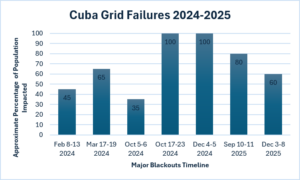
What comes next will be dictated predominantly by the tolerance of the Cuban government for further privation on one hand and the tolerance for risk by the United States on the other. Although the United States’ objective of isolating the Cuban state is defined and ironclad, its desired end-state for the island remains comparatively ambiguous and subject to revision as circumstances evolve. Despite the myriad weaknesses of the overall Cuban position, short of U.S military intervention the Communist Party as an institution retains a significant degree of structural resilience built on the interconnected foundations of historical memory, ideology and patronage. However, this too may be weakening in a way that spurs adaptation by necessity. Raul Castro, now 95 years old, represents one of the last remaining linkages to the government’s revolutionary and ideological origins and the political legacy of his more famous brother.
The Cuban government has long been reticent to institute meaningful reforms to its command economy, only experimenting with doing so in fits and starts over the past two plus decades, for fear of generating new nodes of political power capable of challenging single-party rule. Yet, for the current generation of rising party leaders, for whom the nominal promise of 20th century communism likely seems impossibly distant, regime survival through economic adaptation may seem a preferable alternative to allowing the country to slide further into obsolescence and poverty. A personal letter delivered to the Trump administration by Raul’s grandson in early 2026, presenting opportunities for economic investment in exchange for sanctions relief, offers one potential window into what a Venezuela-lite model might look like for Cuba, contingent on the Trump administration’s willingness to accept a negotiated deal. Pressure will mount on both countries in the months ahead to achieve a breakthrough, one way or another, for the longer present humanitarian and material conditions persist the more likely that ‘victory’ for either side might be a pyrrhic one.
Sources:
https://www.wsj.com/politics/national-security/cuba-trump-secret-letter-marco-rubio-1951dc9a
https://horizontecubano.law.columbia.edu/news/lagging-behind-competitors-cuban-tourism-industry-post-covid-era
https://www.american.edu/centers/latin-american-latino-studies/cuba-after-the-july-11-protests-leogrande.cfm
https://www.hrw.org/report/2022/07/11/prison-or-exile/cubas-systematic-repression-july-2021-demonstrators
https://www.whitehouse.gov/presidential-actions/2026/01/addressing-threats-to-the-united-states-by-the-government-of-cuba/
https://www.nbcmiami.com/news/local/cuba/from-mastercard-to-melia-the-companies-leaving-cuba-after-trumps-executive-order/3816782/
https://voz.us/en/world/260616/36585/cuba-is-running-out-of-tourists-58-drop-in-visits-exacerbates-the-foreign-exchange-crisis-and-exposes-the-chaos.html#google_vignette
https://english.elpais.com/international/2026-06-03/how-washington-delivered-the-checkmate-to-cubas-weakened-tourism-industry.html
https://www.politico.com/news/2026/06/11/u-s-sanctions-cubas-state-owned-oil-company-00959910
https://www.war.gov/News/News-Stories/Article/Article/4370431/trump-announces-us-militarys-capture-of-maduro/
https://www.justice.gov/opa/pr/united-states-unseals-superseding-indictment-charging-raul-castro-and-five-castro-regime-co
https://www.npr.org/2026/05/14/nx-s1-5822583/cuba-blackout
https://en.unav.edu/web/global-affairs/cuba-se-vacia-exodo-de-un-millon-de-personas-que-deja-una-poblacion-envejecida
*** Graph Sources

A lifelong enthusiast of armored vehicles, Thomas serves as an analyst on Forecast International's Military Vehicles Forecast product. In addition, Thomas is responsible for updating the reports and analysis within Forecast International's International Military Markets – Latin America & Caribbean product. He also provides analysis for Forecast International's Airborne Retrofit & Modernization Forecast. Before this assignment, Thomas served as a research assistant for Forecast International's analytical team and has made written contributions to the Civil Aircraft Forecast, Military Aircraft Forecast, and Rotorcraft Forecast services. Thomas derives his knowledge from a multidisciplinary background, with a strong emphasis on the history and politics of Russia and the former satellite republics of the Soviet Union. He has studied in the Russian Federation at Saint Petersburg State University and is proficient in the Russian language at an advanced level.