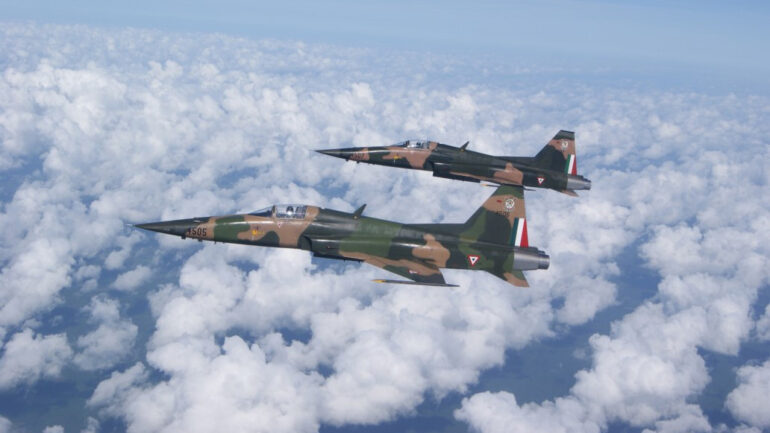
Mexican Air Force (FAM) commander General Román Carmona announced at the 2026 Tulum Air Show that the service will retire its aging Northrop F-5E/F Tiger II fleet after more than four decades of operational use. The FAM will now initiate a market analysis to evaluate potential replacements, with plans to acquire 12 modern combat aircraft. The review will consider multiple next-generation fighter options to sustain the force’s air defense, reconnaissance, and ground-attack capabilities.
Through a deal with the Northrop Corporation inked in 1982, Mexico’s Ministry of National Defense (SEDENA) purchased ten single-seat E variants and a pair of two-seat F variants used for training. The nimble, supersonic, and cost-efficient small fighter aircraft proved to be a financially prudent option for the needs of the FAM at the time. Four decades later, though, these largely defunct aircraft platforms have created a reliability issue due to a crumbling supply of spare parts and a lack of technically trained maintenance personnel, which has left roughly three to five aircraft in an airworthy status at any given time.
Latin America’s Military Modernization
SEDENA has not released any further information about the combat aircraft modernization push; the only detail known as of June 2026 is the market analysis for the acquisition of twelve aircraft with a targeted completion by 2028. A number of international primes, such as Lockheed Martin, Saab, and Leonardo, have been identified as top contenders to supply next-generation fighter aircraft for the FAM. Lockheed Martin’s F-16 Block 70/72 offers a tried and proven option with a robust supply chain of parts augmented by an established global logistics reach. The Argentine Air Force closed a deal in late 2025 to purchase twenty-four secondhand F-16s from Denmark. In addition, the Peruvian Air Force purchased twelve F-16 Block 70/72 aircraft for $3.2 billion in early 2026 to bolster its air defenses.
Swedish defense giant Saab has not been quiet when it comes to maneuvering into the global market. Their footprint has grown rapidly including a new deal closed in June 2026 with Ukraine for the purchase of sixteen of its Gripen E fighter jets, and the continued partnership with the Brazilian government and Embraer to produce the fighter jet, namely the two-seat F variant, domestically in Brazil. The Brazilian Air Force chose the Gripen as its next-generation fighter in 2014 with a multi-year deal for thirty-six E/F variants with the understanding that a portion of these aircraft would be produced domestically in Brazil by Embraer. Saab has continued to expand into Latin America with a recently confirmed deal with Colombia for seventeen Gripen E/F variants valued at approximately EUR 3.1 billion. This aircraft option has quickly become a top alternative to the F-16 as it can be operated in less-than-ideal conditions such as makeshift airfields and even civilian roads. Additionally, it has proven to be cheaper to maintain and fly, an important factor for countries who are not accustomed to investing heavily in defense.
Other potential options for the FAM’s mission include light attack aircraft such as the KAI FA-50 and Leonardo’s M-346. Both are able to act as Lead-In Fighter Trainers while also having the capability to fulfill the role of a multi-domain fighter aircraft. These light attack aircraft options are cheaper alternatives to the F-16 and Gripen, yet their specifications mirror the lower price tag. For example, the M-346 is outfitted with twin turbofan engines, but they are not outfitted with afterburners, which prevents Leonardo’s option from reaching sustained supersonic flight. Although the KAI FA-50 is capable of supersonic speeds, its intended design was to be a cost-effective alternative for the F-16, something that the FAM may not be looking for as it looks to become a stronger actor in the regional defense framework.
Past Attempts Fall Short
SEDENA is no stranger at attempts to walk away from the dated F-5 platform. In 2006, the Mexican Navy appeared to have selected the Russian-made Sukhoi Su-27 fighter aircraft for its naval aviation defense unit. The proposed deal would have seen the Mexican Navy acquire a fleet of ten aircraft – eight single-seat fighters and a pair of two-seat trainers – to carry out surveillance and defense of its coastal areas, including its vital oil and natural gas ocean platforms. The deal, massive for the Mexican government at the time, was reportedly set to be worth $410 million.
In a sharp turn, in February 2007, the Mexican Secretariat of the Navy (SEMAR) issued a press release stating that it was not pursuing any deals or negotiations to acquire Sukhoi Su-27s, citing cost concerns. The statement reiterated that the Navy would continue to defend Mexico’s naval airspace and its maritime interests, such as oil, natural gas platforms, and transport ships using fixed-wing and rotary aircraft already at their disposal.
New Defense Priorities
The push to modernize the FAM’s capabilities at this time is a direct response to wider geopolitical factors. As Mexico faces a continued domestic conflict with rapidly evolving international drug cartels, the need for more sophisticated countermeasures has triggered a renewed emphasis in the need for defense modernization. Mexico currently has the second-highest defense spending budget in Latin America ($14.8B FY25), second only to Brazil ($30.3B FY25), and has shown a desire to grow as a significant regional defense partner along with the U.S. and Canada. The acquisition of next-generation fighter aircraft that are on par with those of allied militaries, such as the Lockheed Martin F-16 or the Saab Gripen, will allow SEDENA and, by extension, the Mexican government to position themselves as vital players on the regional stage.