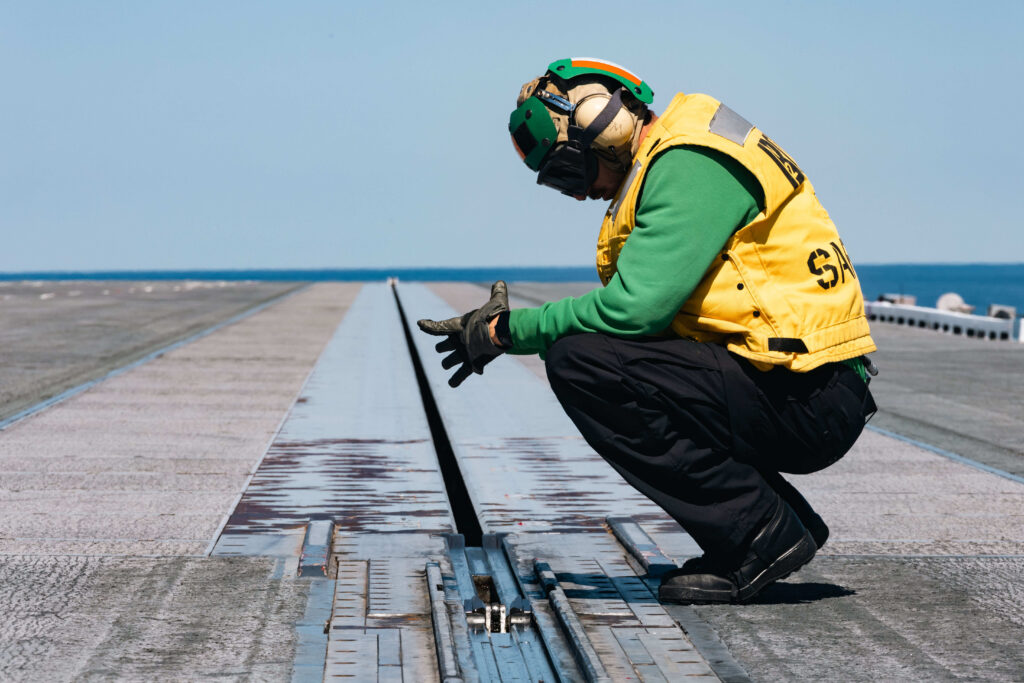
Steam catapults have defined carrier aviation for decades, launching thousands of aircraft from the decks of U.S. Navy carriers. Then, the arrival of the Electromagnetic Aircraft Launch System (EMALS) launched a new era of naval aviation. While it once seemed as if steam catapults would become a thing of the past for American naval aviation, President Trump has repeatedly criticized EMALS in favor of returning to steam and has now directed the Pentagon to redesign a new aircraft carrier with steam catapults. This article seeks to explain the difference between steam catapults and EMALS, which is best for the future of naval aviation, and why.
Defining the Options
Steam Catapults: The traditional steam catapult, developed in the 1950s, uses steam pressure to generate the force required to accelerate an aircraft from zero to flight speed in a matter of seconds. High-pressure steam, produced by the ship’s nuclear reactors, drives pistons inside long cylinders below the flight deck. These pistons connect to a “shuttle” that engages the aircraft’s nose gear. When released, the pistons propel the shuttle forward, and the aircraft along with it, with enough force to enable takeoff in under 300 feet. The U.S. Navy’s Nimitz-class carriers use traditional steam catapults.
EMALS: In contrast, EMALS replaces steam power with electromagnetic energy. Instead of pistons and valves, EMALS draws power from the ship’s generators to discharge electrical pulses into a series of magnetic coils lined along the catapult track, which create a moving magnetic wave that accelerates the launch shuttle smoothly and precisely. The U.S. Navy’s newer Ford-class carriers are intended to use EMALS. To date, only the first of its class, the USS Gerald R. Ford (CVN 78), is in service and employs EMALS.
Pros & Cons
Steam Catapults:
Steam catapults are a battle-tested, highly reliable technology with decades of successful operational history. The other primary advantage of steam catapults is their relative simplicity. They rely on mechanical valves and hydraulic systems rather than complex software algorithms or massive electrical energy storage banks. However, their physical mechanisms required for steam propulsion take up massive internal volume, can require tens of thousands of gallons of fresh water to operate during heavy flight windows, and can be very labor-intensive to maintain due to intense mechanical wear. Furthermore, steam catapults lack precise throttle control, delivering an intense, inflexible accelerative force that puts severe structural stress on airframes and prevents them from safely launching lighter aircraft or unmanned drones.
EMALS:
EMALS, on the other hand, provides smooth, precisely controlled acceleration to match the needs of each aircraft, which reduces stress on airframes and improves energy efficiency. The controlled acceleration enables carriers to launch a wider range of aircraft, especially unmanned drones, which are expected to make up an increasing percentage of carrier-launched aircraft. Moreover, EMALS is known to have faster reset times, which allows for higher sortie rates—the number of individual aircraft flights or missions that a ship can support in a given time. EMALS can also be improved via software updates and requires less maintenance due to reduced mechanical wear. However, these benefits come with some substantial trade-offs, such as the need for significant electrical power infrastructure, storage, and management. Generally speaking, EMALS is a more complex system that requires advanced software and training, plus the system had steep initial development costs and early reliability struggles. (It’s worth noting that reliability issues have since largely been resolved.) The contract for General Atomics to build EMALS and Advanced Arresting Gear for the future USS Doris Miller (CVN-81) cost $1.2 billion. Yet, despite the high price tag, EMALS is expected to provide cost savings in the long term by using less energy per launch, requiring a smaller crew to operate, and reducing maintenance costs.
Strategic Outlook
The transition from steam to EMALS represents more than just a technical upgrade that applies 21st-century technology to carrier operations; it’s part of a long-term move toward electrically driven ship systems that can also power the latest in defense technology, such as directed energy weapons and autonomous systems. Notably, other nations are following this same trend. China’s Type 003 Fujian carrier is reported to feature an electromagnetic launch system of its own, signaling that peer adversaries are also adapting to future battlefield requirements. Meanwhile, France also intends to use EMALS for its Navy’s next-generation aircraft carrier, PANG (porte-avions de nouvelle génération).
Additionally, President Trump’s plan to swap the catapults, arresting gear, and elevators on the future USS Doris Miller represents a major shift in the carrier’s construction and is expected to cost billions of dollars. What’s more, steam catapults are no longer in production, and supply chains for their components dissolved after the Navy’s last purchase roughly twenty years ago.
“The muscle behind the carrier’s strategic strength is the ability to launch and recover combat aircraft, and the American edge comes from maximizing the efficiency and reliability of sortie rates enabled by the catapult system.” — Jon Hemler, Director and Lead Analyst, Military Aerospace and Weapons Systems, Forecast International
Conclusion
Steam catapults have served the world’s navies well for over half a century, combining brute force with reliability. Yet, as technology advances and aircraft designs evolve, the limitations of steam are becoming increasingly clear. EMALS offers a cleaner, smarter, and more adaptable approach, one that aligns with the power systems and operational needs of tomorrow’s carriers. In summary, where steam represents the industrial might of the 20th century, EMALS embodies the precision and efficiency of the 21st century. The future of naval aviation will be launched not by steam, but by electromagnetism. The larger question is whether or not the United States can afford to be left behind.