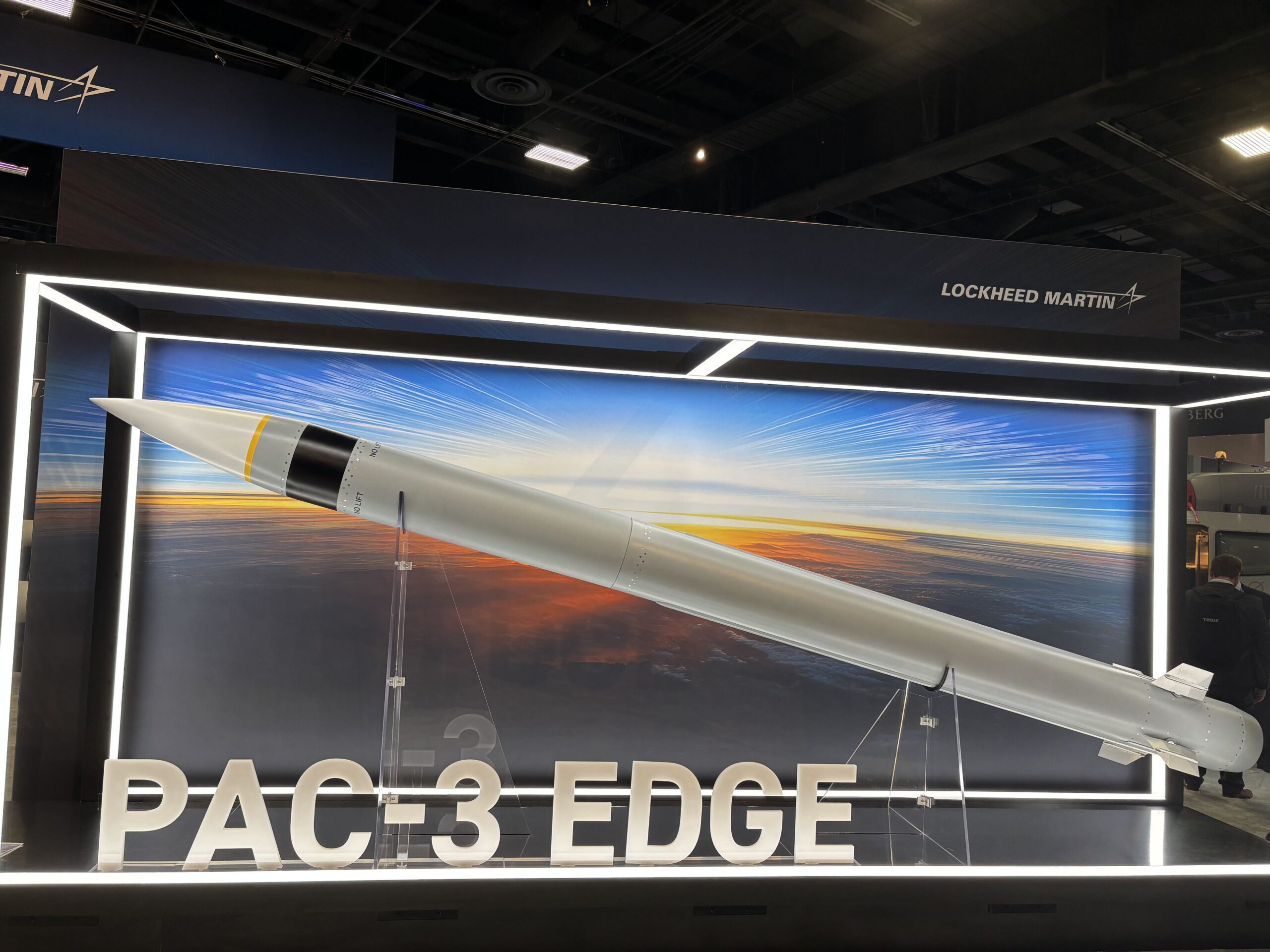
On October 29, 2026, the U.S. Army announced it had selected Lockheed Martin’s PAC-3 Edge for prototype development under its Future Interceptor program, choosing it over Anduril’s Steelfin family of interceptors. The decision comes as the U.S. works to rebuild its depleted interceptor stockpiles and avoid similar shortfalls in the future. The Army opted for an existing, sustained production line, choosing to add to the PAC-3 family rather than start a new one.
In competition, Anduril pitched Steelfin as a family built for multiple threats, arguing that “no single interceptor can defeat every threat.” Lockheed is not positioning Edge as a one-size-fits-all solution either. As part of the broader PAC-3 family, Edge seems to complement other variants across different scenarios and threats.
As an initial concept pitch, Steelfin seems like the stronger prospect. Anduril, which recently became the third U.S. supplier of solid rocket motors, presented Steelfin as a low-cost family that could be built on a single assembly line using commercial off-the-shelf components. This makes the Army’s choice worth questioning. The PAC-3 line has historically carried a higher unit cost, and Edge is so far focused on advanced ballistic and hypersonic threats, though its role could expand as development continues.
The Edge development contract is valued at $1.08 billion, with $660.4 million coming from the U.S. government and the remaining $423 million from Lockheed Martin. It’s unclear what Anduril would have needed from the U.S. for funding, so cost could be a factor in the Army’s selection, but there is likely a broader and more technical reason for Edge winning the contract. While Anduril’s plan to build a new low-cost production line for a family of interceptors is an ambitious goal that could address many of the stockpile problems the U.S. faces, the PAC-3 already has multiple variants and decades of research, development, and testing behind it.
The Army’s 2024 decisions may also have shaped the outcome. That year, it cancelled its Lower-Tier Future Interceptor (LTFI) program, which would have developed a new Patriot interceptor, due to cost concerns. At first glance, it seems contradictory to cancel one new Patriot missile in 2024 and then choose another in 2026 over a cheaper alternative. But the LTFI cancellation wasn’t only about dropping a new interceptor. The Army stated it aimed to reduce its reliance on Patriot batteries and focus instead on Integrated Battle Command System network integration and PAC-3 Missile Segment Enhancement upgrades, a direction Edge builds on.
What complicates the decision is that Steelfin offered much of the same flexibility. Anduril designed it to work with the Aegis and IBCS fire-control systems and to launch from the Patriot M903A2 launcher, the Navy’s Mk 41 Vertical Launch System, the Army’s Typhon system, and emerging containerized launchers, though that integration would still need to be proven through testing and certification.
Since both companies were offering solutions to largely the same problems, the deciding factor was likely that Edge builds on an existing family of reliable interceptors, making it a less risky investment. Still, the PAC-3’s record belongs to the family, not to this missile. Edge introduces a new seeker and motor, which has yet to fly.
As more information becomes available, it will be worth comparing how much each system costs and how each performs in flight. Until testing proves either one, judging which is better on the battlefield rests on expectations and each company’s track record. The Army is betting on lineage, and flight testing will show whether that bet holds.
It is also worth noting that choosing Edge doesn’t mean the U.S. has given up on cheaper interceptors. The Army is pursuing an effort to develop a Patriot-compatible interceptor under $1 million, through the notice MOSAIC-26-03. That leaves the question of where Anduril takes Steelfin next. The low-cost Army effort is one option, and the Navy’s Terminal Stage Interceptor competition is another, where Steelfin’s compatibility with the Mk 41 Vertical Launch System could make it a strong contender. With Steelfin flight testing scheduled for 2027, Anduril will soon have a chance to show whether its low-cost approach can deliver.

Lauren Estrada has a background in global and cyber intelligence, with a strong interest in communicating technical threats to non-technical audiences. She currently works as an Editor & Analyst with Forecast International and Military Periscope, where she contributes to research and analysis on defense technologies. Her previous experience includes defense technology research, regional risk assessments, client-facing intelligence reports, trend analysis, threat of actor behavior, and cyber-focused research.
While pursuing her B.S. in Global Security and Intelligence Studies at Embry-Riddle Aeronautical University Prescott, Lauren co-led a cross-disciplinary initiative to introduce cybersecurity fundamentals to students across all majors. Her team designed and proposed a course that bridged cybersecurity and non-technical disciplines, fostering inclusive engagement with cyber skills. This work led to speaking engagements at university industry board meetings and the 2025 National Conference on Undergraduate Research in Pittsburgh, PA.