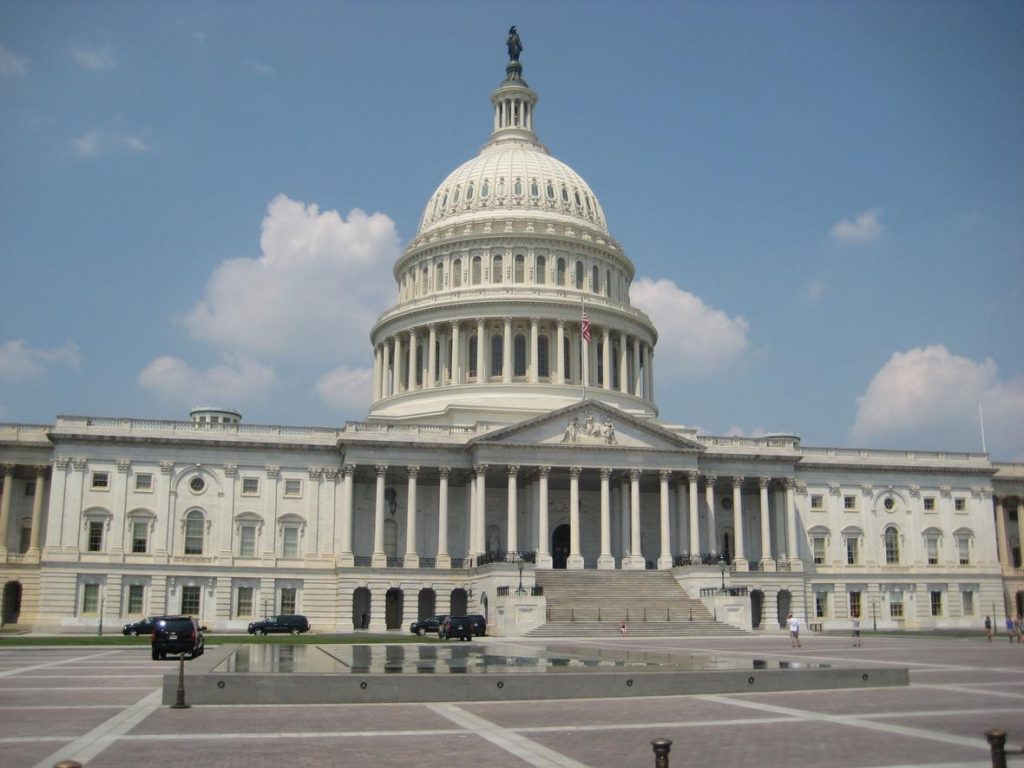
In a sweeping power shift, Democrats won majorities in both the House and Senate in the midterm elections, raising questions about how Congress and the administration will navigate the stalled FY27 defense budget process, the war with Iran, and other defense policy measures. These issues will affect the timing of a final FY27 defense appropriations bill, as well as the handling of hundreds of billions of dollars in acquisition funding that might not materialize.
The biggest issue at hand for the Pentagon is the fate of the proposed reconciliation bill. The administration’s $1.5 trillion FY27 request relies on $350 billion to be provided through budget reconciliation, a process that requires only a simple majority to pass the Senate. This process was already used to give the Pentagon more than $150 billion in additional funding for FY26, but the larger FY27 proposal has faced more resistance. Prior to the election, Defense Secretary Pete Hegseth said the Pentagon would continue to fight for the full $1.5 trillion request, even though some Republican lawmakers questioned whether they had the votes to pass the $350 billion reconciliation bill. The Democratic wins in both the House and Senate effectively kill the reconciliation bill under the new Congress. Republicans could try to pass the bill over the next two months before the next Congress is seated, but that appears unlikely. The GOP lacked concrete support before the election, and it has since lost political momentum typically needed to pass such a large piece of legislation.
Impact of No Reconciliation Bill
The lack of a $350 billion reconciliation bill would affect programs across the military. Most notably, the Pentagon would lose access to around $113 billion in defense industrial base funding, including $49 billion related to domestic sourcing of critical minerals, as well as various strategic investment and loan programs spanning multiple industries.
The reconciliation bill would have pushed FY27 munitions funding to $76.3 billion, a 184.7 percent increase over FY26 levels. This influx was intended to help rebuild stockpiles following several years of equipment transfers to Ukraine and a depletion of inventories during the war with Iran. The reconciliation package would have backed a production surge for air and missile defense munitions such as Patriot, THAAD, SM-3, and SM-6, as well as a range of offensive strike weapons, including hypersonic missiles. Munitions funding was also included in a separate Iran supplemental request, but that proposal has faced resistance from Democrats who oppose the war.
Another major reconciliation loss for the administration would be the Golden Dome homeland missile defense system. The reconciliation bill included $17 billion for a new Golden Dome for America Fund, as well as separate investment for related programs such as a Space-Based Air Moving Target Indicator (SB-AMTI) capability and a revamped Space Data Network (SDN) that would serve as the communications layer of the defense system. The reconciliation request also included nearly $54 billion for the Defense Autonomous Warfare Group (DAWG), funding that now appears unlikely to materialize.
Several ongoing defense programs normally funded in the base budget also relied in part on the proposed reconciliation bill. For example, several F-35 and KC-130J airframes were allocated to the reconciliation portion of the request, while the Navy relied on reconciliation to fund the Medium Landing Ship and some investment in the Virginia class submarine. Lawmakers will have to determine whether to move any of those items into the regular defense budget before passing a final spending bill.
The Pentagon’s $1.1 trillion base budget request will also face more resistance. House Armed Services Committee Ranking Member Adam Smith (D-Wash.), who is expected to chair the committee in the next Congress, released a statement this week saying he wants to find a path forward that does not require spending more than $1 trillion on defense. The base budget request reflected an increase of $242.4 billion, or 28 percent, over the regular FY26 defense appropriations bill enacted by Congress. The defense request was paired with a proposed reduction in domestic non-defense discretionary spending. The guns-versus-butter debate will be reignited, and it is unclear whether base budgets will stay above the $1 trillion threshold. However, the base budget could absorb several programs originally slated for reconciliation funding.
Political Headwinds
Beyond the reconciliation issue, several programs are likely to face increased scrutiny in the new Congress. Chief among them are the administration’s “Golden” efforts, namely Golden Dome and the Navy’s Golden Fleet. Golden Dome’s space-based interceptor (SBI) component is a likely target for Democratic opposition. The Pentagon initially selected a dozen companies to work on SBIs, including Anduril, General Dynamics, Lockheed Martin, Northrop Grumman, Raytheon, and SpaceX.
SpaceX’s involvement in the SB-AMTI and SDN programs could also face new roadblocks in the next Congress. The company received contracts worth up to a combined $6.5 billion for these efforts.
The Navy’s Trump class battleship, the signature component of the proposed Golden Fleet, is also at risk. This author has already raised concerns about the practicality and affordability of the battleship, and Democrats are likely to push back on the program’s rapid development and construction plans. The Navy had already selected General Dynamics Bath Iron Works and Huntington Ingalls Industries to build the ships, which would use a distributed construction approach. Leidos’ Gibbs & Cox was tasked with supporting ship design and engineering. If this program falls through, the Navy may revisit plans for a follow-on DDG(X) destroyer, which had been shelved in favor of the battleship.
The next Congress will also place more political pressure on the administration to end the war with Iran, which has caused prolonged disruption of shipping through the Strait of Hormuz. Democrats have been unwilling to act on the Iran war supplemental request without establishing guardrails or an exit strategy. At the same time, Democratic majorities in the House and Senate are more likely to push for greater support for Ukraine, which could include additional funding, faster arms transfers, and pressure on the White House to avoid actions that could harm Kyiv.
Areas of Alignment
The change in congressional control does not mean defense markets will lose support across the board. In fact, there is bipartisan support for a broad swath of Pentagon acquisition priorities. Even without reconciliation, Congress will continue to fund replenishing munitions stockpiles depleted during operations against Iran, despite Democratic opposition to the war itself. Counter-unmanned aircraft systems (C-UAS) investment will remain a priority, spanning everything from low-cost munitions to directed energy. Congress has long been supportive of Navy shipbuilding, which will continue to see increased investment, even if lawmakers disagree about specific platforms. There will also be continued support for developing autonomous solutions across domains, as well as the robust networks needed to support them. The scale of funding might be up for debate, but these markets will generally continue to see congressional support.
More Budget Delays Expected
Another concern for the Pentagon is the timing of FY27 appropriations, which are likely to face additional delays. The government is currently operating under a continuing resolution (CR) through December 11, at which point lawmakers must either pass a budget or adopt another CR to avoid a government shutdown. Congress will not have enough time to finalize a full spending plan by then, meaning it will likely pass another short-term CR that extends into the next calendar year. From there, passage of a final spending bill could be hindered by negotiations over the status of the Iran war, topline spending levels, the debt ceiling, or other policy issues.
There is also the prospect of a long-term CR, whether one lasting several months or one covering the entire fiscal year. These stopgap spending bills typically restrict new start programs and production rate increases, limitations that become more consequential the longer a CR remains in place. However, lawmakers can provide workarounds for these limitations, as they did in the FY25 full-year CR.
Without these funding exceptions (or anomalies, as they are formally called), a long-term CR could put a hold on dozens of new programs. The Army could see delays in starting procurement of the MV-75 tiltrotor aircraft and the XM30 Mechanized Infantry Combat Vehicle. Funding would also be limited for its new High Accuracy Detection and Exploitation System (HADES) surveillance platform, Next-Generation Command and Control (NGC2), and procurement of new Common Tactical Trucks (CTT).
The Navy would face funding gaps for its new FF(X) frigate program and procurement of new submarine tenders. Production of hypersonic Conventional Prompt Strike missiles and planned funding increases for MQ-25 development would also be blocked.
A long-term CR would affect several Air Force missile programs, including procurement of hypersonic AGM-183A Air-Launched Rapid Response Weapons (ARRW), Hypersonic Attack Cruise Missiles (HACM), and the Family of Affordable Mass Missiles (FAMM). The Air Force’s plan to start procurement of new Collaborative Combat Aircraft (CCA) would be delayed without an FY27 spending bill, as would investment in new technologies to defend aerial tankers and a new aircraft to conduct the Looking Glass mission currently performed by the Navy’s E-6B Mercury.
A Bumpy Road Ahead
The White House and congressional Republicans must decide how to use the two months remaining before the new Congress is seated. Options include focusing on their budget agenda, working on leadership nominations that require Senate confirmation, or other policy matters. After a wave of defeats at the polls, it’s unclear whether Republicans have enough wind in their sails for a rapid-fire lame-duck session. There are also questions about leadership in the Pentagon, with Democrats, and even some Republicans, calling for Hegseth’s removal. Although congressional leverage is limited while President Trump is in office, the results of the midterm elections will have a sweeping effect on the Pentagon, from budgets to leadership to defense policy.

Shaun's deep-rooted interest in military equipment continues in his role as a senior defense analyst with a focus on the United States. He played an integral role in the development of Forecast International's U.S. Defense Budget Forecast, an interactive online product that tracks Pentagon acquisition programs throughout the congressional budget process. As editor of International Military Markets – North America, Shaun has cultivated a deep understanding of the vast defense markets in the United States and Canada. He is a regular contributor to Forecast International's Defense & Security Monitor blog and has co-authored white papers on global defense spending and various military programs.