The Russo-Ukrainian war is grinding into its fifth year of conflict and has caused both actors to develop new technologies out of immediate necessity, more often than not. Entire industries have been formed and expanded to supply each military with the necessary innovative equipment to maintain an edge on the battlefield. One such aspect that has seen an emphatic surge is the military drone market. Countless videos and articles highlighting Ukrainian and Russian first-person view (FPV) drones for Intelligence, Surveillance, and Reconnaissance (ISR) or for one-way attack missions have become commonplace. What began as simple, off-the-shelf civilian drones being adapted for military use has evolved into purposefully designed unmanned systems that have entered serial production for combat operations. These systems, such as Unmanned Ground Vehicles (UGVs) and Unmanned Aerial Vehicles (UAVs), are now being outfitted to adapt to the transforming dangers of the last tactical mile, the final section of terrain leading to the front lines that is the most hazardous to troops and equipment.
Ukrainian Advances in Unmanned Systems
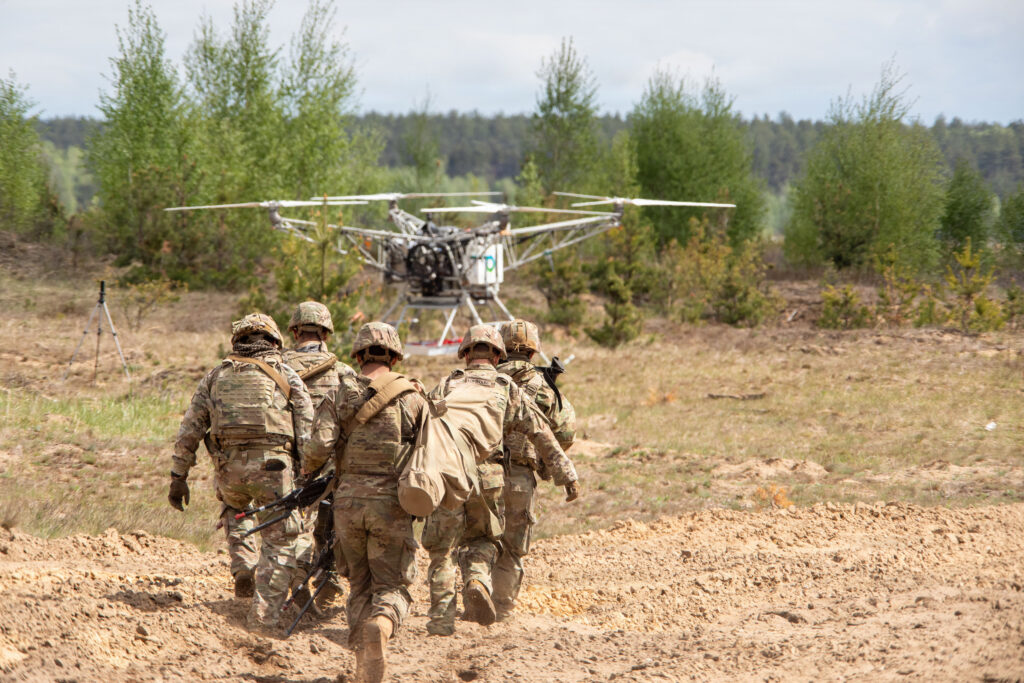
When it comes to innovation in the use of unmanned systems on the front lines of the Russo-Ukrainian war, necessity has once again proven to be the mother of invention. For instance, the Ukrainian Armed Forces’ (UAF) 475th Separate Assault Regiment has claimed that it has successfully evacuated two seriously wounded soldiers from forward positions using the StarGate UAV. StarGate is a specialized CASEVAC drone produced by SkyFall, a Ukrainian defense tech company. This follows a previous case reported by the UAF’s 30th Mechanized Brigade, in which it claimed it had successfully completed the world’s first frontline CASEVAC of a wounded soldier using a heavy hexacopter provided by Gurzuf Defense.
Unmanned systems have also served in other roles on the Ukrainian front lines. Smaller models such as the Frodo multipurpose UGV have been used for logistics and medical evacuations. Other models, such as the proven Droid TW 12.7 UGV, successfully held a key position against Russian attacks for 45 days in 2025. These instances have shown that unmanned systems have become critical for battlefield operations. These are just two examples among the countless unmanned systems that have been codified for operational use by the UAF. This has essentially fostered an incubator of sorts for new defense technology in Ukraine that has developed into a robust drone industrial base. In summer 2026, Ukraine’s Deputy Defense Minister Mstislav Banik went so far as to claim that the country’s defense industrial base could produce as many as 20 million military drones per year if allies committed sufficient resources.
The European Union has itself invested heavily in Ukraine’s innovative endeavors and wartime manufacturing footprint. In the summer of 2026, the European Commission disbursed €1 billion to Ukraine for drone procurement, the second payment from a €6 billion plan under the Ukraine Support Loan. The Commission also approved an additional €10 billion long-term disbursement plan to fund Ukraine’s defense industrial base and help further develop its burgeoning drone market. Additionally, a new coalition known as the EU-Ukraine Drone Alliance was formed to bolster cooperation and form joint ventures between Ukrainian and European companies to enhance Europe’s drone and counter-drone capacities.
U.S. Attempts to Catch Up
Whereas Ukraine has largely focused on more cost-effective, attritable unmanned and autonomous systems for the ongoing conflict in defense of its country, the U.S. has gone down a different path. The Department of Defense (DoD) has invested in varied takes on unmanned systems across all branches of the U.S. military, with a specific focus on autonomous models. It has already committed more than $115 million to UGV projects in FY26 to push ahead in testing and evaluation of systems before potential full deployment.
The DoD has pushed to procure UGVs to further bolster its troops’ capabilities within the last tactical mile of future battlefields. As a result, U.S. defense companies have been busy developing systems to meet the Pentagon’s strict standards for these unmanned systems. The U.S. Army launched the Infantry Last Tactical Mile (ILTM) initiative in August 2026 and announced it had chosen six vendors to provide production-ready prototype systems for beyond-line-of-sight autonomous control. The companies are Maren-Go, Overland AI, Forterra, Hendricks Motorsports, American Rheinmetall, and HDT (now known as BLADE). A seventh vendor, Azak, announced in October 2026 that it had been added to the ILTM initiative. These companies will now provide autonomous systems designed for logistics resupply to the forward line of own troops (FLOT) and CASEVAC operations for demonstrations and assessments. The final phase of the ILTM initiative will consist of an Operational Assessment with an Army unit in early FY27.
Funding U.S. Innovation
The reality that has come to the forefront in 2026 is that the DoD wants a cheaper alternative to costly munitions that can also be manufactured at a significantly faster pace, something it was forced to come to terms with as a result of the ongoing conflict with Iran. Where the cost of a surface-to-surface missile can run into the low millions of dollars, the DoD may only have to pay in the low tens of thousands of dollars for a single Low-cost Uncrewed Combat Attack System (LUCAS) drone that can potentially be manufactured close to the front lines. Granted, these systems serve distinct purposes, yet that distinction feeds into the Pentagon’s push for the adoption of an entirely new drone doctrine.
In late September 2026, the Pentagon launched Project Agincourt, an initiative designed to accelerate the development, procurement, and deployment of unmanned and autonomous military systems. It will also begin to lay the groundwork for the proposed Autonomous Warfare Command (AUTOWARCOM), with a target launch of October 1, 2027. Additionally, the Drone Dominance Program, an endeavor aimed at procuring large numbers of low-cost drones through the creation of a stable domestic industrial base, has begun to produce results. Overseen by the Direct Reporting Portfolio Manager for Unmanned Systems (DRPM-UxS), these initiatives are examples of an overarching strategic overhaul to field unmanned systems. DRPM-UxS has already invested approximately $782 million in 2026 and delivered over 1,300 one-way attack UAVs and more than 24,000 counter-UAS systems via its Joint Interagency Task Force 401. The Drone Dominance Program is set to receive over $1 billion in funding over two years to further develop its procurement capabilities with a goal of fielding 200,000 drones by 2027.
Uncertainty in the Future
A significant factor as of November 2026 is the very real possibility that many line items in the Pentagon’s budget may be reworked or slashed as Democrats take control of Congress in January after a monumental midterm election. Democrats have stated that they will attempt to keep defense spending under the administration’s requested $1 trillion Pentagon base budget. It is unclear whether the newly elected Congress will want to continue to fund the significant uptick in unmanned autonomous systems programs, as the U.S. military is already struggling to resupply its munitions stockpiles. Additionally, the continued threat of fragile critical mineral supply chains failing could lead to a bottleneck in the availability of important components for military drone production. The U.S. has begun to reshore these supply chains, but it will take years, if not decades, to produce a stable mineral industrial base at the needed scale.
The DoD has learned lessons from the Russo-Ukrainian war and has taken important steps to address its shortcomings when it comes to drones on the battlefield. It has become especially evident that unmanned system innovation for the last tactical mile is a priority for the U.S. military. As it looks to potential large-scale conflicts in the Pacific or an escalation in the Middle East, the Pentagon has identified essential autonomous unmanned systems for a modern battlefield. The challenge now is whether it will be able to strengthen the domestic industrial base to supply drones at a mass scale for vast, theater-wide conflicts, as it aims to do in the coming years.

Juan Lopez pursued an undergraduate degree in Political Science with an emphasis in International Relations and a minor in Russian studies from the University of California, Riverside. Juan’s diverse background includes his work as a staffer in the U.S. House of Representatives and in federal law enforcement which gave him extensive experience and knowledge in federal government operations, international affairs, counter terrorism, and national security. His interests include land-based weapon systems, small arms, military fixed wing aircraft, and Latin American relations. He is proficient in the Spanish language at a native level.