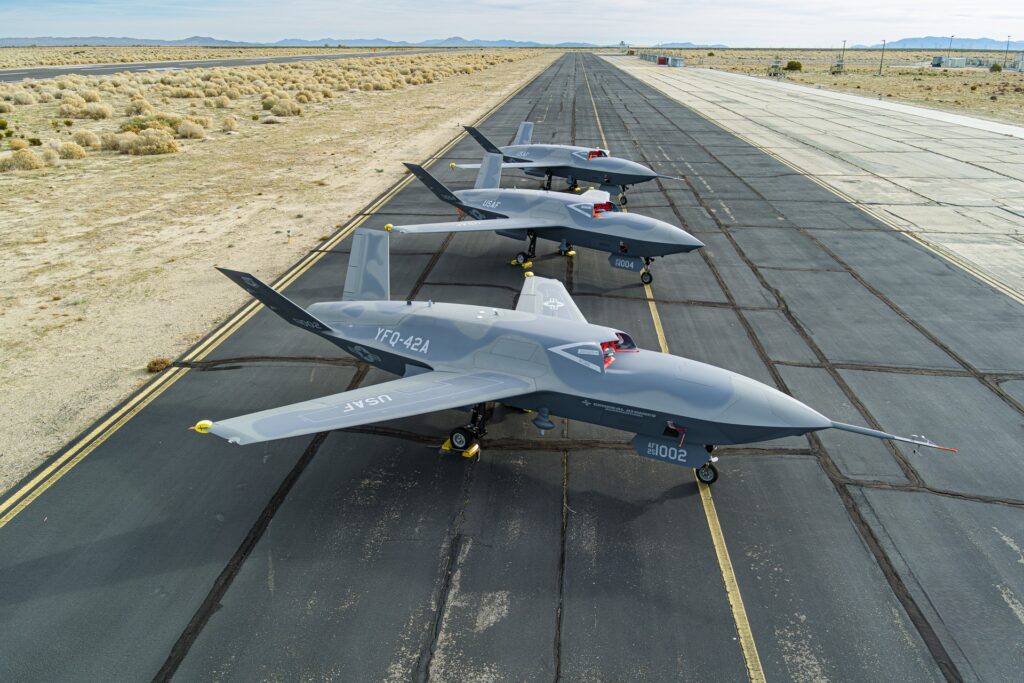
General Atomics and Anduril are co-winners to build loyal wingman drones to fly alongside U.S. Air Force F-22, F-35, and future F-47 fighter jets. On June 17, U.S. Air Force Public Affairs announced contractor selectees for hardware and software components for the Collaborative Combat Aircraft (CCA) program.
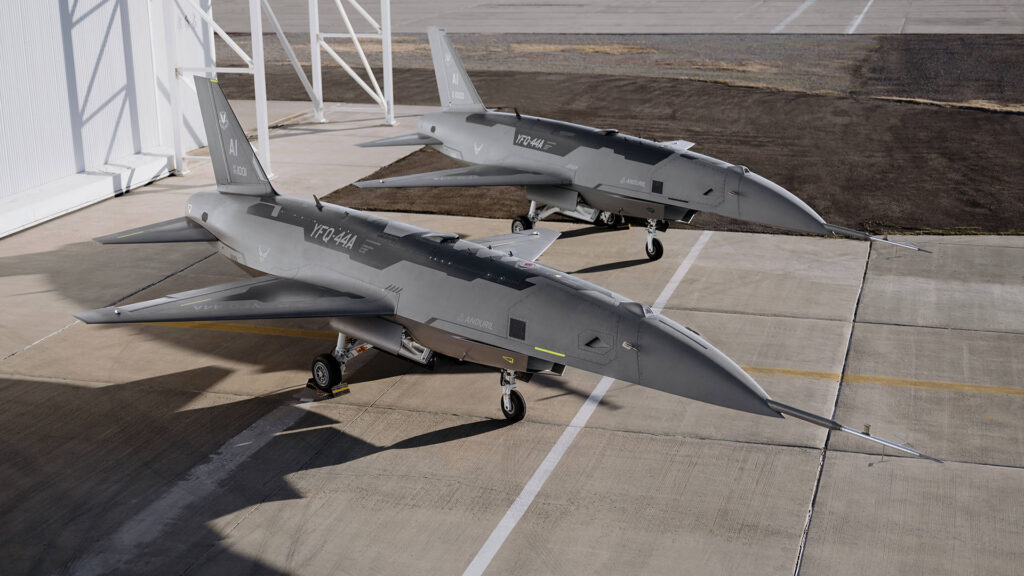
With engineering and manufacturing development (EMD) agreements in place, General Atomics and Anduril will build over 150 FQ-42 and FQ-44 CCAs through 2029. The “Y” prototype prefix, now dropped from their designations, signals authorization for production units. Both companies have previously announced preparations for full-rate production, with investments and infrastructure in place to scale manufacturing at the Air Force’s direction.
An integral and unique component of the CCA awards is the additional announcement for mission autonomy software contracts. The Air Force tapped six companies, including Anduril, General Atomics, Lockheed Martin, Northrop Grumman, RTX Collins Aerospace, and Shield AI, to enter a “competitive marketplace” six-year contract framework to continue developing CCA autonomy stacks. Moreover, Anduril, RTX Collins Aerospace, and Shield AI received production options for operational autonomy software, funding a six-month competitive iteration.
Relatedly, those three vendors successfully flew their respective autonomy stacks earlier this year aboard YFQ-42A and YFQ-44A prototypes during flight testing. The testing campaign demonstrated the modular benefits of the federal Autonomy Government Reference Architecture (A-GRA), which, in part, enables the customer to competitively source software independent from the airframe manufacturer. During testing, the industry partners showcased the ability to transfer in-flight aircraft control between different software pilots.
Following the two-part year-long competitive mission autonomy period, the Air Force will select a CCA Increment 1 “primary mission autonomy provider” from the pool by next summer.
Analysis
The CCA program offers several bright spots for Pentagon customers and the U.S. aerospace and defense tech industry. CCA stakeholders continue to show an appetite for prioritizing development speed while resisting the temptation to over-refine before fielding. The program illustrates an important aspect of future American defense acquisitions, compressing the development-to-fielding timeframe.
Both the General Atomics YFQ-42A and Anduril YFQ-44A completed their maiden flights last fall within 18 months of their prototype production awards. Anduril marked the milestone at only 556 days from clean-sheet design to takeoff. For context, Anduril acquired Blue Force Technologies in 2023, a North Carolina company that began developing Fury in 2019. The Air Force moved into the EMD phase four months early, suggesting satisfaction with testing progress and trust in their industry partners.
Using a phased approach, the Air Force can accelerate the placement of Increment 1 FQ-42 and FQ-44 aircraft with operators while simultaneously working with other competitors to iterate for subsequent increments.
The decision to award production contracts to both competitors, rather than a single vendor, benefits all stakeholders. The inherent design differences between the two aircraft, notably the YFQ-42A’s internal weapons bay and YFQ-44A’s external hardpoints, present both performance and manufacturing advantages. Two different aircraft will afford mission planners flexibility for assigning assets particular mission roles to capitalize on the strengths of each, perhaps a missile carrier for one sortie, a stealthy sensor platform for another.
With a traditional UAS prime contractor in General Atomics and a software-first defense firm in Anduril, the Air Force will be able to assess each company’s scaled manufacturing performance. Anduril, from the start, has prioritized mass production to drive down cost, simplifying its factory layout at its Ohio Arsenal-1 plant and building YFQ-44A with over 90 percent commercially available components.
The CCA effort has so far stimulated the defense aerospace base like no other modern combat aircraft program, drawing both publicly traded defense primes and privately backed tech-forward companies into the same arena. With the main legacy primes such as Lockheed Martin, Northrop Grumman, RTX, and likely Boeing involved, the inclusion of newer VC-backed entrants like Anduril and Shield AI breeds competition in a market segment once dominated by only a few giants.
Despite a deep-rooted belief that the defense acquisitions landscape has historically favored the growth of major defense corporations, newer players are willing to challenge that stereotype. One day before the production award announcement, Shield AI President Brandon Tseng told attendees at the Defense One Tech Summit that there is an overemphasis on the “Valley of Death” narrative surrounding defense tech startups. “Companies fail all the time. It’s okay, it’s healthy for capitalism, it’s healthy for resource allocation.” Tseng underscored that startups face challenges everywhere, perhaps more so in non-defense markets like consumer tech.
In addition to catalyzing competition, the CCA program also requires industry participants to coordinate capabilities to support the purchaser. Interoperability, playing well with others, is now the standard expectation for the Pentagon. In practice, this means modular options for the operator. Software upgrades from industry must meaningfully advance hardware capabilities, regardless of which manufacturer builds the platform.
But the Air Force has done more than pay lip service to its aspirations for CCAs and acquisition reform. The service’s FY27 budget request shifted from research to procurement funding, with nearly $1.0 billion for production vehicles and includes over $2.5 billion in total for the program. Funding growth from FY26 to FY27 is a statement to industry and observers: the Air Force is serious about moving fast to field AI-piloted fighter drones.
Thus far, the Air Force CCA story is one of promising contract and program management design and execution. It’s a model that has the potential to tap into the best of American defense capitalism and set a precedent for the U.S. Navy and Marine Corps’ own CCA ambitions.

A former naval officer and Seahawk helicopter pilot, Jon currently leads the Military Aerospace and Weapons Systems group at Forecast International. He specializes in current and emerging military fixed and rotary-wing aircraft. With over a decade of experience in military aviation, operations, and education, he forecasts a diverse range of defense and naval systems.
Influenced by his time as a former Presidential Management Fellow and International Trade Specialist at the Department of Commerce, Jon gained insights into government operations and global markets.
Before joining Forecast International, he served as an NROTC instructor and Adjunct Assistant Professor at the University of Texas, teaching undergraduate courses in naval history, navigation, defense organization, and naval operations and warfare.