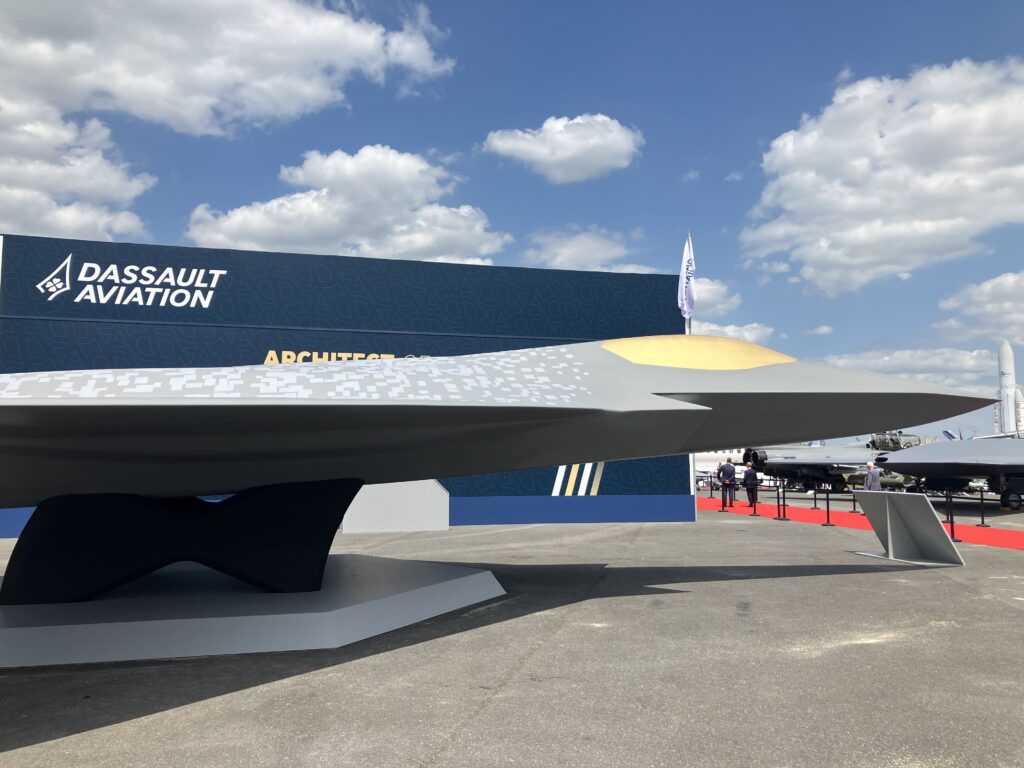
The Future Combat Air System (FCAS) is in its death throes. The end of Germany, France, and Spain’s combined effort to develop a sixth-generation fighter comes after years of a publicly tenuous relationship between the main industrial partners.
Following reports this week that German and French political leadership failed to find common ground between the prime contractors, Germany’s defense minister, Boris Pistorius, stated that termination resulted from “differing positions among the industries.” At the core is a long-running workshare ownership dispute between France’s Dassault Aviation and Airbus Defence and Space, representing Germany and Spain.
That dispute, bubbling over for nearly four years, centered on design and supplier control of the cornerstone New Generation Fighter (NGF) platform. Last summer, Dassault CEO Eric Trappier claimed that his company desired up to 80 percent workshare on the aircraft because of the airframer’s technical know-how and history of fighter development. Subsequently, German industry warned that ceding that much territory would threaten the life of the country’s fighter manufacturing capability.
Aside from the deeply entwined political and industrial ramifications for the main players, national security interests and air power needs fed the divide over FCAS. France envisioned the NGF as the successor air component for its nuclear deterrent strategy and needed compatibility with the next-generation Porte-Avions de Nouvelle Génération (PA-NG) aircraft carrier. Both requirements added industrial and financial complexity for Germany as a non-nuclear, carrier-less nation. Earlier this year, it appeared the standing contradiction might fade with Airbus’ proposal for a “two-fighter” mediation, but resolution never materialized.
Options and Aftermath
Attention is now quickly turning to what moves the stakeholders will make next. For Germany, Pistorius has publicly outlined at least three potential alternatives. The first involves a stopgap fighter procurement, presumably for fifth-generation aircraft like the U.S. F-35. Despite concerns last year that the White House’s political disposition toward NATO could impact F-35 sales, Germany’s commitment to the Lightning II has remained firm.
Last fall, reports emerged that Berlin planned to procure 15 F-35s in addition to its current order for 35 F-35As. More F-35s as an interim solution is a logical move considering Germany’s ties to the fighter. German defense firm Rheinmetall opened a plant in mid-2025 to build F-35 center fuselages with plans to employ 400 workers by the end of 2026.
Second, Germany could join the trilateral Global Combat Air Programme (GCAP) alongside partners Italy, Japan, and the U.K. Concerns about a delay to the 2035 target fly date are already surfacing if Germany comes aboard. However, the alliance would benefit from the infusion of German cash flow and technical expertise.
Alternatively, Airbus is reportedly signaling interest in working alongside Sweden on a possible sixth-generation fighter project. Saab’s work and intentions on a next-generation fighter are less clear. Nonetheless, the Gripen airframer is under contract from Sweden through 2027 for a future fighter concept study. For its part, France is likely to turn its focus to the Dassault Rafale, primarily, ushering in the F5 upgrade for service entry in the 2030s.
Resulting impacts will now ripple across the global fighter market. Spain and Belgium will need to shift plans, and potential customers or contributors, such as Saudi Arabia, will be standing by to watch how things shape up. American fighter builders, Boeing and Lockheed Martin, could capitalize on export opportunities, and, to an extent, the increasingly eventful Collaborative Combat Aircraft (CCA) segment will respond. Moreover, the question persists about whether Europe has the political will, industrial capacity, and financial power to produce two next-generation fighter systems.

A former naval officer and Seahawk helicopter pilot, Jon currently leads the Military Aerospace and Weapons Systems group at Forecast International. He specializes in current and emerging military fixed and rotary-wing aircraft. With over a decade of experience in military aviation, operations, and education, he forecasts a diverse range of defense and naval systems.
Influenced by his time as a former Presidential Management Fellow and International Trade Specialist at the Department of Commerce, Jon gained insights into government operations and global markets.
Before joining Forecast International, he served as an NROTC instructor and Adjunct Assistant Professor at the University of Texas, teaching undergraduate courses in naval history, navigation, defense organization, and naval operations and warfare.