 Source: Ukraine Ministry of Defense
The Defense One Tech Summit held on June 16 focused on the technologies shaping the battlefield as well as the process of integrating those technologies into Armed Forces. The summit featured a range of speakers and panels examining everything from artificial intelligence to unmanned systems to defense finance. Two segments, “All Wars are Robot Wars” and “Deterrence at the Edge,” focused specifically on the war in Ukraine and how emerging technologies are being utilized in modern conflicts.
For the “All Wars are Robot Wars” discussion, D1’s Patrick Tucker interviewed Maj. Gen. Dominique Luzeaux, NATO digital transformation champion and special advisor to the Supreme Allied Commander Transformation, on the lessons that NATO can draw from the war in Ukraine, particularly in the unmanned domain.
A significant factor in Ukraine’s defense is the country’s ability to knit its various unmanned systems together into a cohesive fighting force. “What is important is to have an integrated multi-domain robotic ecosystem, because it’s not just one drone making the difference, it’s all the drones being together – the right number, at the right place, at the right time, making a true difference,” Maj. Gen. Luzeaux stated. Modern militaries must thus focus more on “the orchestration between the different assets.”
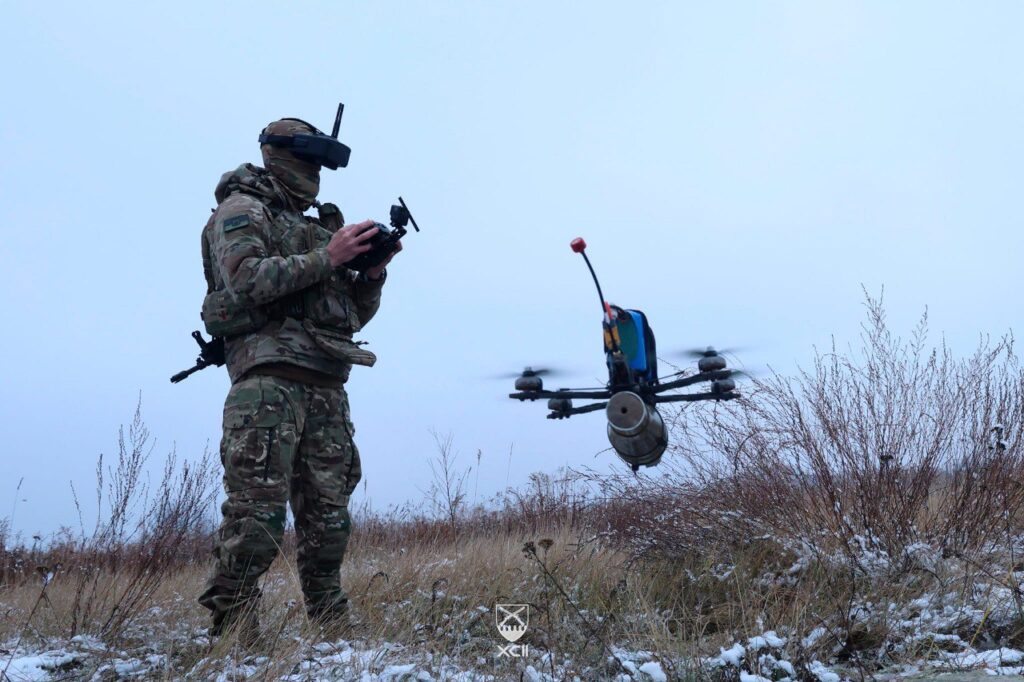
The close integration of Ukraine’s unmanned systems can be seen from the copious amounts of combat footage coming out of the war. Ukrainian reconnaissance drones, together with real-time satellites, provide a constant picture of the frontlines, relaying information back to FPV operators who will then deploy attack drones to hit Russian armor, artillery, and personnel. Surveillance drones will assess the impact of the strikes and additional assets can be deployed as necessary.
As Ukraine refines its capabilities, the country’s military has continually compressed the timeframe in which this strike process takes place. This has resulted in a very lethal frontline, and expanded the definition of what the ‘frontline’ is. Any personnel or assets operating within 5 kilometers of the line of control is at very high risk of being “targeted and neutralized in the very short term,” Maj. Gen. Luzeaux observed. Both Ukraine and Russia have worked to expand that ‘kill zone’, to the extent that even forces 20 kilometers or more from the front face the threat of precision strikes should they be detected.
It is a similar story for defense as with offense. The proliferation of one-way attack drones in war has spurred investment in counter-unmanned aerial system (C-UAS) technology to guard troops, assets, and infrastructure. Plenty of individual solutions exist to defeat an incoming drone, but the key to success in an actual operation will revolve around integrating these C-UAS tools with sensors – some of which can be leveraged from the civilian sector. Maj. Gen. Luzeaux highlighted 5G infrastructure as an example, as it can be utilized as sensors in addition to communication.
Powering these developments on the battlefield are rapid innovation cycles in both Ukraine and Russia squaring off against one another. Maj. Gen. Luzeaux noted that, over time, the two sides have developed a six-week innovation cycle. By 2024, the conflict had evolved into an “innovation cycle against innovation cycle,” as each worked to counter the advances made by the other.
The ‘Robot Wars’ discussion was followed later in the day by a presentation from Red Hat’s Stephen Gordon, called “Deterrence at the Edge,” that took a high level view of the impact of Ukrainian operations on the pace of Russia’s invasion.
At the war’s start in 2022, the conflict was primarily “conventional, mechanized, maneuver warfare” that saw significant amounts of territory change hands, Gordon highlighted. Already by 2023, however, “the lines started to crystallize” and it became much more difficult “to conduct operational maneuver at scale.” In 2025, Russian troops were advancing on average 15 square kilometers per day. That rate has subsequently slowed in 2026, to about 7 square kilometers daily in the first quarter of the year and as few as 2-3 square kilometers per day in recent weeks.
Slowing rates of advance run contrary to Moscow’s expectation of how the war would unfold. The Kremlin presumably expected a fast victory in 2022. Even as the initial assault failed to topple Kyiv, Russia’s leadership has remained confident that a war of attrition would grind Ukraine’s defenses down and eventually produce a Russian military victory anyway, leveraging Russia’s larger population and industrial base.
A major factor hindering Russia’s war of attrition has been the introduction of drone systems and, more crucially, the software that interconnects them. Following the start of the conflict, Ukraine developed Delta, a digital battlefield management system, that runs in the cloud and can be installed on operators’ computers, tablets, and phones. Delta brings together all of Ukraine’s data feeds to provide a real-time picture of the battlefield, and is used by everyone from operators in the field to commanders to the General Staff.
Where commanders were slow to adopt Delta, their sectors saw the greatest rate of Russian advances, Gordon noted. While many factors play into that dynamic, it is likely that the reduced level of situational awareness compared to other sectors played a role. In August 2025, the Ukrainian Ministry of Defense issued an order to deploy Delta across all levels of the country’s Armed Forces, essentially forcing adoption.
As for where modern warfare might be headed, Gordon observed that peer warfare may increasingly be “dispersed, protracted, and lethal.” Precision strike capabilities have inhibited – though not eliminated – maneuver warfare, forcing dispersed operations undertaken by very small teams of personnel. Each soldier faces a significant threat of mortality, as Gordon noted that in the war in Ukraine, “the kill rate exceeds the wounded rate.”
Conflicts are thus more likely to be drawn-out affairs, and the winner defined not necessarily by who has the best kit (or the largest quantity of kit), but “the side that is able to leverage the industrial base to their advantage.” In particular, that will mean cultivating a culture of innovation within the industrial base, as seen in the conflict in Ukraine, where rapid development cycles have enabled each to create counters for the other’s technological advances in a matter of weeks, not months or years.

Military markets analyst, covering Eurasia, Middle East, and Africa.
image sources
- Ukraine FPV drone: Ukraine Ministry of Defense