On August 4th, the United States Southern Command (SOUTHCOM) announced the formation and activation of the Joint Task Force Western Hemisphere (JTF-WHEM), a dedicated new organizational entity intended to facilitate and coordinate military action against organized criminal threats by U.S military formations and regional partner states. The DoD’s creation of the JTF-WHEM represents the institutional culmination of over a year of heightened U.S military and intelligence activity across Latin America and an effort to consolidate and formalize the progressive expansion of the U.S military’s directly interventionist security posture in the region under the strategic principles of the emergent ‘Donroe Doctrine’.
The objectives and doctrinal approach of the JTF-WHEM build most directly upon the foundations laid by the second Trump administration’s preceding Operation Southern Spear. Initiated in late 2025, Southern Spear marked a significant departure from recent precedents regarding U.S foreign policy in Latin American. Over the late 1990s and 2000s, the conclusion of the Cold War and rising regional democratization, mounting diplomatic concerns over the divisive regional response to historical U.S interventions and their legacies and the subsequent operational demands of the Global War on Terror (GWOT) saw the United States adopt a more distant posture towards the management of its interests in the near-abroad. While the U.S remained active in the provision of bilateral security cooperation and assistance and continued to leverage its intelligence and economic levers to confront regional threats and advance its regional objectives, the U.S military’s open and active presence in the region receded considerably relative to the historical norm. Southern Spear was envisaged as a highly visible reorientation of the United States’ regional posture. Beginning with lethal U.S Navy strikes against alleged narcotics trafficking vessels in the Caribbean in 2025, the operational and strategic purview of Southern Spear steadily expanded over the course of the following year plus, coming most dramatically to encompass the direct military overthrow of Venezuelan President Nicolas Maduro in early 2026 under Operation Absolute Resolve and the subsequent re-intensification of U.S economic and military pressure on Cuba.
While significantly less visible than U.S military-fronted events such as the Maduro operation, over the past year SOUTHCOM has also steadily sought to more closely integrate U.S formations into local security operations and deepen the integration of partner states’ security forces into the operational umbrella of a United States-lead regional security architecture. In March 2026, the Trump administration oversaw the formation of the Americas Counter Cartel Coalition (A3C or Shield of the Americas), a U.S-lead multilateral body aimed at coordinating regional security actions against transnational organized crime. That same month, U.S military formations under SOUTHCOM directly participated in a joint-operation alongside Ecuadorian security forces against an alleged criminal hub inside Ecuador’s borders.
The creation of the JTF-WHEM and the A3C can be placed in the context of a deepening cognizance of the need to at least partially manage regional security relationships and strategy on a multilateral basis. Though a rising tide of Latin American states are adopting similarly ‘iron fisted’ policies towards organized crime and were broadly sympathetic to the removal of the Maduro regime, the predominantly unilateral character of Southern Spear’s controversial boat strikes and the future implications for national sovereignty stemming from the Maduro operation have also generated unease in a region where the political legacies of U.S interventionism continue to loom large in the popular imagination of the public.
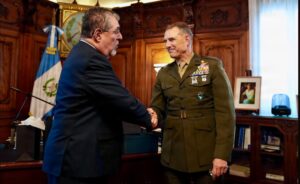
Consequently, the transition towards the JTF-WHEM and A3C, both announced with a distinctive rhetorical emphasis on deepening regional security synchronization and coordination, is aimed at facilitating the United States’ leadership role in the region. Both the JTF-WHEM and A3C represent forums through which the U.S and SOUTHCOM leadership can potentially build and enforce strategic consensus, guide the direction of operational planning and ensure U.S involvement, manage and mediate disputes and pressure or isolate non-participating parties. With the provision of direct security and economic assistance to regional states increasingly contingent on bilateral cooperation on areas of U.S interest, there are strong political and material incentives for regional states to join the A3C’s ranks. In recent months, through diplomatic activity and visits from senior SOUTHCOM personnel, the U.S has sought to attain regional buy-in or acquiescence for its expanded leadership role in the region and the potential formalized deployment of U.S military formations inside the borders of regional partner states. Alongside Ecuador, on August 12th U.S Secretary of Defense Pete Hegseth announced that Colombia, Honduras and Guatemala had also approved U.S participation in combined operations against criminal entities. In totality, these moves lay the foundation for the significant expansion of the U.S military’s direct operational participation in internal security operations across Latin America.

A lifelong enthusiast of armored vehicles, Thomas serves as an analyst on Forecast International's Military Vehicles Forecast product. In addition, Thomas is responsible for updating the reports and analysis within Forecast International's International Military Markets – Latin America & Caribbean product. He also provides analysis for Forecast International's Airborne Retrofit & Modernization Forecast. Before this assignment, Thomas served as a research assistant for Forecast International's analytical team and has made written contributions to the Civil Aircraft Forecast, Military Aircraft Forecast, and Rotorcraft Forecast services. Thomas derives his knowledge from a multidisciplinary background, with a strong emphasis on the history and politics of Russia and the former satellite republics of the Soviet Union. He has studied in the Russian Federation at Saint Petersburg State University and is proficient in the Russian language at an advanced level.