On August 31st, the Japanese government submitted its FY2027 defense budget request. Formulated amidst both mounting global security challenges and uncertainty surrounding the resilience of the alliance structures that have maintained Japan’s external security for decades, both the latest budget and recently published defense policy documents are characterized both by continuity and change in equal measure. Whereas the titles of preceding budget requests predominantly emphasized the ‘fundamental strengthening’ of Japan’s defense capabilities, the language of the latest document instead highlights Japan’s emergent objective of ‘transforming defense capabilities’ in the face of global instability and technological change. The FY2027 budget’s fiscal scope and newly articulated procurement priorities reflect the deepening maturation of the Takaichi administration’s strategic aim of ensuring that Japan can act as an equal peer with global partner states in defending its territorial sovereignty and core interests, as well as the Ministry of Defense’s cognizance that the country’s armed forces must urgently adapt to the rapid evolution in warfare that is now playing out on the battlefields on Eastern Europe and the Middle-East if it hopes to credibly achieve this aim in material reality and practice.
In tandem with the content of the latest edition of the MoD’s annual Defense of Japan White Paper, published just before the budget in early August, the latest request paints an increasingly precarious picture of the regional and global security environment that Japan inhabits. The progressive rise of the People’s Republic of China (PRC) as an ascendent regional power and the threat posed by North Korea’s missile and nuclear capabilities have already been at the forefront of Japanese strategic planning for years. Particularly under the administrations of Takaichi’s mentor, the late Shinzo Abe, Japanese defense expenditures steadily rose over the 2010s in response to these threats and these considerations likewise informed the gradual restructuring and reform of Japan’s defense institutions. However, the trajectory of the Russian Federation’s destructive invasion of Ukraine since 2022 and the coalescence of interests and action amongst states adversarial to Japanese security have thrown both the country’s vulnerabilities and requirements into starker relief under the latest budget cycle. The 2026 White Paper identifies the manner in which deepening strategic cooperation between the states of China, Russia and North Korea, the rapid evolution and proliferation of emerging technologies on the nature of warfare and the return of inter-state conflict and wars of aggression are all pressing the international community into “its greatest trial since World War II” and “new era of crisis.” In even more explicit and direct terms than preceding years, the document identifies China’s burgeoning strategic cooperation with other like-minded states as an ‘unprecedented’ strategic challenge for post-war Japan.
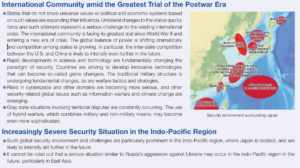
In its broadest of strategic strokes, the white paper’s prescriptions for Japan’s response to this new era crisis are constituted by reaffirmations of the country’s traditional security posture, namely the buildup of military capabilities as a defensive deterrent against the prospect of an outbreak of war, a resolute commitment to the country’s long-standing alliance with the United States, the further development and maturation of its multi-lateral ties to regional partners across Asia and the gradual organizational reform of its defense and security structures and legal frameworks. Even in this locus of relative continuity however, there are subtle indications that Japanese defense planners are contemplating the prospect that a more profound shift in the regional security architecture and assumptions upon which it has long depended may be emerging beyond its control. Analytical released in 2025 and 2026 by the Ministry of Defense’s National Institute of Defense Studies (NIDS), such as The America First Conception of National Interest: U.S. Self-Perception of Power and Foreign Policy in the Post-Unipolar World and Future Air Battles Envisioned by China confront issues such as how to manage Japan’s alliance with an increasingly transactional and inward looking United States and how to confront and understand the transformation of air defense requirements in the wake of the lessons of the ongoing conflict in Ukraine.
Considerations such as these are liable to inform the next stage of intermediate and long-term Japanese strategic planning. Indeed, in the 2026 White Paper Defense Minister Koizumi explicitly acknowledges that the country’s Three Strategic Documents (consisting of the National Security Strategy, National Defense Strategy and Defense Buildup Program) have already become functionally obsolescent due to the “accelerating” pace of change now rippling across the national security environment. Consequently, Koizumi has pledged that the Ministry will issue revised editions of the Three Strategic Documents by year’s end 2026. In the more immediate term, it is in the extensive emphasis within the FY2027 budget request and 2026 White Paper on responding to what Defense Minister Koizumi calls the “new ways of war” that one finds the meaning of the budget’s titular focus on the transformation of Japanese capabilities. In this regard, the FY2027 request is liable to offer a preview of the long-term industrial-development, force structure revision and procurement objectives that will be articulated further through the revision of the Three Strategic Documents and the Ministry’s impending assessments of its five-year budget outlook and requirements.
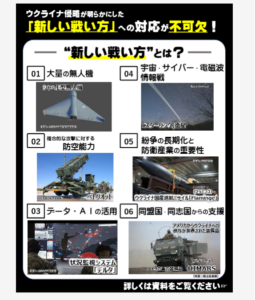
The FY2027 budget submission advances an initial request of YEN8.9 trillion ($55.6 billion) in annual financing, a figure that will evolve as final appropriations are negotiated in the days ahead. Alongside the fulfillment of more traditional procurement aims, the priorities of the FY2026 are guided by the advent and advancement of artificial intelligence technologies, proliferation of low-cost but high lethality UAS capabilities and the associated strain both these, and more capable standoff weapons, place on national air defense architectures. Developmental priorities include the introduction of multiple sub-categories of attack and interceptor UAS platforms and a low-cost standoff missile system, emphasizing that these assets should encompass a diversity of use-cases and procurement costs in order to both accommodate multiple strategic and tactical contexts and collectively complement each-other in the formation of a full suite of capabilities. On the higher end of the spectrum, the budget highlights planned investments in a new hypesonic guided missile capability and existing capabilities like the as the air-launched AGM-158 Joint Air-to-Surface Standoff Missile (JASSM). Connecting these varied procurement considerations is a growing cognizance of the limitations of the country’s current defense-industrial capabilities and the need to invest in capacity expansion across multiple segments of production, as well as the role electronic warfare (EW) and AI capabilities might play in determining the ultimate efficacy or failure of the manufactured systems on the hypothetical battlefield of the future.
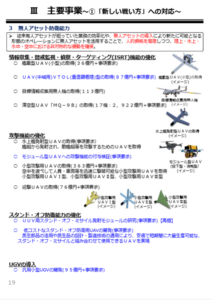
Informed by the insatiable demand for ordnance that characterizes the battlefields of Ukraine, and likely reinforced by mounting concern in the United States regarding the potential depletion of air defense stockpiles amidst hostilities over the Strait of Hormuz, Japan’s latest documentation highlights the need for the military and industrial base to prepare for, and be able to materially withstand, the demands of a prolonged high-intensity conflict. Correspondingly, the initiation of new EW projects and efforts to stimulate local and multi-lateral defense industry activity are likewise articulated as necessary policy aims. As the Japanese government continues to grapple with an uneven economic trajectory and weak currency, defense-industrial investments fulfill an intended dual purpose of both stimulating growth and building greater self-sufficiency. Collectively, Japan’s revised procurement objectives reflect its efforts to enhance its own capabilities in these emerging segments and build greater resilience against their potential deployment by its adversaries at a time when the nature of warfare and the international environment alike are undergoing a rapid and unpredictable evolution.

A lifelong enthusiast of armored vehicles, Thomas serves as an analyst on Forecast International's Military Vehicles Forecast product. In addition, Thomas is responsible for updating the reports and analysis within Forecast International's International Military Markets – Latin America & Caribbean product. He also provides analysis for Forecast International's Airborne Retrofit & Modernization Forecast. Before this assignment, Thomas served as a research assistant for Forecast International's analytical team and has made written contributions to the Civil Aircraft Forecast, Military Aircraft Forecast, and Rotorcraft Forecast services. Thomas derives his knowledge from a multidisciplinary background, with a strong emphasis on the history and politics of Russia and the former satellite republics of the Soviet Union. He has studied in the Russian Federation at Saint Petersburg State University and is proficient in the Russian language at an advanced level.