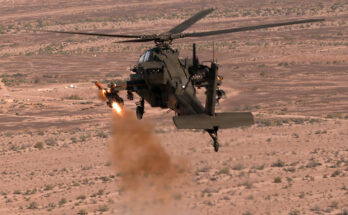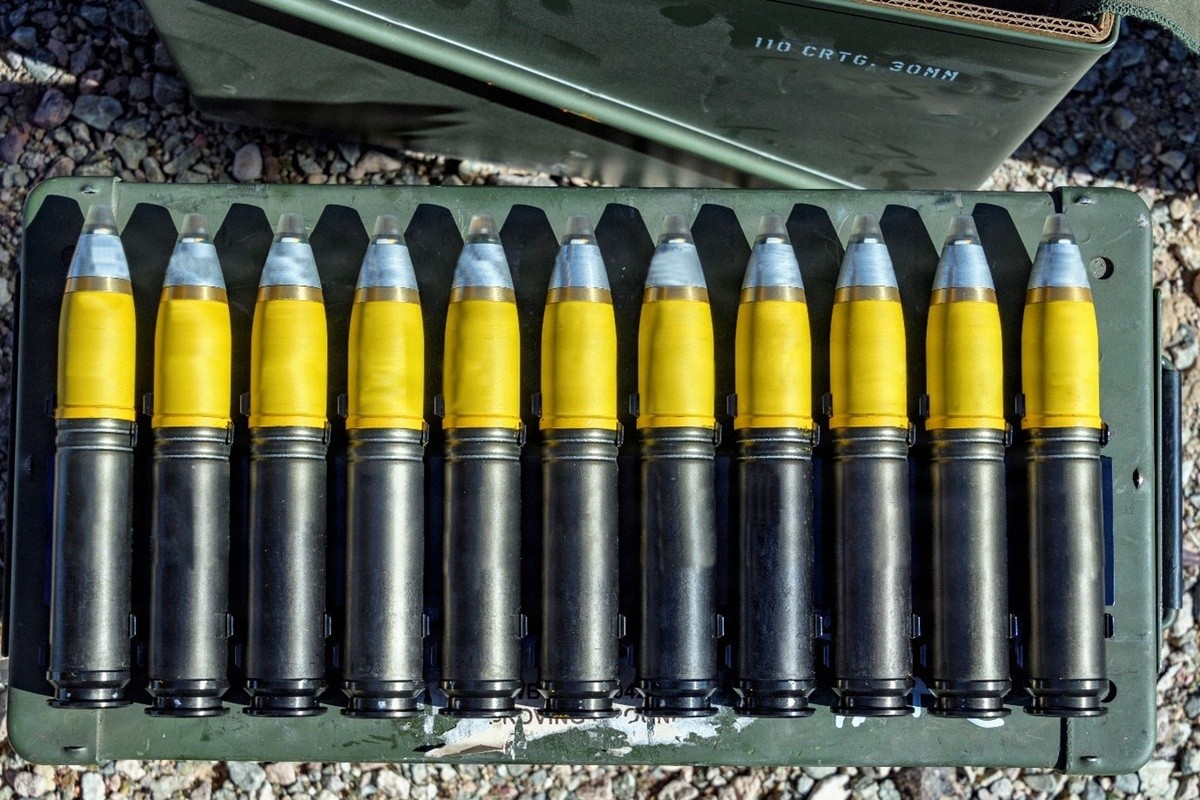
The U.S. Army recently tested the AH-64 attack helicopter’s 30mm cannon against unmanned aircraft systems (UAS) using a new proximity fuze ammunition, which allows the round to detonate near the target, creating a lethal radius of fragments that can destroy lightly or unarmored targets.
The live-fire test took place at Yuma Proving Ground, Arizona, in December 2025, according to an Army press release. This was the Apache’s first-ever air-to-air engagement using a new 30mm proximity ammunition round against UAS targets at various ranges. If fielded, it will add to the service’s counter-UAS capabilities, a major concern for planners at a time when drone warfare is increasingly common around the world.
One oblective of the exercises was to compare the performance of the new round, designated the 30x113mm XM1225 Aviation Proximity Explosive (APEX), against the legacy M789 High Explosive Dual Purpose (HEDP) cartridge under identical conditions in the field. A secondary objective of the tests was to collect data on mixed loads of XM1225 and M789 rounds against both ground and UAS targets. The Army considered the initial results to be highly successful, with the XM1225 meeting all accuracy requirements and demonstrating effectiveness against both ground and UAS targets.
A major advantage of the XM1225 round is that it can be used to counter UAS, exposed personnel and small boats without requiring modifications to the Apache’s M230 Area Weapon System or fire control system. Its ballistic characteristics resemble those of the currently fielded 30mm HEDP round, so using it requires no substantial additional training for maintainers or pilots.
The XM1225 is developed and managed by Product Manager Medium Caliber Ammunition (PdM MCA) from Picatinny Arsenal, New Jersey. The proximity fuze technology was developed by DEVCOM’s Armaments Center, in collaboration with PdM MCA, with data provided to Northrop Grumman to set production and accelerate delivery for operational use.

A lifelong aviation enthusiast, Douglas Royce currently co-edits Forecast International's Military Aircraft Forecast and Aviation Gas Turbine Forecast. As such, he plays a key role in many important projects that involve market sizing and forecasting for various segments of the world aerospace industry, as well as demand for related systems.