Over the coming weeks, the big story for counter-unmanned aerial systems (C-UAS) procurement and operations will likely remain the U.S./Israeli joint attack on Iran and how military forces and neighboring countries are responding to that nation’s largely missile and drone-based counter attacks on civilian centers, energy infrastructure, and armed forces positions and bases.
While bigger drones like the very dangerous Shahed are being intercepted by pretty much anything heavy and fast enough that can be thrown at them, including attack drones, surface to air missiles, attack helicopters and even jet fighters, smaller drones, also making an impact, are being opposed by an equally wide, if sometimes novel variety of responses.
By some accounts, thousands of drone and missile attacks have been launched by Iran region-wide, with apparently only a relatively smaller number actually hitting significant targets. This disparity is happening because, outside of Ukraine, and even before the new war, the Middle East was already one of the most heavily drone-defended regions in the world.
Beyond the venerable missile defense systems used by Israel and the U.S. such as the Patriot and Iron Dome systems, and the related, laser-based Iron Beam, for years the nations of Bahrain, Jordan, Kuwait, Qatar, Oman, Saudi Arabia, and the United Arab Emirates have also been investing in a counter-drone systems, especially in concert with the U.S. military and the bases located within their borders.
Late last year, in November, MBDA signed its first export contract with a Middle Eastern country to provide its SKY WARDEN C-UAS solution. Though not specified at the time, the purchasing country was likely one of the heavy counter-drone investors, such as Oman.
MBDA states that the multi-layered SKY WARDEN offers a range of effectors designed to counter and destroy enemy drones, including a CILAS HELMA-P laser weapon, omni and directional jammers, MBDA HTK (Hit-to-Kill) drone interceptors and the MISTRAL 3 missile.
Recent weeks have seen a flurry of new orders for air defense systems and C-UAS, particularly, of U.S. made systems through the Foreign Military Sales (FMS) program, further shoring up an already C-UAS rich region.
Just before the start of hostilities, on February 26, the U.S. Department of State approved an FMS order for Jordan of Ku Band Multi-Function Radio Frequency System (KuMRFS) radars, command and control system; generators; global positioning system receivers, and other related equipment for an estimated cost of $280 million.
On March 19, an FMS to the UAE was approved for 10 Fixed Site- Low, Slow, Small Unmanned Aircraft Integrated Defeat System (FS-LIDS), its primary effector, known by the name Coyote, and related equipment for estimated total cost of $2.1 billion.
The sale was reported to include: 240 Coyote Block 2 All-Up-Rounds; KuMRFS radars; Coyote launcher systems (4-pack launcher); EO/IR Cameras; PYQ-10 Simple Key Loaders; Forward Area Air Defense Command and Control (FAAD C2) systems; support and test equipment; and other supporting elements.
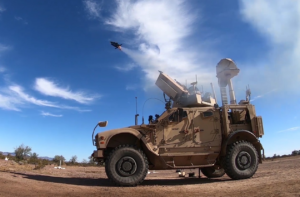
Raytheon-produced Coyote is a rail-launched missile system with a boost rocket motor and a turbine engine for high-speed C-UAS and launched effects (LE) missions. According to Raytheon, the system can defeat small to large target UAS and swarms at longer ranges and higher altitudes than similar class effectors.
In June 2025, SRC, announced it would deliver Coyote as a part of a $1 billion foreign military sales agreement between the U.S. government and the State of Qatar.
Beyond the Battlefront, Teaming Ventures Help Extend C-UAS Market Reach
While the war in Iran will continue to make a big impact on the development, marketing and purchases of C-UAS, other regions have needed little inspiration to pursue the goal of drone defense. The following is a recap of some of the major news for 2026, from outside the newest battlefield.
Because some C-UAS programs can require the integration of a heady mix of elements including, platforms, radar, electro-optical systems, communications, electronic warfare, command and control, AI, and soft- and hard-kill actuators, teaming ventures and strategic partnerships make perfect sense and are becoming more frequent. Companies with distinct disciplines, and name recognition in specific defense areas can join forces to create and promote solutions they might not be capable of as individual developers.
On January 7, U.K.-based Babcock International and Estonia’s Frankenburg Technologies announced a collaboration effort to develop a maritime air defense system designed to counter one-way, and massed attack drones.
Intended to provide a comparatively affordable, kinetic defense option for naval forces and fixed sites, the concept would entail a containerized launch platform that would deploy Frankenburg’s missiles. Babcock plans to focus on integrating the system into a maritime ready platform.
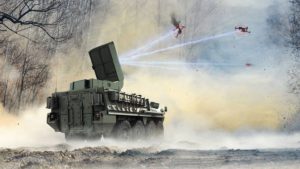
Earlier this week, Epirus, General Dynamics Land Systems (GDLS) and Kodiak AI joined forces to introduce the Leonidas Autonomous Ground Vehicle (AGV), a mobile, fully autonomous C-UAS vehicle.
Leonidas AGV features Epirus’ Leonidas high-power microwave platform integrated onto a commercial-grade truck platform equipped with Kodiak’s AI-powered autonomous driving system, the Kodiak Driver. General Dynamics Land Systems served as lead system integrator.
More 2026 C-UAS News: AI solutions, Orders, Deliveries and Calls for More
On January 12, Axon Vision, a provider of AI-powered solutions for defense applications, announced it had received an order from Leonardo DRS for its new AI-based system for C-UAS missions. The contract covers the delivery of an initial set of systems that provides end-to-end detection, classification, tracking, and interception of C-UAS.
Systems are scheduled to participate in a series of operational evaluations and live exercises across a range of manned and unmanned ground platforms.
On January 20, Fortem Technologies announced first customer deliveries of its next-generation DroneHunter 5.0 autonomous interceptor. The system features dual onboard cameras and enhanced computing power to enable autonomous engagement of multiple targets.
Earlier in the month the Pentagon’s C-UAS task force selected DroneHunter for purchase under the Replicator-2 initiative, signaling the interceptor’s readiness for scaled, real-world deployment.
On January 26, Sierra Nevada Corp. was awarded a one-year, $14.9 million cost-plus-fixed-fee contract to provide the Ukraine Navy C-UAS program field services, maintenance and sustainment. Additionally, this contract provides for reach back support for various systems deployed in Eastern Europe under NATO.
Wrapping up the month of January, on the 30th, Norway’s Kongsberg Defence & Aerospace and consortium partner Polska Grupa Zbrojeniowa (PGZ) signed a contract valued at about NOK 16 billion with the Polish Armaments Agency for the delivery of C-UAS to protect the country. Called SAN CUAS, the program entails the delivery of 18 C-UAS batteries.
February kicked off with the importance of strengthening air and missile defense in the U.S. National Capital Region (NCR) being put on display as Lockheed Martin delivered the first Sentinel A4 radar system for integration and testing to the U.S. Army.
According to the company, Sentinel A4 is well suited to enhance detection and tracking of small drones, low-flying cruise missiles, and other aerial threats in complex urban environments.
On February 11, Raytheon showcased the capabilities of its Coyote Block 3 Non-Kinetic effector to defeat drone swarms launched during a recent U.S. Army testing demonstration. The re-deployable system is designed to loiter and defeat drone swarms by using a high-power microwave (HPM) effector, minimizing the potential for collateral damage.
The next day, BAE Systems secured a cost-plus-fixed-fee indefinite-delivery/indefinite-quantity contract with a ceiling of $145 million for the development, manufacturing, and delivery of C-UAS systems.
Among other solutions, BAE Systems has been marketing its BATS (BAE Systems Anti-Threat System), a sensor and AI-driven, software-based, command and control system for rapid detection, classification, and drone defeat.
On February 16, Fortem Technologies announced it had received a multimillion-dollar order to protect U.S. venues at the upcoming, 11-city, 2026 FIFA World Cup. As a non-kinetic mitigation solution, the company’s net-equipped DroneHunter interceptor disables hostile drones without creating debris or endangering crowds below.
Demonstrating the still developmental nature of C-UAS, on February 19, The U.S. Army Contracting Command issued a Request for Information (RFI) to identify new technologies for the Red Sands Hard Kill Challenge in Saudi Arabia. The initiative seeks to advance development of “hard kill” solutions designed to defeat Group 1-3, small Unmanned Aerial Systems (sUAS) in complex and contested environments.
As counter drone news is on an almost breakneck upswing lately, this blog will be updated with additional reporting in the coming month.

Andrew Dardine is lead analyst for Forecast International's Defense Electronic Systems group. He is the primary author of Forecast International's Electronic Warfare Forecast and co-author of Electro-Optical Systems Forecast and C4I Forecast. Andrew is also a regular contributor to FI's Defense & Security Monitor blog, offering insights into developing technologies such as directed-energy and next-generation jamming systems. His analysis of such vital market areas as EO/IR systems and electronic countermeasures technology has been cited in Defense News, Aerospace Daily, and Bloomberg Businessweek, among other news media. He has also written about the electronic defense market for Aviation Week and the Journal of Electronic Defense.