 Source: U.S. Navy
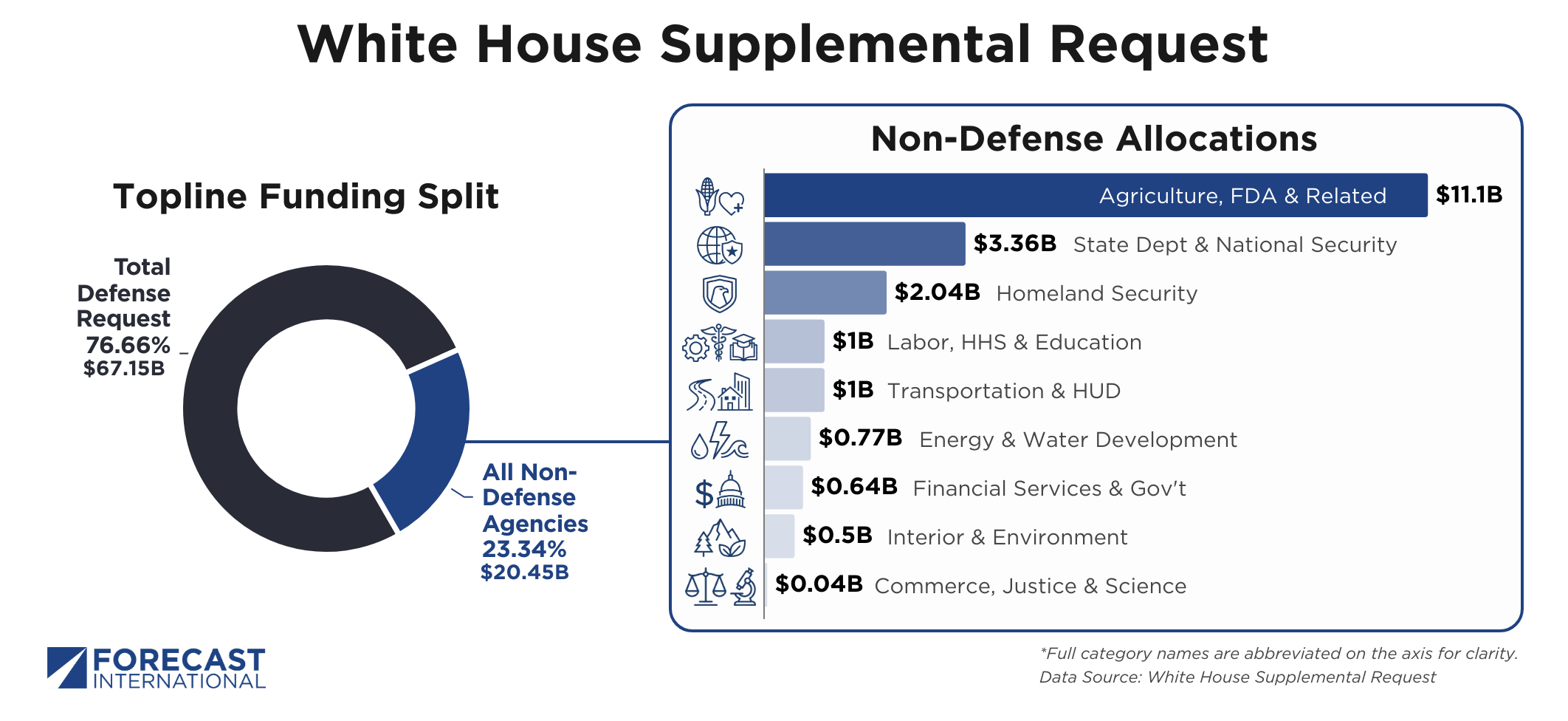
A recent $87.6 billion supplemental funding request from the White House to pay for the Iran war and other expenses complicates an already tense budget process in Washington. The supplemental follows the release of a record $1.5 trillion defense budget request in April, putting additional pressure on Congress to sort out what has become a complex three-part defense budget comprising a $1.1 trillion base budget request, a $350 billion reconciliation request, and the new supplemental request.
Most of the new supplemental funding, $67.1 billion, or 77 percent of the total, would go to the Pentagon. Other investments outside of the Pentagon include $11 billion for the Department of Agriculture, $3.4 billion for the Department of State, and $2 billion for the Department of Homeland Security, among others.
War Expenses
Within the defense portion of the supplemental, most of the funding is allocated toward direct costs of the war in Iran. The single biggest item in the entire supplemental is $21 billion for munitions, which would help rebuild stockpiles after thousands of offensive and defensive missiles and bombs were expended during the opening months of the war. The rapidly growing demand for munitions was already highlighted in the FY27 defense budget request, which sought $76.3 billion for munitions, up 185 percent over the $26.8 billion allocated in FY26. Combined with the supplemental, the administration has now asked for $97.3 billion for munitions across multiple military services this year. For context, that figure is more than three times the size of the Army’s entire FY26 procurement budget of $30.5 billion.
The next largest item requested by the White House is $17.3 billion for operational costs of the war. The initial campaign against Iran included a wide array of aircraft, ships, and ground assets that require fuel, maintenance, and repairs. The subsequent naval blockade sustained many of these logistics expenses, which were exacerbated as fuel costs rose due to Iran closing the Strait of Hormuz. In May, military leaders warned that they would have to begin curtailing some regular training exercises and operations this summer if Congress didn’t backfill the operations budget with supplemental funding.
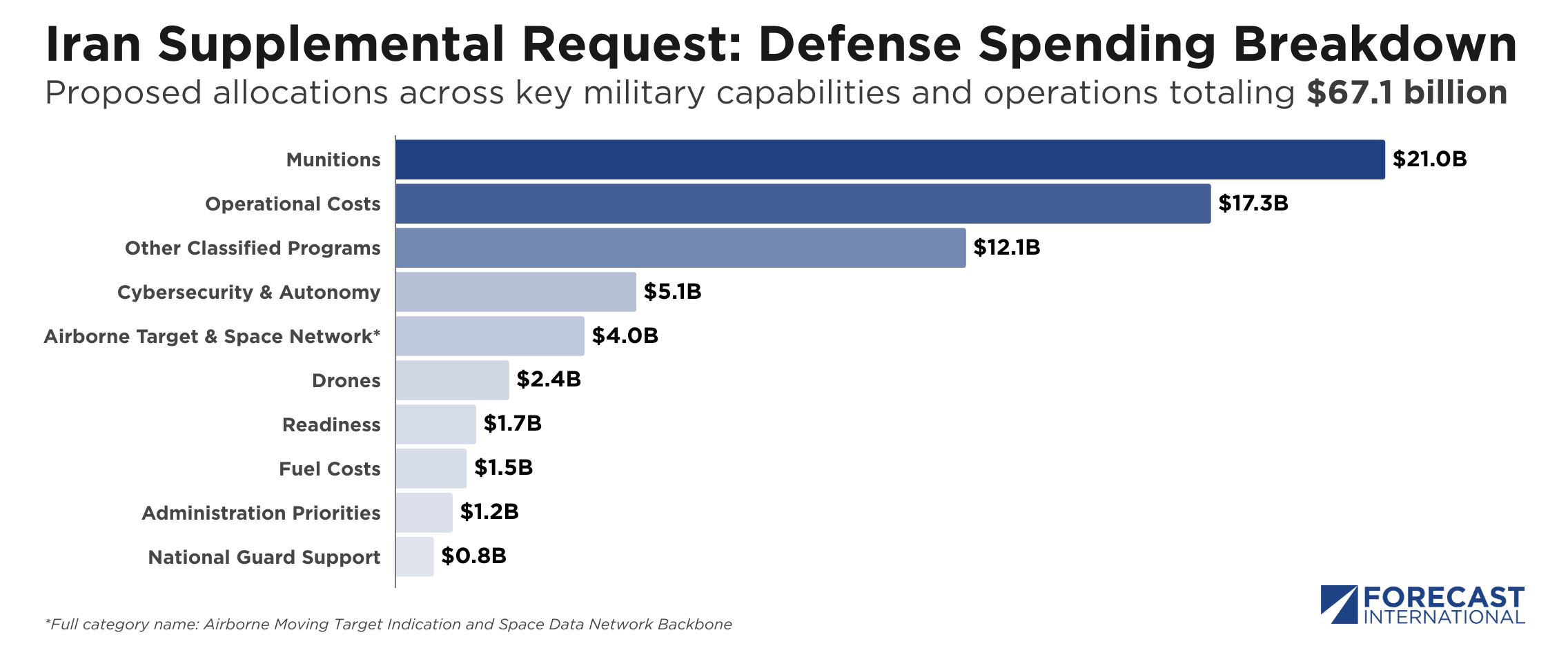
The White House is also asking Congress for an additional $2.4 billion for drones, which could be used to replace one-way attack and interceptor drones used during the war, as well as at least two dozen MQ-9A Reapers lost in combat. The Air Force faces a problem with the Reaper, however. The MQ-9A is no longer in production, leaving the service with a capability gap. The Air Force could try to accelerate a follow-on capability, but that could take longer than desired to meet immediate replenishment needs. Alternatively, the service could procure the larger MQ-9B, which features a 79-foot wingspan compared to the 66-foot wingspan of the older MQ-9A. It’s also possible that some of this funding could be used for other emerging drone programs.
The fragile state of the conflict also raises questions about ongoing war costs. A fragile ceasefire has been interrupted by sporadic skirmishes, and the recent Memorandum of Understanding intended to help end the war lacks substance and relies on further negotiations that have already faced several roadblocks. For the time being, the cost of the Iran war will continue to escalate slowly upwards if the status quo remains unchanged, but the shortfalls and need for additional resources could spike if all-out hostilities resume. A true lasting peace agreement would avoid additional war costs down the road, but that outlook is far from certain.
Beyond the War
The defense supplemental is more than just an Iran war request. While most of the defense portion of the request does support items like operational costs and equipment replenishment related to the war, it also includes other priorities that aren’t directly related to the conflict. For example, the White House wants $4 billion for Airborne Moving Target Indication (AMTI) and the Space Data Network (SDN) Backbone, which are related to the president’s Golden Dome homeland air and missile defense effort.
The Space Force is pursuing a space-based AMTI capability that would allow satellites to track airborne threats. This program would complement the Air Force’s future E-7 Wedgetail fleet, which is replacing the legacy E-3 AWACS. The service requested $7.1 billion in FY27 to begin procurement of a space-based AMTI system, but all the funding was allocated in the reconciliation portion of the request. The Air Force did lose one of its E-3 AWACS to an Iranian strike at an airbase in Saudi Arabia, but this AMTI funding is more of a long-term follow-on than a direct replacement for a particular E-3 aircraft.
Meanwhile, the Space Data Network Backbone represents part of the communications layer of the planned Golden Dome architecture. The SDN, formerly known as MILNET, is being pursued in place of Transport Layer Tranche 3 satellites, which would have been competed among several contractors. SpaceX is working on both of these programs, and in May the company was awarded a $2.3 billion SDN contract and a $4.2 billion AMTI contract. The Space Force requested around $3 billion for the SDN through the FY27 reconciliation request. Other vendors will continue working on earlier Transport Layer tranches, which will be integrated with SDN. Officials have also said that additional AMTI awards to multiple vendors are planned later in the year.
The supplemental also sets aside $12.1 billion for classified programs. The original FY27 request included $98.7 billion in classified funding, split between $61.5 billion for research and $37.2 billion for procurement, according to Forecast International’s U.S. Defense Budget Forecast database. If approved by Congress, the supplemental would increase the classified topline by more than 12 percent, which is a sizeable change. Naturally, we’re unable to determine how much, if any, of that classified funding is directly related to the war.
The administration also wants $5.1 billion to support cybersecurity and autonomy, which appears to be a request for emerging tech rather than direct war costs, but the supplemental lacks transparency and doesn’t allocate funding to individual line items in the budget.
A Complicated Budget Outlook
Even before considering the new supplemental, the administration’s approach to mixing base and reconciliation funding in its FY27 request creates risk and uncertainty for the Pentagon. The defense budget process involves four defense committees (the House and Senate Armed Services Committees and the House and Senate Appropriations Committees) releasing markups of the budget request that contain line-item adjustments that add or remove funding at the program level. So far, three defense committees have released markups of the FY27 defense budget, and none of them have addressed the $350 billion reconciliation portion of the request. That funding will have to be considered during a separate process, but some GOP lawmakers have expressed doubt about passage of another reconciliation bill.
Adding the supplemental bill to the mix further complicates an already fraught legislative landscape. The supplemental has faced resistance in Congress. Democrats largely oppose the bill, arguing it pays for a war that Congress did not authorize. This position is bolstered by passage of resolutions against the war in both chambers. While mostly symbolic, the resolutions underscore the difficulty of getting a controversial war spending bill through both chambers. GOP Rep. Mark Harris (N.C.) suggested Republicans may have to use the reconciliation process to pass a war supplemental in the face of Democratic opposition, but that approach won’t necessarily guarantee success.
The Pentagon would still be left with a $1 trillion budget even without the $350 billion reconciliation package and the new supplemental, but it would still face challenges. The most immediate impact would be the reduced training and operations this summer without the supplemental to backfill operating accounts. New efforts to dramatically scale up munitions procurement, which are heavily reliant on reconciliation and supplemental funds, would also be significantly curtailed. Other key initiatives, such as Golden Dome and new investments in autonomous systems, would similarly be affected. These programs would have to be slowed or reduced in scope in the near-term in the absence of reconciliation or supplemental funding.
Several legacy programs would also be negatively impacted due to how the administration structured its request. For example, 53 out of 85 F-35 fighters requested in FY27 were allocated to the reconciliation portion of the budget, while nearly one-third of the Navy’s KC-130J request is tied to the reconciliation package.
The administration has set high expectations for its FY27 budget request and its new supplemental proposal, but the complex realities of the budget process could result in a final spending plan that looks very different from the original request.
More Defense Budget Data
Forecast International’s U.S. Defense Budget Forecast makes it easy to navigate the latest U.S. defense budget. The product features sorting and data visualization options and presents the entire Future Years Defense Program (FYDP) through an online interface with downloadable spreadsheets. This is the go-to service for anyone looking to save time and energy in navigating the massive Department of Defense budget.

Shaun's deep-rooted interest in military equipment continues in his role as a senior defense analyst with a focus on the United States. He played an integral role in the development of Forecast International's U.S. Defense Budget Forecast, an interactive online product that tracks Pentagon acquisition programs throughout the congressional budget process. As editor of International Military Markets – North America, Shaun has cultivated a deep understanding of the vast defense markets in the United States and Canada. He is a regular contributor to Forecast International's Defense & Security Monitor blog and has co-authored white papers on global defense spending and various military programs.
image sources
- The Dwight D. Eisenhower Strike Group Two transit the Strait of Hormuz: U.S. Navy