 Source: UK MoD
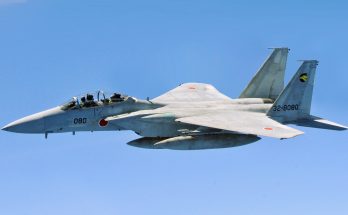
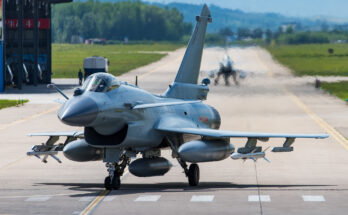
Canada formally announced its participation in the Global Comat Air Program (GCAP) as the first observer nation, confirming rumors that began swirling last week. GCAP is a sixth-generation fighter development effort involving Italy, Japan, and the United Kingdom. Given the recent tumult surrounding Canada’s ongoing F-35 procurement efforts, the casual observer could be forgiven for thinking that perhaps Ottawa is looking to GCAP as an alternative to the F-35, but that isn’t the case. Canada’s participation in GCAP is more about building relationships than determining the trajectory of near-term fighter acquisition plans.
Canada’s Fighter Requirement
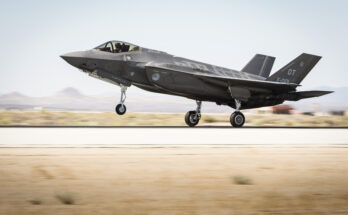
First, a look at Canada’s current fighter requirements. The Royal Canadian Air Force flies a fleet of Boeing CF-18 Hornets that were originally expected to retire by 2020. Ottawa’s aspirations to buy a new fleet of F-35s to replace those aircraft stem all the way back to 2010, but the CF-18 replacement effort is running years behind schedule after the F-35 became a political target due to rising costs. An original 2010 plan to buy 65 F-35s was scuttled so the government could examine other options, including the Boeing F/A-18E/F Super Hornet and the Saab Gripen.
A follow-on competition was a chaotic process that involved a trade dispute with Boeing about government commercial aircraft subsidies and negotiations over industrial benefits. Justin Trudeau’s government ultimately selected the F-35 again, despite his initial opposition to the platform. This time around, the government outlined plans to buy 88 aircraft. In the meantime, the legacy CF-18 fleet underwent several rounds of upgrades to keep it modernized and airworthy, and Canada even procured a batch of second-hand F/A-18A/B aircraft from Australia as an interim capability to fill a fighter requirement gap.
A Deteriorating Relationship with Washington
It appeared that the reselection of the F-35 in 2022 had finally closed the book on the CF-18 replacement plans, but that all changed when Donald Trump entered the White House. His global trade war included new tariffs on Canada that unsettled Washington’s close ally to the north, and comments from Trump about annexing Canada further strained a once-ironclad relationship. The fallout was significant enough to reshape Canada’s political future. Trudeau’s Liberal Party was facing abysmal approval ratings, leading to his ouster as prime minister prior to the 2025 federal election. His replacement, Mark Carney, promised to stand up to Trump in the trade war, which ultimately secured his Liberal party an election victory.
Carney has continued to push back against Trump since then, including outlining plans to distance Canada from its reliance on U.S. defense equipment due to a lack of confidence in Washington. As part of that move, Canada put its F-35 procurement plans on hold to review the program and determine if a different aircraft would better serve Canada’s broader interests. Ottawa is already contractually committed to the first 16 F-35s, so at this point the government is deciding whether to continue with a pure fleet of F-35s or adopt a mixed fleet that would likely integrate the Saab Gripen. The Royal Canadian Air Force has long preferred the F-35, but the program remains a political negotiating tool.
How Does GCAP Fit into the Picture?
Ottawa’s involvement in GCAP isn’t about replacing the CF-18, which will be retired sooner rather than later. Before putting the F-35 on hold, Ottawa anticipated receiving its final new aircraft in 2032. However, GCAP isn’t expected to enter service until 2035, and any theoretical Canadian aircraft wouldn’t arrive until well after that date, meaning it isn’t a viable platform to replace the CF-18. Canadian Defense Minister David McGuinty confirmed as much on Monday when he said any GCAP involvement is a separate issue from the ongoing F-35 review.
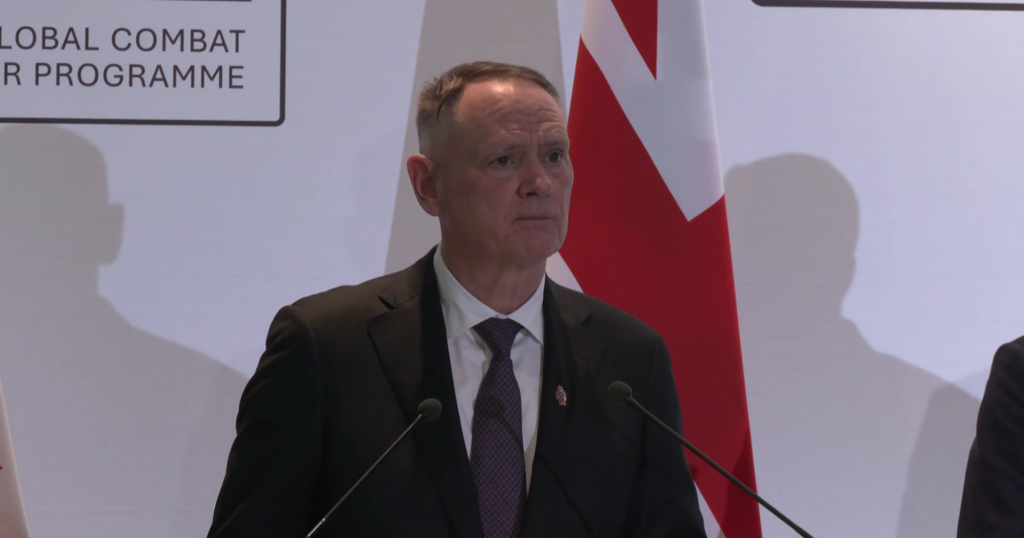
Rather, Canada’s move is about building relationships and realigning strategic partnerships at a time of deteriorating relations with the U.S. Canada is increasingly looking abroad to bolster defense and industrial ties with other nations. Joining GCAP, even if only as an observer, serves as way to learn more about sixth-generation fighter capabilities, increase industrial collaboration with allies overseas, and strengthen ongoing security arrangements. “Today is about more than a program, it’s about an enduring strength of partnership,” McGuinty said at a press conference announcing the GCAP news.
McGuinty also spoke of a world that is becoming more contested, with technology and conflict transforming at an unparalleled pace. “The nations that can innovate together, build together, and stand together will be best positioned to meet the challenges of tomorrow,” he said. These sentiments echo a speech Prime Minister Carney gave at the January 2026 World Economic Forum in Davos, Switzerland. There, he called for increased cooperation among middle powers to hedge against uncertainty and the rise of “hard power.” While Carney didn’t mention the U.S. or Trump by name, the speech clearly served to highlight Canada’s displeasure with the new status quo in Washington.
Walking a Fine Line
Canada finds itself in a difficult position. It faces diminished trust in its closest ally and has outlined plans to reduce its reliance on American military equipment in the future. At the same time, U.S. and Canadian defense interests remain closely linked through shared security under the North American Aerospace Defense Command. U.S. and Canadian defense industrial bases are also deeply integrated, and Canada already operates many U.S. platforms. The tense relationship also hasn’t derailed other recent efforts to procure U.S. equipment, such as Boeing P-8A maritime patrol aircraft, General Atomics MQ-9B drones, and Lockheed Martin High Mobility Artillery Rocket Systems (HIMARS).
As with other European nations that have expressed a desire to rely more heavily on domestic hardware, shifting away from reliance on U.S. equipment is something that would take years to achieve and is a goal that will be significantly impacted by future administrations. For now, GCAP observer status doesn’t change Canada’s fighter fleet or its F-35 review. What it does is give Ottawa a new seat at the table as it works to diversify its defense relationships beyond Washington.

Shaun's deep-rooted interest in military equipment continues in his role as a senior defense analyst with a focus on the United States. He played an integral role in the development of Forecast International's U.S. Defense Budget Forecast, an interactive online product that tracks Pentagon acquisition programs throughout the congressional budget process. As editor of International Military Markets – North America, Shaun has cultivated a deep understanding of the vast defense markets in the United States and Canada. He is a regular contributor to Forecast International's Defense & Security Monitor blog and has co-authored white papers on global defense spending and various military programs.
image sources
- GCAP McGuinty: UK MoD