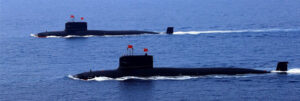
Chinese Project 093B (Shang III) Submarines – Source: Chinese Government Media
Last week, the U.K.’s International Institute for Strategic Studies (IISS) think tank issued a landmark report concluding that between 2021 and 2025, China launched, in both number and tonnage, more nuclear submarines than the United States. This assessment marks the first-ever instance of Beijing outpacing the U.S. in the construction of these advanced submarines, after years of indication that Chinese shipbuilding, both surface and subsurface, was moving with greater efficiency than that of the U.S. These findings are significant, but a surging launch rate does not, on its own, indicate a reversal in U.S. undersea dominance.
According to IISS’ analysis, between 2021 and 2025, China launched 10 nuclear submarines totaling 79,000 tonnes, while the U.S. launched only 7 hulls displacing 55,000 tonnes in comparison. A key milestone in the shipbuilding lifecycle, a launch reflects a ship or submarine’s completion and first transfer to water, typically followed by the beginning of trials before entry to service. China’s launches during this period primarily consisted of Project 093B (Shang III) attack submarines (SSNs) and Project 094 (Jin) ballistic missile submarines (SSBNs). The U.S. exclusively launched Virginia-class SSNs during the 2021-2025 window.
While this report should be a warning to decision-makers in both government and industry in the West, there are several contextual factors to consider before sounding the alarm.
A Milestone of Production
China’s superior productive capacity has not come out of nowhere. Western intelligence and media have reported consistently on China’s expansion of nuclear submarine construction facilities in recent years. Bohai Shipyard, China’s only major nuclear submarine construction facility, was massively expanded, with major sections rebuilt over the past two decades, reflecting Beijing’s goal of significantly enhanced production of these submarines. Despite its expansion, Bohai remains, for the moment, China’s only dedicated nuclear submarine yard, whereas the U.S., despite backlogs and delays, operates two, in Groton, Conn., and Newport News, Va. These facilities are, however, smaller in size than the expanded Bohai facility.
Similarly, while China is edging ahead in the growth of nuclear submarine fleets, it is starting very much from behind. While estimates vary, at the moment, China operates around 16 nuclear submarines, including some aged units kept in reserve and at least one experimental platform not designed for actual deployment. While the increasing launch rate indicates a rapidly growing Chinese fleet, the U.S. currently has about 63 active nuclear submarines, more than four times the number deployed by China.
Quantity vs. Quality
A substantial quality contrast also differentiates Chinese and U.S. submarines in critical areas. China is currently finishing the production run of its Project 093B SSNs and 094 SSBNs, both of which lag behind U.S. boats in several areas, including acoustic quieting, internal systems, and propulsion. While Beijing seems to have launched the lead boat of its new Project 095 Sui SSNs earlier this month and plans to introduce new Project 096 Tang SSBNs in the coming years, even these vessels are expected to lag behind the current generation of U.S. Virginia-class SSNs and Ohio-class SSBNs. China is moving faster than its adversaries, but it is doing so to close a large technical gap.
Some useful parallels can be drawn to the Soviet Union, the last major challenger to U.S. undersea dominance. The Soviet Union outproduced its Western rival over the course of the Cold War by around 66 nuclear submarines. Moscow’s emphasis on nuclear submarine construction succeeded in building an advanced fleet of impressive size, but this failed to translate into Soviet naval dominance or a victory in the broader geopolitical struggle of the time.
It is also worth noting that while China’s nuclear submarine production booms, it reflects Beijing’s construction of both SSN and SSBN designs, whereas the U.S. is currently only producing Virginia-class SSNs. The U.S. will not begin launching new SSBN units until the planned Columbia class finishes development, with a launch expected around 2028, and full-rate production not likely until 2031 at the earliest. This difference in life cycle schedules accounts for some of the disparity in launch rates.
Furthermore, while Beijing has clearly hit a stride in producing material hardware, the institutional knowledge needed to make optimal use of current and future submarines is less easily acquired. The PLAN has far less experience in the sustained operation of advanced nuclear submarines, particularly long-term deployments, continuous at-sea deterrence, and maintenance of new hulls. In contrast, the U.S. is the original operator of the nuclear submarine, possessing over 70 years of continuous experience.
Implications
The extensive production of new builds and the growing shadow of the next generation of Chinese nuclear submarines have some key ramifications for U.S. and Western naval leaders. It demonstrates the seriousness with which Beijing takes its undersea fleet, putting concerted effort into transitioning from a primarily diesel-electric fleet to a nuclear force with modern capabilities.
China’s expanded production also draws attention to U.S. problems in production, backlogs in delivery, and bottlenecks in production, which have become a growing concern in Washington.
The industrial footprint China has developed is significant and certainly capable of producing a true nuclear fleet, though it is not there yet. For a great power, a nuclear submarine fleet is both a practical military tool and a symbol of national prestige. The current and incoming generation of submarines will, despite technical inferiority compared to Western opponents, allow China to project power far beyond its territorial and adjacent waters, extending Beijing’s capabilities deeper into the Pacific and Indian Oceans. China’s growing nuclear fleet will do more to enhance its relative military influence over regional rivals such as South Korea, Japan, and India.
China’s growing nuclear-powered submarine fleet is a major development for the country; however, its surpassing of the U.S. in construction rate is not necessarily a sign of true naval dominance. China is still working to overcome a major deficit in technical quality as well as a massive volume difference, underpinned by a lack of institutional experience in the operation of these sophisticated platforms. While the incoming generation of Chinese nuclear boats may pose a more realistic challenge to U.S. naval interests, the IISS’ recent report should not be taken to indicate that China is overtaking the U.S. as the world’s foremost undersea power. The trend shows Beijing’s growing industrial and undersea capabilities, yet, in this domain, quantity does not necessarily equal quality.

Tom Freebairn is a weapons analyst with Military Periscope covering naval affairs and maritime systems. He pursued an undergraduate degree in International Relations and Modern History, followed by a master's in Middle East, Caucasus, and Central Asia Security Studies from the University of St. Andrews. His master's thesis focused on the relationship between oil and separatist politics in Northern Iraq. Tom's interests include the politics of energy, ethnic separatism, the evolution of naval warfare, and classical history.