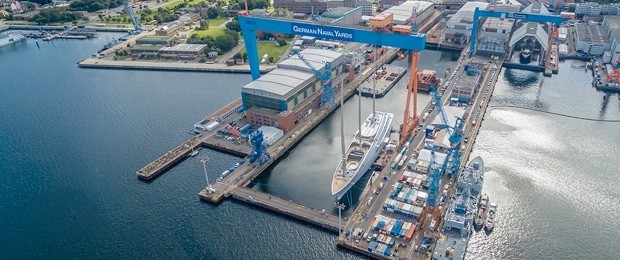
German defense industrial giant Rheinmetall has submitted a non-binding bid to acquire German Naval Yards Kiel (GNYK), a key shipyard on the Baltic Sea coast. The bid, announced by company CEO Armin Papperger on May 7, marks a major move for Rheinmetall, traditionally a manufacturer of ground vehicles, missiles, ammunition, and artillery, into the field of naval ships and systems. The company established its Naval Systems division only this year, with the finalization of its purchase of Naval Vessels Lurssen (NVL), the shipbuilding wing of the Lurssen corporation.
This foray into the shipbuilding field is a significant expansion for Rheinmetall, one that the company expects to generate billions in revenue annually. Rheinmetall is optimistic that a new area of operation can bolster the company’s financial performance, with its new Naval Systems division coming with $6.46 billion (EUR5.5 billion) in existing projects. The bid for GNYK reflects Rheinmetall’s rapid entry into a growing market, demonstrating its ambition to become a major player in the German naval shipbuilding industry.
The Shipyard
GNYK owner, France’s CMN Naval, has been expected to sell the facility to a larger company for some time. One of Germany’s major naval shipyards, GNYK possesses a significant volume of sophisticated shipbuilding infrastructure, including the longest dry dock in the Baltic Sea, measuring 1,400 ft (426 m) long. The extended dry dock allows for the construction, repair, and maintenance of larger vessels, from warships to amphibious landing ships and auxiliaries. Replicating comparable waterfront infrastructure through greenfield development would likely require years of permitting and investment substantially exceeding the cost of acquisition. The shipyard also employs a workforce of 400, a valuable commodity in a country that, like most of the Western world, faces a shortage of skilled shipbuilding labor.
The acquisition of GNYK would add to Rheinmetall’s rapidly expanding portfolio of shipbuilding facilities, helping the company support its ambitious goals to move into Germany’s growing naval shipbuilding market. Currently, Rheinmetall operates several facilities inherited from NVL and its subsidiary Blohm+Voss. Only two, the Peene-Werft shipyard in Wolgast and the Blohm+Voss shipyard in Hamburg, can produce major surface ships. The addition of a third warship-capable yard in GNYK would build Rheinmetall’s industrial capacity and demonstrate the seriousness of its pivot into the shipbuilding field, shoring up the company’s likelihood of receiving major naval contracts from the German government and export clients.
A Challenge to TKMS
The non-binding bid, likely to be followed by a binding bid in several weeks, is also a challenge to Germany’s dominant shipbuilder, ThyssenKrupp Marine Systems (TKMS). TKMS, a partially spun-off subsidiary of the ThyssenKrupp corporation, has been the heavyweight of German shipbuilding for years, securing major orders from the German Navy and international clients alike. The company produces a variety of naval vessels, including warships and submarines. TKMS also launched a bid for the GNYK shipyard in January, seeking to add another warship-capable shipyard to its own arsenal.
While TKMS officials have downplayed the significance of acquiring GNYK, with CEO Oliver Burkhard calling it “an opportunity but not a must-have,” the Baltic shipyard may prove pivotal in the struggle for industrial capacity between the established firm and its emerging competitor, Rheinmetall. TKMS, like Rheinmetall, operates two warship-capable shipyards in Germany, its own Kiel shipyard, adjacent to GNYK, and TKMS Wismar, a former commercial yard purchased by the company in 2022. With both TKMS and Rheinmetall operating two major shipyards in Germany, the acquisition of GNYK could be a major advantage for either in the unfolding competition for market share.
F-126 or Meko?
The additional shipbuilding capabilities offered by GNYK would better position both companies to compete to receive contracts from Berlin, as part of a renewed emphasis on German defense spending and fleet modernization. Chief among the early contests between the two defense giants is the F-126 frigate program, Berlin’s struggling plan for up to six anti-submarine warfare (ASW) warships. Originally led by Dutch shipbuilder Damen, the project has experienced substantial delays and cost overruns, leading to a likely reorganization of the project with Rheinmetall’s NVL as the prime.
Acknowledging the less-than-ideal realities of the F-126 program, Berlin announced in March the planned procurement of four MEKO A-200 light frigates from TKMS. Rumors have even suggested that the F-126 project could be cancelled in favor of a large MEKO order.
The resulting uncertainty has sparked greater competition between the two companies, as Rheinmetall seeks to emphasize the project’s feasibility under its oversight, while TKMS hopes to receive more work for its proven MEKO frigates. While Berlin may pursue some combination of both programs, the F-126 conundrum offers a taste of the fierce competition that is likely to define the two firms’ relationship in the shipbuilding world for years to come. Ownership of an additional developed shipyard like GNYK could sway either company’s ability to receive and fulfill orders for the F-126 or MEKO alternative, as well as future awards.
Conclusion
For Rheinmetall, this acquisition would mark an early success in building the footprint to support the award of future large naval contracts from the German government. The company has staked billions on its capacity to capture a larger share of this market, and establishing control of critical infrastructure is a key step to executing on the company’s ambitious plans. Meanwhile, for TKMS, the site would help assert its traditional role as Germany’s primary naval shipbuilder and would be essential to follow through on a large existing backlog of orders from both the German government and international clients. A losing bid could also be taken as a signal of Rheinmetall’s emergence as a comparable player in this rapidly consolidating field.
As Berlin looks to increase its naval spending in the coming years as part of an expanding role in NATO and European security, it will look to domestic shipbuilders to accommodate a growing slate of orders worth billions of dollars. The possession of sophisticated construction sites like the GNYK shipyard will be a key metric in deciding which of Germany’s two defense giants will receive the larger share of these awards, particularly in the short term. While TKMS has a more defined specialized edge in the market, Rheinmetall is the larger company with sizable resources underwriting its high-momentum inroad into the German naval sphere. The sale of GNYK sits at the center of a broader consolidation and restructuring of Germany’s naval industrial base, with the evolving competition between TKMS and Rheinmetall poised to become one of the sector’s most defining dynamics.

Tom Freebairn is a weapons analyst with Military Periscope covering naval affairs and maritime systems. He pursued an undergraduate degree in International Relations and Modern History, followed by a master's in Middle East, Caucasus, and Central Asia Security Studies from the University of St. Andrews. His master's thesis focused on the relationship between oil and separatist politics in Northern Iraq. Tom's interests include the politics of energy, ethnic separatism, the evolution of naval warfare, and classical history.