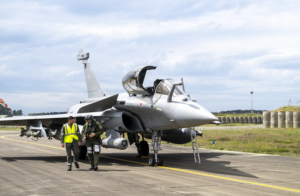
The TArgeting Long-Range Identification Optronic System, or TALIOS, is an electro-optical, dual-use laser designation pod for targeting and reconnaissance. It is produced by French defense firm Thales as the successor to its earlier Damocles targeting pod. TALIOS is platform-agnostic, though its primary platforms include Dassault Aviation’s Mirage 2000D RMV, Rafale F3-R, and Rafale F4. It is expected to equip the Rafale F5 once released in the early 2030s.
The TALIOS pod can switch between targeting and reconnaissance functions on command. It comes equipped with high-resolution sensors that operate in tandem with daylight cameras, and likewise has a Vision Permanent mode that allows for target-tracking in poor weather conditions.
Upgrades to the TALIOS pod equipped to the Rafale F4.3 are said by Thales to come with onboard artificial intelligence (AI) algorithms trained on a combination of flight data and classified data from the French armed forces (the latter is a draw in training AI models for defense applications). Their integration is meant to alleviate a data-processing bottleneck, accelerating the detection and classification of potential targets in large quantities of image data, including the pre-selection of targeting options for the pilot. The algorithms are likewise intended to improve the detection of small or otherwise well-hidden targets in difficult environments – a design feature that one sees prominently in the United States’ use of the Maven Smart System in Operations Absolute Resolve and Epic Fury.
Thales has since shared in March 2024 that its “Thales Neural Processor” is the name of the technology responsible for onboard image analysis, presumably housing the algorithms in question. Its purpose is to replace and accelerate the mode of image analysis previously conducted on the ground, with AI performing the heavy lift of automating imagery analysis through rapid detection of incoming data and the pre-selection of detected objects of interest which are then transmitted to the pilot (the aforementioned pre-selection of potential targets). The Neural Processor is developed by Thales’ cortAIx AI accelerator.
Who Has the TALIOS Pod?
The French defense procurement agency (DGA) is, unsurprisingly, responsible for a disproportionate share of TALIOS demand. An early contract led to the delivery of 46 TALIOS pods to French armed forces beginning in 2019. TALIOS was later declared to have achieved Initial Operational Capability in November 2020 on French Air Force Rafale F3-Rs. The DGA placed an additional order with Thales for 21 TALIOS pods for Rafale F4 aircraft in May 2022. Finally, the DGA successfully tested TALIOS aboard the Mirage 2000D RMV in a maritime zone in January 2024 (with the Mirage 2000D being used a testbed in years prior).
Upgraded Mirage 2000D RMVs, re-delivered to the French Air and Space Force between 2024 and 2025, are equipped with TALIOS.
To be sure, TALIOS is not produced 1:1 with aircraft like the Rafale. The most important source of variation for our purposes is the decision by a state outside of France importing the Rafale to use indigenous technology in place of TALIOS, or to adopt TALIOS as part of their purchases.
As my colleague Douglas Royce noted recently, the United Arab Emirates (UAE) made a “blockbuster” order for 80 Rafale F4s in December 2021. Although the UAE has not explicitly stated its position on the TALIOS pod, some indigenous munitions technology are believed to be adapted to the F4 by the UAE, including Mk81, Mk82, and Mk83 bombs developed by the Emirati EDGE defense conglomerate.
Indonesia likewise ordered 42 Rafale F4s in February 2022, with all aircraft under contract as of January 2024. The first three F4s were received in January 2026.
France and Iraq have reportedly held discussions over the latter’s acquisition of 14 new-build Rafale F4s, presumably to come equipped with the TALIOS pod (10 single-seat Rafale C and 4 two-seat Rafale B variants). This potential purchase is not confirmed.
India and Ukraine represent special cases.
India and France signed an intergovernmental agreement in April 2025 to deliver 26 of the Rafale Marine (“M”) variant to the Indian Navy. There is no confirmation of TALIOS’ inclusion in this order, and the Indian Ministry of Defence indeed noted that a “Transfer of Technology” of indigenous Indian weaponry to the aircraft was part of the intergovernmental agreement.
Separately, the Indian Defence Acquisition Council approved a purchase of Rafale fighters in February 2026 as part of a broader defense spending package worth 3.6 trillion rupees, with local Indian media reporting that 114 Rafale jets would be acquired (18 to be manufactured by Dassault Aviation, and 96 manufactured locally). The Rafale variant was unspecified.
This is not a done deal. India has requested access to the Rafale’s Interface Control Document for the integration of indigenous weapons, a currently unresolved matter.
Ukraine, for its part, signed a Letter of Intent (LOI) with French President Emmanuel Macron in November 2025 for the potential acquisition of up to 100 Rafale F4 fighters, with deliveries stretching out to 2035. This LOI, however, remains aspirational. There is ample reason to be skeptical about the ultimate outcome.
Production Outlook
The French Air and Space Force are expected to continue driving substantial production of TALIOS. This includes the stated aim of the Air Force to retrofit all existing Rafale aircraft to the F4.1 standard. This effort is expected to begin in roughly 2027-2028, though note, again, that TALIOS production and retrofits are not 1:1.
In the 2030s, the (currently unreleased) Rafale F5 standard is expected to host the TALIOS pod, driving further production still by the French Air and Space Force. Production of the F5 is still somewhat speculative (only in terms of which quantities on which timeline), but the F5 is certain to be acquired.
Internationally, three states will drive disproportionate production of TALIOS-equipped platforms, should they each accept the TALIOS pod rather than replace it with indigenous technology: the UAE, Indonesia, and Egypt. Deliveries of aircraft have begun in each case.
Indian and Ukrainian interest could drive production of TALIOS-equipped Rafale aircraft, though ‘smart money’ would not be placed on this bet as-yet. These are special cases, and remain highly speculative, particularly given Indian’s preference for technology transfers for the imported aircraft.
Looking ahead, Indian and (non-French) European interest in the Rafale F5 will plausibly lead to either retrofits or new purchases that drive additional TALIOS production – bearing in mind that aircraft retrofits may not require new TALIOS production and some states will opt for indigenous technologies. Dassault Aviation indeed partnered with India-based Tata Advanced Systems in June 2025, announcing their intention to produce Rafale fuselages in India. For now, this does not bear directly on TALIOS production, though it is to be monitored.
A setback in the joint funding for Rafale F5 development by France and the UAE in April 2026 is also to be monitored, though this is not currently expected to impact the F4s currently on contract for delivery to the UAE.
The TALIOS-equipped Mirage 2000D RMV, for its part, is slated for retirement by French forces by 2035. Still, the aircraft remains in demand – particularly by European NATO forces – owing to geopolitical tensions generally and a renewed defensive posture vis-à-vis Russia specifically.
In any event, current operators will require maintenance on these various platforms throughout the 2020s, with an eye toward continuous upgrades of the TALIOS pods this decade and the early-to-mid 2030s. Dassault Aviation’s efforts to expand production capacity for Rafale aircraft indicate there is a robust foundation for future TALIOS production by Thales.

Vincent Carchidi has a background in defense and policy analysis, specializing in critical and emerging technologies. He is currently a Defense Industry Analyst with Forecast International. He also maintains a background in cognitive science, with an interest in artificial intelligence.
image sources
- : Thales Group