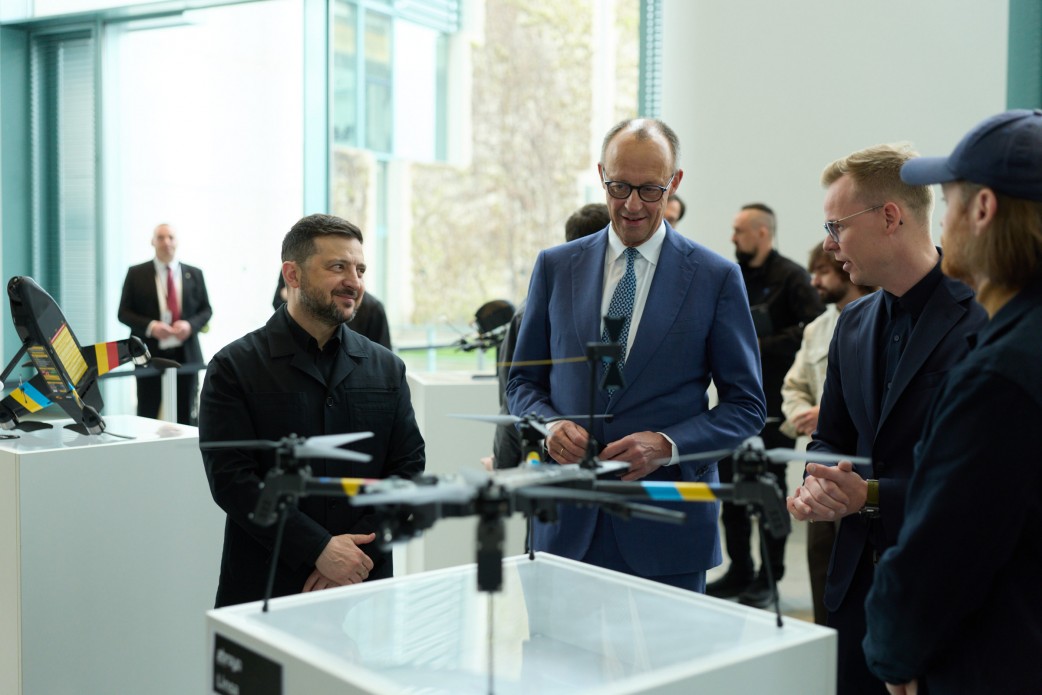
Ukrainian enterprise drones demonstrated to Volodymyr Zelenskyy and Friedrich Merz. Source: The Presidential Office of Ukraine
Ukraine is establishing a larger presence in the drone market, as it has initiated a multi-year cooperative program with nearly 20 countries aimed at strengthening defense capabilities through drone technology. As of June 9, six agreements have been signed, with additional contracts in preparation.
This framework is tailored to meet Ukraine’s specific needs from each nation. Zelenskyy announced it will include at least 10 contracts for exporting Ukrainian weapons, planned co-production, and new technology development. While these contracts are underway as an attempt to establish resource and economic stabilization for Ukraine, Washington is approaching the framework with a completely different objective: obtaining Ukraine’s technology for its own national interest.
U.S. Hesitation on the Deal
Although Ukraine has actively expanded its drone partnerships and pushed for the U.S. to join, Washington has refrained from signing despite repeated Ukrainian appeals.
Zelenskyy noted a possible U.S. motive for this hesitation is a desire to lower global oil prices and build a conversation with Russia. This statement comes as long-range Ukrainian drone strikes have critically damaged Russia’s oil infrastructure. Damages had already affected 40% of Russia’s oil export capacity, and in March, those oil prices faced a near $100 per barrel spike. Ukraine argues that sustaining strikes at this rate could push Russia to negotiation.
While Ukraine has requested the U.S. to sign onto the deal, the U.S. has instead requested access to the intellectual property (IP) rights of the Ukrainian drones.This alternative allows the U.S. to secure vital technological advancements and maintain control over how the systems are utilized, without formally tying the U.S. to Ukraine’s expanded offensive operations, thereby mitigating direct conflict with Russia.
Ukraine’s Drone Leverage
What makes Ukraine’s drone ecosystem so valuable to Washington is not just the hardware, but its software integration and resilience. Unlike American systems that can often struggle in contested environments, Ukrainian drones have been forced to evolve against aggressive Russian electronic warfare. The Pentagon is interested in acquiring Ukraine’s AI-assisted terminal guidance, which allows drones to hit targets autonomously, even when severed from operator control, and its navigation systems that function in GPS-denied environments.
As Ukraine cements its status as a global leader in autonomous warfare, its maturing defense ecosystem continues to gain leverage in ongoing dialogues with the United States. In March, Ukraine sent interceptor drones and a team of drone experts to help protect U.S. military bases in Jordan, following Washington’s request for assistance. Further, the Pentagon announced in May that it would be sending U.S. military personnel to Ukraine to study how drones are used in combat.
The question hanging over Washington is no longer whether Ukrainian drone technology is vital to U.S. national security, but how much control over that technology the U.S. can successfully extract. To achieve this, Washington has bypassed formal participation to demand direct IP access, a strategy that allows the U.S. to absorb this defense modernization wave without expanding its formal wartime commitments.
Industrial Realities and Scalability
This quest for intellectual property reaffirms the divergence in manufacturing philosophies between the two nations. While the United States remains optimized for producing smaller numbers of multi-million dollar defense platforms, Ukraine has created a hyper-scaled, decentralized production model capable of churning out hundreds of thousands of low-cost first-person view (FPV) and long-range strike drones annually. If the U.S. can successfully acquire these IP rights, Washington will likely prioritize domestic manufacturing facilities to retain supply-chain control and stimulate the American defense sector.
If the United States successfully obtains the IP rights to Ukraine’s drone technology, it would formally decouple the warfare innovation from the physical warzone. Legally, Washington would gain the authority to replicate, modify, and scale proprietary technologies, without requiring ongoing Ukrainian oversight.
However, to truly match the sheer amount of mass that is now required on the battlefield, the U.S. will likely find it unavoidable to fund and utilize Ukrainian factories, tapping into an established wartime pipeline that can iterate, build, and deploy unmanned systems at a speed American bureaucracy simply cannot replicate.

Anna Miskelley has cultivated a deep interest in global security, emerging technologies, and military systems throughout her academic and professional career. She is currently a Defense Industry Analyst with Forecast International.
Before joining Forecast International, Anna was a research fellow at the Center for Security, Innovation, and New Technology, where she researched the impact of artificial intelligence on U.S. nuclear command and control systems. Proficient in Mandarin Chinese, Anna has published research on topics including strategic stability, internal Chinese politics, and artificial intelligence.

Lauren Estrada has a background in global and cyber intelligence, with a strong interest in communicating technical threats to non-technical audiences. She currently works as an Editor & Analyst with Forecast International and Military Periscope, where she contributes to research and analysis on defense technologies. Her previous experience includes defense technology research, regional risk assessments, client-facing intelligence reports, trend analysis, threat of actor behavior, and cyber-focused research.
While pursuing her B.S. in Global Security and Intelligence Studies at Embry-Riddle Aeronautical University Prescott, Lauren co-led a cross-disciplinary initiative to introduce cybersecurity fundamentals to students across all majors. Her team designed and proposed a course that bridged cybersecurity and non-technical disciplines, fostering inclusive engagement with cyber skills. This work led to speaking engagements at university industry board meetings and the 2025 National Conference on Undergraduate Research in Pittsburgh, PA.