Summary
China is becoming a more prominent supplier of military equipment to Central Asia, with recent aircraft sales to Uzbekistan and Kazakhstan adding to a growing portfolio of defense exports to the region.
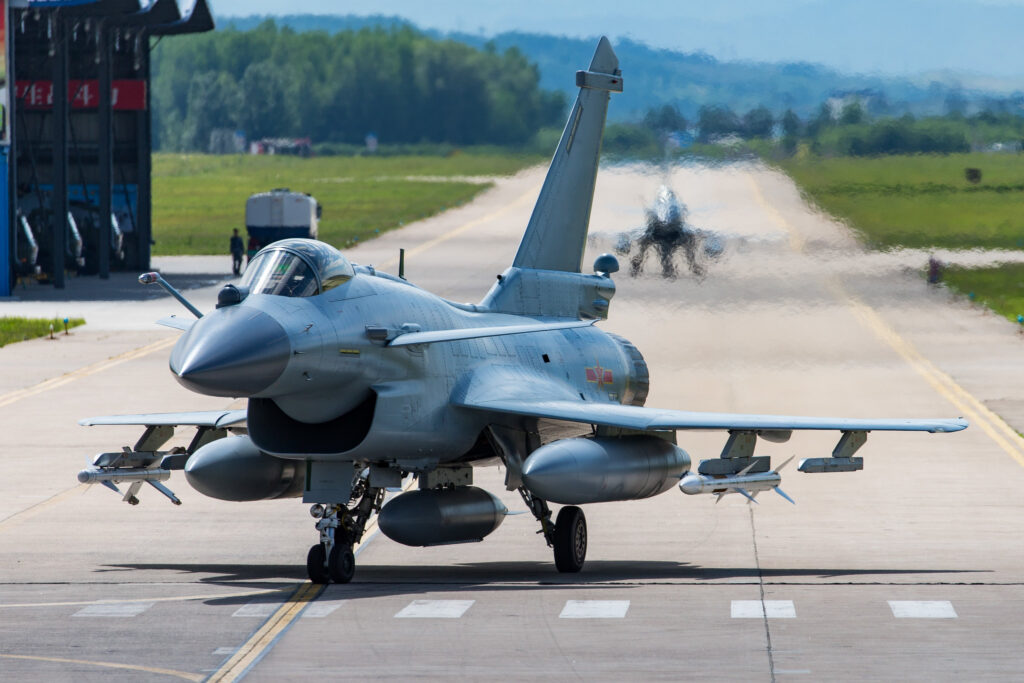 Source: Flickr/Sunson.X.Images
China is becoming a more prominent supplier of military equipment to Central Asia, with recent aircraft sales to Uzbekistan and Kazakhstan adding to a growing portfolio of defense exports to the region.
On August 28, six J-10C fighter jets were shown on Uzbek state media flying to Karshi-Khanabad airbase in southern Uzbekistan. The sale of the Chinese fighter jets to the Uzbek Air Force had been rumored throughout recent months, and in the days leading up to August 28 several unmarked jets had been seen conducting flight-testing. Uzbekistan may have ordered 24 J-10s in total, though that figure has not been confirmed by either government. It is equally unknown what armaments were purchased for the jets, as they were only seen with external fuel tanks but not weapons.
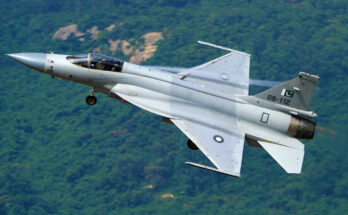
With the J-10’s arrival, Uzbekistan becomes the second foreign operator of the type after Pakistan. The Uzbek Air Force has now finally made a step towards the eventual replacement of its MiG-29 fleet, after years of talks over a successor platform. In 2017, Russia and Uzbekistan held dialogue over a potential purchase of the Su-30SM, which were then beginning to join the Air Force of northern neighbor Kazakhstan. French President Emmanuel Macron reportedly pitched the Rafale as an option to Uzbekistan in 2023.
Simultaneously with the J-10 deliveries, China is flight-testing a pair of Y-9E military transport aircraft destined for Kazakhstan. According to a report in Scramble, Kazakhstan ordered six Y-9Es, following Namibia in becoming a customer for the turboprop transport. The Y-9s follow a previous purchase of Y-8 transports for Kazakhstan’s National Guard.
Scramble’s report added that another agreement for the purchase of K-8 Karakorum jet trainers may be in the works, which if acquired would be used as an initial step in replacing Kazakhstan’s older L-39s. Astana would be passing up the Russian-made Yak-130 in choosing the K-8 instead.
Beijing has gradually worked its way into Central Asia’s defense market, with sales picking up over the past decade. Uzbekistan and Turkmenistan are significant customers of Chinese air-defense equipment, each acquiring the FM-90, FD-2000, and KS-1. Ashgabat purchased those systems – along with QW-2 MANPADS – in the mid-2010s, while Uzbekistan acquired the FD-2000 in 2017 and more recently showed off the FM-90 and KS-1C in early 2025.
Drones are another significant product in China’s export portfolio. China has sold unmanned combat aerial vehicles (UCAVs) to Kazakhstan, Turkmenistan, and Uzbekistan. The Kazakh and Uzbek militaries operate Wing Loong UCAVs, while the Turkmen military has received CH-3 and WJ-600 drones. A large Chinese drone, seemingly a WJ-100, crashed in Tajikistan near Ayni airbase in December 2024, implying Tajikistan had either bought the system or was testing it for future procurement.
To a lesser extent, China is also a source for armored vehicles. Tajikistan has received Chinese-made CS/VN3 and VP11 patrol vehicles for domestic security and border protection.
Arms sales to Central Asia are a component to Beijing’s broader outreach to the region. Already, Beijing is the dominant foreign investor in Central Asia, channeling tens of billions of dollars to expand energy and mining infrastructure. A FPRI report published earlier in 2026 noted that as many as 11,000 enterprises in the region have received Chinese capital, with a stock value of $36 billion. China similarly dominates trade with the five Central Asian republics. Chinese media reported in June that Beijing is working to create a constellation of over 1,000 satellites over the region, ostensibly to monitor environmental developments.
Increasing defense relationships is thus an extension of Chinese policy towards Central Asia. And in an outgrowth from purely acting as a vendor, China has quietly deployed troops to Tajikistan to help Dushanbe monitor its border with Afghanistan, demonstrating a security commitment as well, albeit a small one.
China’s rising defense ties with Central Asia have not got unnoticed in Moscow, plausibly serving as background motivation for the Kremlin’s July announcements that it would be renegotiating separate bilateral military-technical cooperation (MTC) agreements with Uzbekistan and Kazakhstan. The Russian government is principally concerned with finding ways to circumvent Western sanctions; a similar MTC renegotiation with Kyrgyzstan in 2025 was geared towards expediting and streamlining defense procurement that may make it easier for Russia to source components and receive maintenance for its military equipment.
Over the longer term, however, Moscow aims to maintain its traditional influence over security affairs in Central Asia.
The Central Asian republics, by contrast, have sought to diversify their relations, purchasing arms from China and, increasingly, Europe as well. Doing so is a delicate balancing act, as they seek to reduce their dependence on Russia while maintaining workable relations with Moscow.

Military markets analyst, covering Eurasia, Middle East, and Africa.
image sources
- J-10 fighter jet: Flickr/Sunson.X.Images