The $4.8 billion U.S. Army contract awarded Tuesday to Northrop Grumman for their Common Infrared Countermeasures (CIRCM) system signals a major expansion of an already critical program. The vital self-protection system, currently being installed on a majority of the Army’s helicopter fleet, now appears well on its way to equipping more future platforms not just in the U.S., but also abroad for select allies.
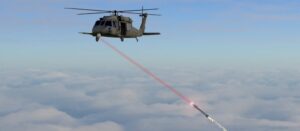
Replacing the previous, widely distributed Advanced Threat IRCM (ATIRCM) system, CIRCM was designed to protect against shoulder-fired and vehicle-launched anti-aircraft missiles, and other threats that home in on heat signatures of aircraft.
The program really kicked off in April 2021, when the Army awarded Northrop Grumman a five-year, indefinite delivery/indefinite quantity (ID/IQ) contract valued at $959.1 million for full-rate production.
Earlier this year, the Army committed to strong support for the program in the FY27 defense budget, with a five-year procurement allocation of $1.6 billion. By the start of the next decade, this funding would result in production of 962 CIRCM units. Plans then called for ongoing support and total procurement of close to 2,000 systems, with installations on most AH-64 Apache, CH-47 Chinook, and UH-60 Black Hawk helicopters.
The new, nine-year, firm-fixed-price, ID/IQ contract will now see full-rate production into 2035 for a number of platforms that seem more than capable of supporting earlier projections. A range of factors may add extra weight to this outlook.
Growing Rotorcraft Requirement
Beyond the substantial requirement for current U.S. Army rotorcraft, CIRCM is also expected to be a key part of the Future Vertical Lift modernization program, and it’s Future Long Range Assault Aircraft (FLRAA).
The service intends for FLRAA, officially dubbed MV-75, to begin operations in the 2030s, and eventually replace the Sikorsky UH-60. In October 2025, the Army announced plans whereby the tiltrotor could enter service as early as FY32, moving up from a previous target of FY34.
Since the start of the CIRCM program, there was also a strong expectation that additional production would flow for U.S. rotorcraft sold to other nations through the Foreign Military Sales (FMS) program. In March 2026, this came to pass, with Northrop Grumman’s announcement that it was providing its first export CIRCM systems to Germany for CH-47 helicopters ordered in October 2025.
As a suite, along with associated technology such as missile and radar warning systems, the predecessor ATIRCM system was acquired by Australia, Egypt, the Netherlands, Saudi Arabia, Spain, the U.K. the United Arab Emirates, and Tunisia, through the FMS program.
The Ripple Effect
The expansion of CIRCM production will have a profound ripple effect on demand for associated systems that are historically essential to its operations, such as BAE Systems AAR-57 Common Missile Warning System (CMWS) and Northrop Grumman’s APR-39E Radar Warning Receiver (RWR)/Electronic Warfare Management System (EWMS).
In the FY27 defense budget, the Army allocated $113 million for CMWS over the next five years. By FY31, the total procurement commitment, including previous purchases, is expected to total $1.8 billion.
Other technology directly supporting the advanced countermeasure system, and likely replacing some legacy support systems in the future, have also received a boost. In October 2023, Northrop Grumman announced the development of a next-generation missile warning sensor, the Advanced Tactical Hostile Engagement Awareness (ATHENA) system, as part of the Army’s Improved Threat Detection System (ITDS) effort.
According to the company, ATHENA’s features include significant increases in resolution and processing power, and capabilities to detect threats beyond infrared guided missiles, including hostile fire and anti-tank guided missiles.
Leonardo DRS highlighted another major component with the January 2024 announcement that they had delivered the 1,000th Solaris ruggedized laser system for CIRCM systems. The Solaris laser source works in the CIRCM system to ‘dazzle’ an attacking missile’s infrared guidance system.

Andrew Dardine is lead analyst for Forecast International's Defense Electronic Systems group. He is the primary author of Forecast International's Electronic Warfare Forecast and co-author of Electro-Optical Systems Forecast and C4I Forecast. Andrew is also a regular contributor to FI's Defense & Security Monitor blog, offering insights into developing technologies such as directed-energy and next-generation jamming systems. His analysis of such vital market areas as EO/IR systems and electronic countermeasures technology has been cited in Defense News, Aerospace Daily, and Bloomberg Businessweek, among other news media. He has also written about the electronic defense market for Aviation Week and the Journal of Electronic Defense.