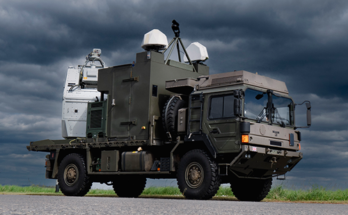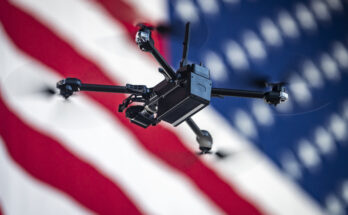
In the face of growing threats in multiple sectors of Europe’s eastern flank, recent weeks have seen a marked ramping up of NATO’s efforts to greatly expand region-wide counter-drone efforts. Numerous contract awards, evaluation exercises, and system deployments have followed, with strong indications that this trend will continue for the foreseeable future.
Much of this activity is the culmination of nearly a year’s worth of momentum building. The big advance came in July, when NATO announced that over 40 billion dollars (€36.3 billion) would be invested in counter-drone capabilities over the next five years, and that a counter-drone marketplace would be established to ensure that systems are NATO-tested, NATO-compatible, and readily available for purchase.
Plans also include the call for training five times as many drone operators in its Armed Forces by the end of 2027. This points out a very important, often overlooked factor in discussing the C-UAS effort in general. Considerable time and money must be dedicated to training large numbers of people in the use of systems that are often brand new and, in some instances, virtually experimental.
To accelerate the acquisition of counter-drone technologies, on November 5, NATO formally launched the planned C-UAS marketplace, through which member countries will be able to procure solutions directly from the NATO catalogue without any further tender process.
In line with this effort, NATO competed and selected 16 solutions from five companies, including Alta Ares; Axon Enterprise Inc.; Northrop Grumman; OSL UK; and Quantum Systems. Additional companies and products are expected to follow.
Systems chosen, including fixed and mobile solutions, were selected based on experience gained through NATO, national innovation activities, and exercises, and all have been deployed in allied countries and in Ukraine.
Along similar lines to this NATO activity, in September the European Council approved several European Defence Projects of Common Interest (EDPCIs), including DECODER, an effort to develop counter-drone technology, and EU Federated Integrated Air and Missile Defence including Early Warning (EU-FIAMD), which focuses on early warning of incoming threats.
Additional projects will focus on the creation of early-warning satellites and space-based communications, as well as initiatives to detect and respond to threats at sea. An Eastern Flank Watch program was also approved to boost security along the bloc’s eastern border.
A Threat on Multiple Fronts
The growing number of troubling incidents that have led NATO to accelerate C-UAS acquisition help illustrate the challenges for defenders.
In October, the Bulgarian government formally requested allies deploy counter-drone systems to coastal area after a series of attacks in the Black Sea, which saw drones striking commercial ships, and even the actual sinking of a merchant ship.
In August, a NATO-led, Spanish F-18 shot down a drone that had entered Romanian airspace. After a maritime drone was detected near the Neptun Alpha offshore natural gas platform just a few days later, two Romanian F-16s were scrambled to respond.
One month later, and more pointedly, a drone struck the locomotive of a passenger train traveling to Warsaw from Kiev and just kilometers from the Polish border.
Not long after an Italian Air Force Eurofighter shot down a drone over Latvia, in August, the Italian government formally requested thousands of U.S.-made air-to-air guidance kits for the Advanced Precision Precision Kill Weapon System-II (APKWS-II). Quickly approved by the U.S Department of State, the $364 million order covers the acquisition of 5,031 WGU-59B/B kits, which modifies the APKWS-II into an air-to-air munition.
This order also highlights an apparently growing expectation that fighter jet-borne, air-to-air defense against drones may be preferable method in some cases, especially in instances involving more deadly, larger sized UAS. According an to article in The Baltic Sentinel, the Estonian government is seeking to acquire new fighter jets specifically for counter-drone missions. Citing Defense Minister Martin Herem, the high speed aircraft were seen as the most effective way to shoot them down.
The Call for Self-Reliance
At the same time this sense of urgency has been building, there has also been growing calls for more for self-reliance, homegrown solutions, and most critically, less reliance on U.S. participation. This has led to increased domestic defense manufacturing with greater dependence on local supply chains.
While NATO recently acquired Palantir’s targeting capability, Maven Smart System (MSS) and recently touted its’ use in conducting C-UAS missions during an experiment in Latvia, there are some indications that future prospects for this technology in Europe may not be entirely firm. Two days ago, Reuters reported that a growing number of firms within the region are competing for similar business, among them, Germany’s Helsing which is promoting its own military intelligence software called Clarity.
For now, however, with its advanced development and extensive experience, Mavin does appear to have significant, built-in support. In June NATO announced MSS had achieved full technical operational capability and had met all of Allied Command Operations’ requirements. The organization also granted full security accreditation for the system to operate on NATO’s classified network, paving the way for further implementation across all Allied Command Operations subordinate headquarters.
Poland’s Strong C-UAS Lead
With its’ strategic importance to NATO defense planning, and key participation in the Combined Joint All-Domain Command and Control (CJADC2) initiative, Poland has naturally taken a strong lead in C-UAS efforts.
Backed by a €1 billion venture capital investment, the NATO Innovation Fund, on October 13 announced a branch in Warsaw to accelerate technology adoption on the alliance’s eastern flank. Leaders were expected to spread a wide net from an acquisition standpoint, including the latest AI-enabled and autonomous systems.
The same day, Kongsberg Gruppen ASA announced the establishment of a new manufacturing and sustainment facility in Poland’s Pomeranian region, to expand its production capacity for C-UAS.
According to the company, the primary initial focus will be sustaining and producing equipment for Poland’s SAN counter-drone program, an effort designed to counter low-altitude threats like Shahed-style drones, loitering munitions, and swarms.
In January, Kongsberg won a NOK 16 billion contract from Polish Armaments Agency for delivery of the system. SAN is planned to include 30-mm artillery guns equipped with programmable ammunition and can be equipped with APKWS guided missiles as well as interceptor drones. Future iterations may include non-kinetic effectors, such as electronic warfare systems and microwave-based weapons.

The Ukraine Connection
With its almost five-year, first-hand experience in dealing with hostile drones in a way that neighboring nations surely hope they never have to face, Ukraine is proving to be an invaluable ally in NATO’s efforts. More and more, the beleaguered country is offering its advice, technological knowledge, and even materials to aid in preparation for an eventual attack.
An early demonstration of this assistance came in September 2024, when Ukraine brought its unique experience and participated in NATO’s annual C-UAS Technical Interoperability Exercise (TIE) in the Netherlands to test the capabilities of commercially available counter-drone systems. This participation was part of a wider NATO-Ukraine Innovation Cooperation Roadmap endorsed by Allied and Ukrainian Leaders.
One of the going concerns of TIE involved C-UAS compatibility with NATO’s Integrated Air and Missile Defence (IAMD) mission which takes a 360-degree approach, to address air and missile threats from all strategic directions, whether from state or non-state actors.
In August, Ukrainian and NATO troops worked together on C-UAS battlefield tactics in Exercise Baltic Trust in Latvia, along with participants from two dozen countries.
This past March 2026, Belgium Defense Minister Theo Francken announced plans to coordinate with the Ukrainian defense industry on the production of counter-drone systems, with an emphasis on local manufacturing.
Recent months have seen a marked stepping up of this kind of cooperation.
More News from the European Counter-Drone Front
On November 10 Thales announced the Blue Dome air-defense capability for Belgium, which includes GM200 MM/C radars, as the core of a responsive, sensor-to-shooter defense network with deliveries to start in 2027.
The capability provides for integration with ground-based air defense (GBAD) architectures with Kongsberg’s Fire Distribution Centre and Raytheon’s AMRAAM missile, resulting in the GM200 MM/C–NASAMS configuration.
In September, Kongsberg Gruppen ASA signed an agreement with Oshkosh Defense Europe B.V. for the delivery of PROTECTOR RS4 Remote Weapon Stations (RWS) equipped with KONGSBERG’s PROTECTOR C-UAS capability for the Royal Netherlands Armed Forces. Providing the benefit of high mobility, the pairing will be integrated on Oshkosh Joint Light Tactical Vehicles (JLTVs).
In August, Thales, along with Danish software developer Systematic established a strategic partnership that offers Systematic’s command-and-control software with Thales’ air defense hardware, including the SAMP/T NG surface-to-air missile system for the Danish Armed Forces.
According to the companies, this agreement helps enhance multi-domain interoperability across NATO alliance frameworks. The partnership also includes provisions to expand domestic defense manufacturing capabilities within Denmark, establishing increasingly coveted local supply chain routes.
In July, Spain’s Indra announced development of a point-defense system for military vessels based on laser-guided missiles under the SILAEM Special Modernisation Programme (Shipborne Launcher System). The program will consist of two versions: a stand-alone configuration and another integrated with the SCOMBA combat system.
Comprising an X-band fire-control radar for target acquisition and tracking, laser-guided missiles, and a command-and-control system, the capability will function as a vessel’s last line of defense, enabling it to counter hostile craft, UAS, and anti-ship missiles.
In April 2026, the Latvian Cabinet approved the acquisition of BLAZE interceptors. Produced by Origin Robotics, the man-portable, rapidly deployable interceptor drones are designed to defeat fast-moving aerial threats and are equipped with an HE fragmentation warhead.
Belgium also purchased the systems in November 2025.

Andrew Dardine is lead analyst for Forecast International's Defense Electronic Systems group. He is the primary author of Forecast International's Electronic Warfare Forecast and co-author of Electro-Optical Systems Forecast and C4I Forecast. Andrew is also a regular contributor to FI's Defense & Security Monitor blog, offering insights into developing technologies such as directed-energy and next-generation jamming systems. His analysis of such vital market areas as EO/IR systems and electronic countermeasures technology has been cited in Defense News, Aerospace Daily, and Bloomberg Businessweek, among other news media. He has also written about the electronic defense market for Aviation Week and the Journal of Electronic Defense.