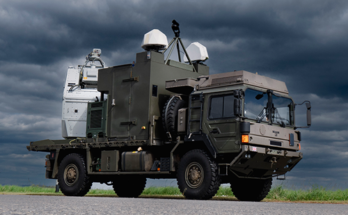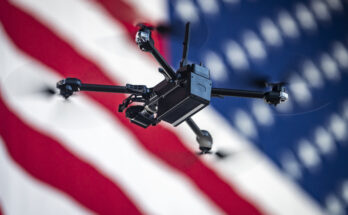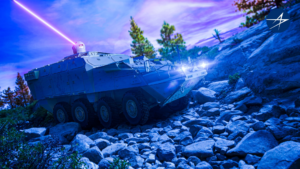
A recent decision by the Pentagon to deploy high-energy laser and high-powered microwave counter-drone weapon systems to five U.S. military bases by the end of the year is a major boost for the growing segment of directed energy (DE) in defense. For a variety of reasons, the appeal of these types of systems is reaching a new peak.
On the battlefield, where widespread destruction is a foregone conclusion, the fallout from blasting hostile drones out of the sky with kinetic effects such as rockets and missiles is an acceptable risk. However, when this rain of destruction is falling on friendly positions far from the battlefield, the risk becomes harder to allow. This is an increasingly critical issue for homeland defense, especially in areas around sports stadiums, airports and international borders.
Recent events have seen the increasing use of directed energy, counter-drone technology in these domestic spaces because there is a perception of less collateral damage when a hostile UAS is disabled or destroyed.
The other big claim for the value of DE-based systems is cost, which may be true on a per-shot comparison with some forms of more expensive ordinance, even though these are usually reserved for bigger forms of hostile drone such as the Shahid. This leaves the question of cost effectiveness when facing more common and smaller forms of invasive UAS.
DE per-shot is said to cost as little as $10 to $50, while missiles can easily start in the tens-of-thousands of dollars. However, the total cost of development, procurement, training for, and deployment of more sophisticated DE systems is not as budget friendly. Just to kick things off, in May 2024, the U.S. Army awarded BlueHalo a $95.4 million contract for advanced prototype development of the DE system now known as LOCUST.
Following recently reported drone incursions over military installations and along the U.S. southern border, the deployment of DE systems – even with the offer of minimized collateral damage and cost effectiveness – still raises issues that are not likely to be resolved any time soon.
For the record, before we dive into the news, the term directed energy describes both laser systems which use a tightly focused beam of energy and high-power microwave systems, which use a wave of a more broadly dispersed field of energy to destroy targets.
Here are some of the big news announcements heralding an increasing preference in C-UAS capabilities.
The Increasing Deployment of Directed Energy C-UAS
With the announcement of a new effort in early May overseen by the Joint Interagency Task Force 401 (JIATF-401), the Pentagon selected Fort Bliss in Texas, Fort Huachuca in Arizona, Grand Forks Air Force Base in North Dakota, Whiteman Air Force Base in Missouri, and Naval Base Kitsap in Washington for the directed energy, counter-drone system deployment.
The accompanying press release did not specify exactly which systems would be part of the deployment. Likely candidates, however, have been making news lately. In March AeroVironment, Inc. announced the release of the 20-35+ kilowatt LOCUST X3, a third generation of the company’s high-energy laser weapon system.
According to AV, LOCUST X3 enables upgrades and integration across both fixed and mobile defense platforms and has been fielded through the U.S. Army Multi-Purpose High Energy Laser (AMP-HEL) and Palletized High Energy Laser (PHEL) programs.
One month later, in April AeroVironment announced the demonstration of LOCUST Laboard the USS George H.W. Bush (CVN-77), a collaboration with the U.S. Navy and the U.S. Army Rapid Capabilities and Critical Technologies Office (RCCTO). The company stated that the exercise validated the system’s adaptability from fixed-site and land-based mobile platforms to the environment of a maneuvering aircraft carrier.
Outside the realm of official press releases, LOCUST was front and center in a recent incident that made headlines for less well-managed reasons. According to Reuters, the system engaged a target near El Paso International Airport in February, leading to a seven-hour airspace shutdown by the FAA, and no small amount of confusion between government agencies. The target, however, was a balloon mistaken for a drug cartel drone.
March 31 saw another deployment for laser C-UAS when NUBURU, Inc. announced that its subsidiary, Lyocon S.r.l., secured an initial order for its portable directed-energy laser dazzler system. The order came from a tier-one government-owned defense electronics organization operating in a major Asia-Pacific defense market.
Like AeroVironment, NUBURU was also selected by the Pentagon for a position on the multiple award Indefinite Delivery/Indefinite Quantity (IDIQ) contract for the fabrication and delivery of prototypes and equipment in support of solid-state HEL weapon systems.
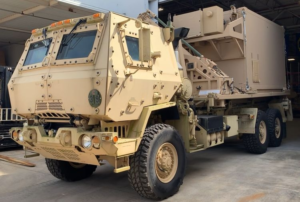
The U.S. Army has already rolled out its Directed Energy, Maneuver Short-Range Air Defense (DE M-SHORAD) system at several homeland bases.
More News from the Counter-Drone Front:
On February 26, the U.S. Defense Innovation Unit (DIU) issued a solicitation to rapidly demonstrate advanced sensors capable of detecting small UAS to protect military installations within the United States and mobile units abroad. Demonstrations with the project, “Counter UAS Sensing for Homeland and Mobile Defense,” started in spring at Yuma Proving Ground, Arizona.
Divided into two primary tracks, the initiative first focuses on domestic civil and military defense, requiring radar-based sensors that can identify small Group 1 drones at a minimum range of two kilometers while filtering out false targets and clutter.
The second track evaluates mobile, low-signature sensing solutions for small military units on the move, with an emphasis on prioritizing passive sensing modalities that minimize physical and spectral footprints.
Big Moves for Australia’s Droneshield
On February 26, DroneShield announced the signing of a Bilateral Collaborative Research Agreement (CRA) with the Australian Department of Defence, through the Defence Science and Technology Group (DSTG), to strengthen Australia’s capability in C-UAS technology.
Spreading its wings even further, on March 11, the company announced the establishment of C-UAS manufacturing in the EU, under a new collaboration with an experienced and established manufacturer.
The venture will see full turnkey assembly and component manufacturing, including PCB assembly, precision machining, cable and wire harness assembly, and associated assembly and testing labor.
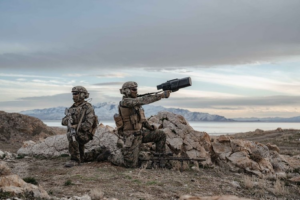
On May 4, DroneShield, along with Terma, announced the signing of a Memorandum of Understanding, establishing a strategic collaboration focused on advancing layered C-UAS capabilities. Both companies have extensive experience in AI-enabled UAS detection, electronic warfare systems, and command-and-control software.
The collaboration will target new markets for boosted air defense including Denmark, the Middle East, and the Asia-Pacific.
Meanwhile, back in the U.S., in March BlueHalo Labs LLC. won a $22.8 million firm-fixed-price and cost reimbursement modification to a previously awarded contract for the procurement of Titan SV MPv3 Systems in support of Program Manager Ground Based Air Defense, Organic-Counter small Unmanned Aerial Systems (O-CsUAS). Delivery of supplies to Marine Corps System Command will be on or before July 1, 2026.
Lessons from Ukraine are Aiding Decision Making in Middle East
For over four years running, Ukraine has been the preeminent, real-world proving ground for all forms of C-UAS. The success of systems and techniques in the beleaguered country is having a profound impact on development, production, and deployment of some notable programs.
After the February 28 start of the U.S. and Israeli airstrikes on Iran, and that country’s region-wide counter attacks, on March 3, the Italian Defense Minister Guido Crosetto announced requests from Gulf countries to supply air-defense and counter-UAS systems.
Among systems the unnamed countries were interested in the SAMP/T NG, an anti-missile system developed in partnership with France, stood out. SAMP/T NG batteries are in wide use by Ukraine in defense of Russia’s unrelenting missile attacks.
In another response to the expanded gulf war, on March 10, the U.S. moved to deploy the Merops C-UAS system to the Middle East to strengthen defenses against Iranian drones. According to its maker, West Coast start-up Perennial Autonomy, Merops utilizes artificial intelligence to navigate and intercept targets even when electronic communications are jammed.
Like SAMP/T NG, the system is deployed in Ukraine and and is also being used by NATO members Poland and Romania.
And in the ultimate sign that Ukraine may be leading the world in counter-drone use, on March 30, President Volodymyr Zelensky visited several Gulf countries to oversee new, 10-year defense cooperation agreements with Qatar, Saudi Arabia, and the United Arab Emirates during his visit to the Gulf.
Increasing Impact of AI
On March 13, Anduril Industries Inc. won a firm-fixed-price contract with a cumulative total of $20 billion to consolidate commercial solutions-including the company’s AI-enabled Lattice suite into a unified, mission-ready capability supporting the U.S. Army’s evolving operational and business needs. Work locations and funding will be determined with each order, with an estimated completion date of March 12, 2036.
In C-UAS applications, the Lattice software platform uses AI to autonomously detect, track, identify, and neutralize aerial threats. The system also integrates multiple sensors and effectors, along with a shared command and control interface, addressing the the problem of disparate defense systems acting in isolation.
On March 16, the U.S. JIATF-401 awarded an $87 million contract to Anduril to make Lattice software the primary tactical command and control (C2) platform for C-UAS.
Lattice was also recently selected as the U.S. Army’s next-generation fire control capability for the Integrated Battle Command System Maneuver (IBCS-M) program, an important element of the Joint All-Domain Command and Control (JADC2) effort.
Meanwhile, in Europe on March 16, Indra announced that its C-UAS system, which is used by Spanish forces in Lithuania under NATO, is attracting significant interest among countries in the region. According to the company, several delegations from Northern and Eastern European countries had traveled to deployed positions to learn more about the system.
The system provides protection for the Vilkas Tactical Air Detachment’s, military personnel, F-18 fighters and an A400M tanker aircraft, from the threat posed by frequent incursions of UAS and unidentified balloons originating from the Russian and Belarus.
On March 17, the U.S. Air Force issued two Requests for Information (RFIs) aimed at bolstering its ability to detect and neutralize sUAS, with an emphasis on identifying incoming threats and employing “kinetic hard-kill” capabilities to intercept them. Citing a series of airspace incursions at domestic installations, the service is stated its prioritizing systems that can be assembled by a four-person team in under two hours.
Effector technologies of interest include high-energy lasers, and high-power microwave systems capable of engaging swarms.
On March 31, Honeywell announced a collaboration with Odys Aviation to deliver a persistent airborne defense solution designed to protect distributed energy infrastructure, such as refineries, pipelines and offshore production platforms from drone threats.
The collaboration on this C-UAS adapts Honeywell’s Stationary and Mobile UAS Reveal and Intercept (SAMURAI) Autonomous Airborne platform for deployment on Odys’ long-range Laila UAV.
According to the companies, the Laila-SAMURAI system introduces a defensive layer between ground-based sensors and high-end missile defense systems, reducing reliance on costly kinetic defenses while extending protection coverage across vast and remote areas.
Homeland Defense Helps Drive Additional Demand
On April 6, U.S. JIATF-401 committed over $600 million to strengthen C-UAS capabilities in support of deployed forces in the Middle East, the 2026 FIFA World Cup and homeland defense.
An allocation of $350 million reportedly went to meet urgent requirements from U.S. Central Command, Air Combat Command, Air Force Global Strike Command and U.S. Army Transportation Command.
The task force also committed $100 million to enhance defense for the World Cup, focusing on mobile, non-kinetic counter-drone technologies to protect stadiums and fan zones.
Lastly, JIATF 401 committed $158 million under the Domestic Shield initiative, to defend the nation’s highest-priority defense critical infrastructure.
More Ukraine C-UAS Influence
On May 18, the JIATF-401 announced a broad-based, three-year, $500 million ID/IQ contract to Perennial Autonomy to support unspecified C-UAS operations.
The contract spans a range of AI-enabled C-UAS platforms, including Merops interceptors, Bumblebee quadcopters, and Hornet midrange strike drones, with capabilities utilizing computer vision, radio frequency sensing, jam-resistant communications, and autonomous targeting.
As mentioned earlier, the Merops interceptor drones have been used in Ukraine since 2024, reportedly ramming hundreds of Russian attack UAS out of the skies.
In the coming weeks and months we will likely be hearing more from the JIATF-401 interagency, as one of the major C-UAS decision makers in the market.

Andrew Dardine is lead analyst for Forecast International's Defense Electronic Systems group. He is the primary author of Forecast International's Electronic Warfare Forecast and co-author of Electro-Optical Systems Forecast and C4I Forecast. Andrew is also a regular contributor to FI's Defense & Security Monitor blog, offering insights into developing technologies such as directed-energy and next-generation jamming systems. His analysis of such vital market areas as EO/IR systems and electronic countermeasures technology has been cited in Defense News, Aerospace Daily, and Bloomberg Businessweek, among other news media. He has also written about the electronic defense market for Aviation Week and the Journal of Electronic Defense.