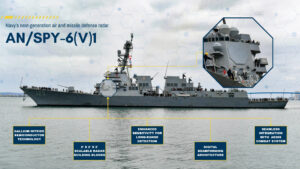
 Source: Sydney Bokenhagen (DVIDS)
The SPY-6 Air and Missile Defense Radar (AMDR) made its debut in the wake of the SPY-3/SPY-4 Dual Band Radar’s failure to replace the AEGIS Weapon System at cost, having been equipped in full solely to the USS Gerald R. Ford.
From the Dual Band Radar, Raytheon developed the SPY-6 AMDR. The SPY-6 now comes in four different variants, each with their intended vessels for application and varying expected lifespans. These variants are divided between the AMDR and the Enterprise Air Surveillance Radars (EASR).
AMDR SPY-6(V)1: Intended to disproportionately outfit Arleigh Burke Flight III destroyers, with an average 40-year lifecycle across 35 ships.
EASR SPY-6(V)2: Intended to outfit Nimitz-class carriers, America-class Landing Helicopter Assault ships (LHAs), and San Antonio-class Landing Platform Dock ships (LPDs), in addition to some Zumwalt- and Wasp-class vessels. It is expected to have an average 37.1-year lifecycle across 15 ships.
EASR SPY-6(V)3: Intended to outfit Ford-class carriers (and was previously expected to equip “Future Frigate” Constellation-class vessels) with an average 50.5-year lifecycle across 10 ships.
AMDR SPY-6(V)4: Intended to disproportionately outfit DDG-51 Arleigh Burke Flight IIA destroyers (as part of a backfit effort) with an average 21-year lifecycle across 28 ships.
While there has been speculation that the SPY-6 radar will equip the “Golden Fleet” BBGN-class ships, this program remains far too speculative and uncertain to make a determination that this will be so.
Sustained Contracts for SPY-6
Raytheon has received a relatively steady stream of SPY-6 contracts from the U.S. Department of Defense for hardware production, spares production, and sustainment in recent years. In particular, a $650.7 million contract awarded in March 2022 has been modified by the Naval Sea Systems Command in Washington, D.C., repeatedly through to the present.
Raytheon was awarded a $646 million contract exercising an option from the March 2022 contract in June 2025 for the continued production of SPY-6(V) radars for the U.S. Navy. By this point, Raytheon noted that 42 SPY-6 radars were under contract for procurement.
In April 2026, Raytheon indicated that at least 60 vessels are expected be equipped with SPY-6 radars (a repeated expectation by the company that at least 60 such radars are to be produced, though not fully under procurement currently) and that “more than 15” had already been delivered to the U.S. Navy.
Interestingly, in May 2026 Raytheon was awarded a contract by the Office of Naval Research (ONR) to “further develop advanced radar software for next-generation naval radars.” The firm noted that the purpose of the software development will be to allow each “building block” within a naval radar to operate independently from one another, in this way allowing for multiple missions to be executed simultaneously by a single radar. The idea, Raytheon notes, is for each individual building block to be “its own software-defined aperture” that collectively allows the radar to adapt and share crowded frequency bands (spectrum-sharing). (One way of putting this effort is that, while simultaneous execution of multiple missions within a single system is by no means novel, what matters is how a given radar adapts to the “environment” – the spectrum – in its distribution of internal resources to these ends.)
The contract for this work was awarded in April 2026 under the Subarray Transmit Orthogonality for Receive Multiplexing (STORM) program through the ONR, with a cumulative value of $22.6 million.
First International Sale to Germany and Potential FMS
The U.S. Navy awarded Raytheon a modification to a 2018 Integration and Production Support contract in May 2025 worth $536 million. This modification specifies integration and production support of SPY-6 radars, as well as upgrading Flight IIA destroyers with the SPY-6(V)4 variant.
Conspicuously, this contract coupled the U.S. Navy’s purchase with a purchase by the German government under the Foreign Military Sales (FMS) program. Somewhat confusingly, Raytheon announced the German government’s selection of the SPY-6(V)1 radar for installation on eight F127 frigates separately from its announcement of the integration and support contract modification. Raytheon did not announce the FMS until October 2025, specifying its “comprehensive support and services” that would go toward adapting the SPY-6(V)1 radar to the F127 frigate’s design.
Later still, in April 2026, the U.S. State Department formally approved the FMS to Germany. The total estimated cost of the sale is $11.9 billion. It includes eight shipsets of the SPY-6(V)1 radars as well as eight shipsets of AEGIS-based Integrated Combat System Mk 6 MOD X computing infrastructures (alongside other major and non-major defense equipment, such as the SLQ-32(V)6).
In June 2026, Raytheon was awarded a modification to the same, aforementioned 2018 SPY-6 Integration and Support contract worth $515.8 million. This contract exercises an option for continued integration and production support efforts for SPY-6 radars. Conspicuously, the contract bundles the U.S. Navy’s purchase and the government of Germany’s purchase (74% of funds) with “the potential for other countries to be added” through the FMS program (26% of funds). Bearing resemblance to the May 2025 contract modification foreshadowing the FMS approval to Germany, the U.S. Navy is plausibly setting an expectation for a near-future requested FMS.
Production Outlook
Production of SPY-6 radars will proceed well into the 2030s. Although it is difficult to ascertain with confidence the precise timeline for new SPY-6 radar production, that Raytheon publicly notes at least 42 such radars are currently under procurement indicates that production is expected to at least modestly accelerate over the next five years (a process likely having begun already).
When it comes to programs as sprawling as SPY-6, nothing’s over ‘til it’s over. That is, production capacity for the four variants of the SPY-6 radars, in addition to the possible FMS to Germany of an adapted SPY-6(V)1, should not be overestimated in the immediate years ahead. The possible FMS is equally indicative of the momentum for SPY-6 radars, although it appears somewhat unlikely – if speculative – that all eight radars under contract for Germany’s F127 frigates will be supplied on a timeframe consistent with the German government’s own expectations for F127 commissioning. Between the radars for the U.S. Navy and the German F127s, production constraints and delays are to be expected.
Keenly aware of this, Raytheon has recently taken pains to indicate that one of its radar production facilities in Andover, Massachusetts where the SPY-6 is designed and manufactured has scaled to meet demand (more specifically, to initiate full-rate production). The company’s public messaging to this effect should be taken with a grain of salt, as production constraints on systems as sensitive and technically complex as the SPY-6 are quite real (and open to improvements, as the ONR’s contract shows). However, the U.S. Navy is intent on equipping several dozen vessels with this family of radars.
A cautious forecast might also link the possible FMS to Germany to broader U.S.-Germany tensions. Specifically, defense cooperation between the U.S. and Germany is increasingly strained, particularly in light of a dispute over the role of the latter in re-opening the Strait of Hormuz, with the U.S. intending to reduce its available military troops and assets in Germany in the event of a NATO crisis. This resembles other diplomatic tensions in recent months, including U.S.-Canada and U.S.-Denmark tensions, where defense cooperation between the involved states has often – but not always – continued apace despite these tensions. No such pattern is guaranteed to hold in the future, particularly where the sale of sensitive military technology is concerned. Just to say: seemingly unrelated disputes over the distribution of American military assets in support NATO in a possible FMS of SPY-6 radars should not be entirely discounted when thinking about the long-term nature of such agreements.
In any event, the SPY-6 family of radars will be a continued focus of U.S. Navy procurement and RDT&E efforts, with a sustained emphasis on the production capacity of Raytheon to meet demand expected. It is likewise anticipated that the FMS to Germany of adapted SPY-6(V)1 radars will proceed, though diplomatic curveballs here are not to be underestimated, and broader geopolitical tensions should be seen as contour-shaping trends for the exchange of military technology as sensitive as SPY-6.

Vincent Carchidi has a background in defense and policy analysis, specializing in critical and emerging technologies. He is currently a Defense Industry Analyst with Forecast International. He also maintains a background in cognitive science, with an interest in artificial intelligence.
image sources
- SPY-6(V)1 Radar: Sydney Bokenhagen (DVIDS)